Intermittent Fasting Crisis – Should I Listen to my Body?

As athletes, we learn to overrule those smarmy voices, the ones that tell us to stop when it starts to hurt. But over time, we learn that sometimes they are right.

The other day I woke up early and got ready for a big hike. But something didn’t feel right. I was hungry.

Typically, I run and hike in a fasted state. Which means no breakfast. I’ll happily go all day in the mountains without food. Which means no lunch or snacks.

I evolved this policy over many years, at first because of a sensitive stomach. During ultramarathons, I was never happy with my choice of foods or the resulting blood sugar swings or feelings of nausea and bloating – no matter what I ate. So, I trained myself to run on empty. The way people did in the old days. Eventually I was able to run marathon distance without kcals, in fact I set my best times that way. Once I ran 50 miles without food or water. My time wasn’t very fast, but I survived without starving myself to death.

Later, I began to look around. More people were becoming sick, most visibly evident in the rising rate of obesity (today over 70% of the US population is overweight). Even worse, scientists pointed to obesity as root cause for chronic illnesses, like diabetes, cancer, heart disease, and dementia. I decided to prioritize metabolic health, which meant teaching my body to operate without sugary snacks for reasonable periods of time. To do this, I adopted the practice of intermittent fasting.

Today, I follow a specific protocol, which is to fast for 150 to 200 hours per month, based on minimum blocks of 16 hours. For example, finishing dinner by 8:00 pm, skipping breakfast, and then having lunch at noon would be one 16-hour fast. Ten of these in a month gets me to 160 hours, within my target range of 150-200. Then I added a second rule – a minimum 30-hour fast once per month, which entails one full day without eating anything. Five years ago, I started tracking compliance with these protocols in my training log.

But now, this morning, there was this plaintive little voice in my head whispering, “I’m hungry.” And another voice asking the question — why?

Just to be clear, intermittent fasting doesn’t make hunger pangs go away – if it did, there would be a high risk of people starving to death accidentally. What I find is that when active outdoors, hunger pangs come and go, but they’re faint, and it’s pretty easy to keep moving. Fasting is harder for me when indoors — say, I’m sitting in the living room, just a step or two away from lots of yummy stuff in the kitchen.

This morning, my stomach was whimpering for attention. The hunger pang, while not intense, felt different. Like a small child tugging at my shirt sleeve insistently.

I cast my mind back to the prior week, recalling how unenthusiastic I’d felt about the need for yet another 16-hour fasting block to stay compliant with the 150-200 hour protocol. Indeed, I’d felt sort of weary.

Maybe the unenthusiastic attitude reflected higher training volume, as I was trying to push my running mileage back up to 50 miles per week. Mileage burns calories. Back in the day, when I used to run ultra’s all the time, I’d frequently slurp down an after-dinner chocolate malt to replace the calories spent in training and racing. The goal of intermittent fasting is to sustain metabolic health, not to make yourself a scarecrow.

I’d recently bought a new pair of shorts. Now I noticed how they were hanging a little loose. Even though they were the same size I’d been wearing since college.

Maybe it was the 3-day fast I’d undergone earlier in the spring, my longest fast yet – maybe it had reduced my energy reserves. The three days felt like a very long time, but even so I remained productive, getting work done and continuing to exercise. When fasting, I feel like I have plenty of clarity and energy, but my mindset becomes conservative. Instead of buzzing around in a sugar-caffeine frenzy, I take on one task at a time. And get it done methodically. Imagine a cheetah, scanning the veldt, picking out animals in the distance. It has the energy to sprint and take down prey, but it’s not going to waste that energy on the wrong target. That’s how I feel when fasting.

As an aside, thanks to my fasting practice, I have the confidence to walk past bad options, like fast food and ultra-processed stuff. I know I can sustain myself for a day or two, stay productive, keep up with running. I’m not going to fall apart.

Why, this confidence is probably the most important benefit of intermittent fasting. Plus, there’s the thrill of self-reliance.

And then there’s the curiosity – how far can I go?

In his book, Hiking with Nietzsche, philosophy professor John Kaag recalls an adventure he undertook when 19 years of age — he went hiking in the Austrian Alps in search of inspiration. Like Nietzsche, he wanted to escape to the mountains in a quest for self-transcendence. Like Nietzsche, he felt a need to confront the void he felt within himself. The hike became intense. For the first time in his life, he camped out overnight. Walked all day. Suffered frostnip and windburn.

Kaag recalls how “thirty-one days dilated, compressed, and slipped away. I stopped eating and sleeping. My hair grew shaggy and my pants loose.” His mother, on the one occasion that he called her, thought he sounded a “little off.” There is an interesting phenomenon, when people starve or overwork their bodies – Kaag explains how “the adrenal glands give off one last burst of superhuman energy in a final attempt to stay alive.”

He studied Nietzsche in the evenings, went out into the mountains during the day. Stayed up later and later. Didn’t even feel hungry. Began to feel a fascination with the mountain chasms. Recognized that fasting is a form of self-regulation, like putting the body on a “short leash.” Recognized that fasting can also become a form of suicide — indeed, he started contemplating various methods – pills, knife, gun, continuing his fast indefinitely, or throwing himself off a cliff. Ultimately, he “chickened out” and took his remaining cash and bought a six-course dinner and a glass of wine and went to bed and slept and slept.

During WWII, the controversial scientist Ancel Keys ran an experiment on conscientious observers, placing them on starvation rations (1,500 kcals per day) for 24 weeks to see what would happen. They lost on average 25% of their body weight. Experienced severe fatigue, extreme muscle wasting, lower extremity edema, and episodes of dizziness. Not surprisingly, food became an obsession. The subjects became anxious. Depressed. Irritable. Withdrawn. Even after the experiment was over, severe lingering physical and psychological disruption plagued them for months afterwards and in some cases years.

So, here I was, sitting in the kitchen, with my stomach quietly protesting, with vague recollections of John Kaag’s youthful pilgrimage and Ancel Key’s mad experiments swirling in my mind. “Listen to your body,” everyone says. So, I reached across the table for an apple and took a bite. Then drove to a nearby diner and ordered four eggs over easy, two servings of bacon (extra crispy), and a side of avocado, after which I drove out to the mountains and hiked all day. On the way home, I stopped at a farmer’s market and bought local mushrooms, eggs, elk, bison, and venison steaks, and a large chocolate chip cookie, after which I stopped for a pizza — a rare indulgence. Got home and finished off a hunk of cheese and some cherries.

The philosophers may debate whether we are composed of body and spirit, or maybe we’re all body – regardless, we experience ourselves as in constant dialogue with a variety of voices, including friends and family and colleagues, the imprecations of advertisers and religious leaders, and now the roar of social media – as well as those quiet voices that come from somewhere inside us.

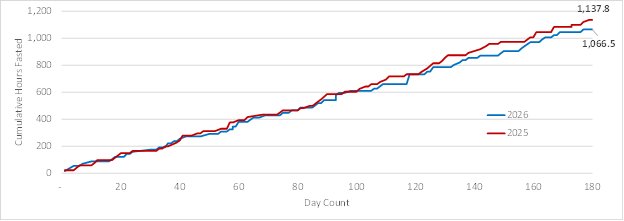
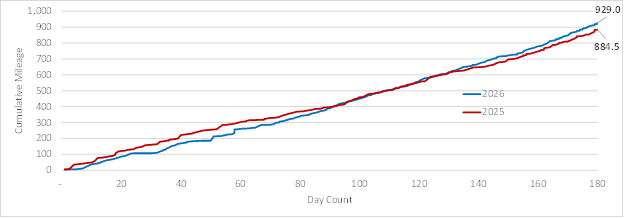
To better understand what my stomach was saying, I decided to look more closely at the data, as I thought this year I might’ve ramped both mileage and fasting intensity, which would have understandably drained my batteries. But year-to-date mileage for the first six months of 2026 totaled 929 miles, only slightly ahead of 884 the year before, which wasn’t a meaningful difference. Year-to-date cumulative hours fasted was 1065 this year, which was actually a bit lower than the year before. Translating miles and fasting into calories, the difference between 2026 and 2025 came to 2,600 kcals – a little more than 1 day’s worth of food. Huh. Was that all it took to spark a mutiny?
There was one more test to consider. I couldn’t even remember the last time I’d weighed myself. Indeed, it was so long ago, that today, when I stood upon the scale, nothing registered — the battery was dead. Once it was replaced, the readout showed the same weight I last recalled. Six pounds more than what I weighed in college.

I guess my system was stable, after all.

Ten days later, with my weekly mileage dipping somewhat due to travel, my monthly fasting hours rose slightly above the 150-200 target range – and I felt fine. Skipped breakfast, not feeling the need, and from my stomach, nary a peep.

Seems like there’s a natural balance between burning calories and ingesting them. Who would have thought?

The secret to stability is probably not to treat every inner voice as accurate all the time. Nor can we reduce the complexity of life to a set of numbers. Rather, the right environment to keep learning about our bodies (and possibly our minds) may well be an interplay between protocols, metrics, and plaintive inner voices who sometimes crave a hearty breakfast and large cookie.

Kaag,John J.. Hiking with Nietzsche: On Becoming Who You Are. Farrar, Straus and Giroux

Thanks for reading! This post is public so feel free to share it –> Share

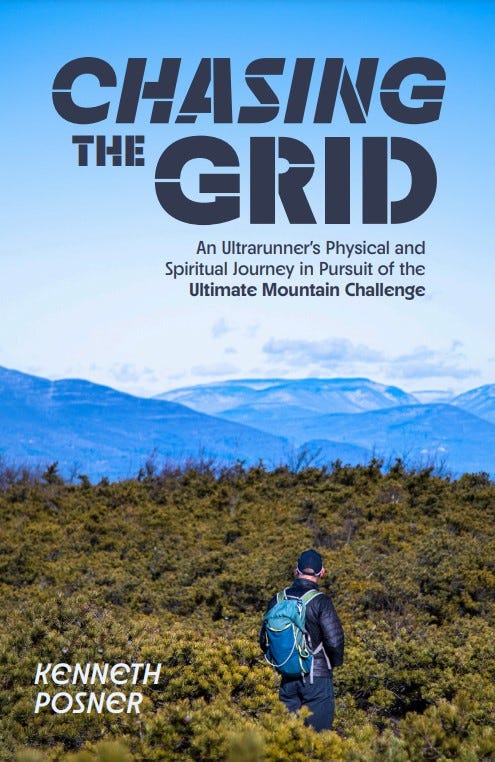
Chasing the Grid is available on Amazon!
Intermittent Fasting Crisis – Should I Listen to my Body?

PUT DOWN THE PHONE (I’m trying, but I can’t!)

“Put down the phone,” I bark to myself, and I know I need to.  But I don’t.  The device is engineered to be engaging, and the information is so intriguing – why, my social media feeds contain the latest headline news, and what my friends are doing and what they care about — which is all quite relevant to my life – and then an email arrives from a colleague with a new task awaiting my attention, a task which really matters.  There’s the familiar ping – incoming text – it’s Mom with a report on what my daughter and grandson are up to.  And I’m somewhat embarrassed to admit this, but I spend a lot of time on my phone doing word games, too.  The dopamine hit from completing one puzzle always makes me want to start the next, and as a result I’m nearly 4,000 levels in.  I do these games to help manage my stress and energy, in other words, to keep myself in the “flow.”

Indeed, I’m so absorbed, I often lose track of time.  Is this not the very definition of “flow state,” the super-productive mindset that coaches, therapists, and scientists exhort us to attain?

Yes.  But.

Continue reading “PUT DOWN THE PHONE (I’m trying, but I can’t!)”

PUT DOWN THE PHONE (I’m trying, but I can’t!)

Bunny Fitzgerald’s Barefoot Manifesto: A Review

Bunny is a writer and jazz singer who’s built a following on Instagram (@bunny_fitzgerald) and Patreon (patreon.com/bunnyfitzgerald) by chronicling her barefoot lifestyle.  Her new book, “The Barefoot Manifesto:  How I stopped Wearing Shoes and Started Living,” is a deeply personal, lyrical, and forceful account of why she walks this interesting path.  But the book is not a practical guide to foot health.  Nor is it about style.  Rather, Bunny positions the manifesto as a “book about freedom” with the key themes being personal sovereignty and the primacy of sensation.

Continue reading “Bunny Fitzgerald’s Barefoot Manifesto: A Review”

Bunny Fitzgerald’s Barefoot Manifesto: A Review

Panic!

The Memorial Day weekend was off to a good start, for the most part.  Following a 4-hour drive to Vermont, I woke up the next morning and coughed up some phlegm, the tail effect of a chest cold the week before.  Got dressed, walked toward the starting line, felt a back spasm, probably the result of sitting in the Jeep for so long the day before.  A couple of Ibuprofen left me a little looser, and feeling excited if unsure, I headed out on the Infinitus 9-mile trail race with some gusto.  Although a tight hamstring, the result of an injury the month before, limited my speed on the uphills.  While a sea of mud limited my speed on the downhills.  The last mile was relatively clear, and here finally I ran hard, and after receiving a large finisher’s medal and a handshake from the organizer, Andy Weinberg, I limped back to the Jeep for an even longer drive:  6 hours to New Jersey, where the next day I was going to take on a 1.6-mile open water swim in the Navesink River… Continue reading “Panic!”

Panic!

Go Barefoot Cow

Maybe my fate would’ve been different if I’d grown up like a Comanche child – playing naked in the forest until adulthood.  Instead I grew up a modern child.  Living in a city, playing in the alleys.  Always clothed and shod, except for bed and bathtub. 

As a teenager I went to the track and tried to run, but after 15 minutes, my shins would go numb.  I couldn’t lift my toes.  Landed flat and heavy.   “Frustration” might have been my middle name, or maybe it was “persistent” for I clumped along despite the disability, hoping the symptoms would resolve.  I wanted so badly to go fast and run far. 

Continue reading “Go Barefoot Cow”

Go Barefoot Cow

What if Chris McDougall was Right?

When Born to Run was published in 2009, it caused a stir.  To many people, McDougall’s thesis rang true – that running is a natural part of being human and so is going barefoot.  More controversial was his claim that modern running shoes predispose us to chronic injury.  The big heels, abundant cushion, and structural features designed to control the motion of the foot create a risk, McDougall argued – that they alter our natural gait.  Why else would 70% or more of runners get injured every year, for participating in such a natural activity?

You could ask similar questions about other aspects of modern life.  If eating is such a natural activity, then why are 74% of Americans overweight or obese?

Clearly, with technology we can solve for things like comfort and taste, since these attributes drive real-time feedback through sales.  But that doesn’t mean we understand what drives health.  Or the hidden costs and unintended consequences of having too much technology.

When Born to Run first came out, people saw barefoot running as primal.  They understood intuitively that going barefoot offered connection and intensity, qualities which modern life sometimes lacks.  The book was the catalyst for a boom in so-called minimalist footwear – lightweight running shoes with thin soles that let you feel the ground –  sandals, like those worn by the Tarahumara Indians whom McDougall profiled in his book — or the funny-looking Vibram Five-Fingers with pockets for each toe.  Some people unlaced their shoes and tried running on the unprotected soles of completely naked feet.

The enthusiasm faded quickly.  People found the transition was too hard.  Going from conventional to minimalist to barefoot exacted a toll on body parts that were used to having cushion.  Many suffered injuries.  For podiatrists, this was a windfall. Shoe companies profited by creating minimalist styles, and then they made even more money with by introducing new shoe types with even more technology.

I, too, experimented with minimalist and barefoot running, thanks to Born to Run.  I, too, suffered aches and pains and injuries and other setbacks.  But my path must have been subtly different from those of other people, because I made the transition successfully and have not looked back. 

My new book, Chasing the Grid, chronicles my pursuit of a peak-bagging challenge in New York’s Catskill Mountains, which I undertook both barefoot and in shoes.  The book’s themes include the power of big goals to drive personal development, and how I adopted the philosophical principles of minimalism and transcendentalism as a consequence of spending time in nature.  The story includes my first experiments with going barefoot, starting with the ascent of Peekamoose Mountain in September 2015, after which  I was immediately hooked.

Benefits of Barefoot

What first impressed me about going barefoot was the intensity.   The wild contrast between aggravating surfaces, like gravel and sharp rocks, and pleasurable ones, such as dirt, smooth slabs, and moss. In shoes, the difference is lost.  Moving barefoot, I felt such a powerful connection to the land – as if I had become part of the forest, instead of merely passing through.

I soon recognized that there were physical benefits, too.  Barefoot teaches you to step carefully, since you can’t afford to slip and stumble without shoes.  As such the practice promotes agility and balance.  As we age, slips and falls become an increasingly serious risk, indeed by the time we’re in our 50s, they are the number one cause of emergency room visits – which might well be another costly side-effect of wearing shoes.

When people see me barefoot, they often ask if I am “grounding.”  There’s no question, in my experience, that going barefoot creates a sense of calm.  Some people think this has to do with electrical forces passing through the soles.  Maybe.  I have a simpler theory – that there’s a lot of circuitry in the brain that’s evolved to guide us in motion, which includes directing soft feet on rough terrain.  When these circuits are engaged, you experience the joy of moving naturally — call it “the original human mindfulness.”  When the feet are covered and protected, this circuitry sits idle, making it easier for the brain to get distracted.

The biggest benefit of going barefoot is that it’s so much fun.  Running without shoes is such a blast!  I think McDougall is right – the practice has improved my form.  I can run hard, go fast, cover long distances, and I feel comfortable and loose.  You know how everyone talks about “pounding the pavement”?  That’s not how you feel in bare feet.  Instead, there’s an incredible feeling of light-footedness.

Suggested Approaches

Since that first climb up Peekamoose Mountain ten years ago, I have completed nearly 14,000 miles barefoot, according to my training log.  These miles include 112 races completed barefoot, of which 23 were marathons and ultra’s (longest distance 50 miles).  Plus a lot of barefoot hiking.  I’ve thru-hiked the 211-mile John Muir Trial in California’s High Sierra and climbed 485 mountains barefoot, including many of the Catskill peaks as chronicled in Chasing the Grid, as well as Mt. Whitney (14,500 feet) and Mt. Elbert (14,440 feet), the two highest peaks in the Continental US.  My training log includes hundreds of miles of barefoot walking, which is such a simple, easy way to take a break from hunching behind the laptop, get some air, enjoy a dose of natural motion, sustain the body – even if it’s a 1-mile stroll on the quiet country roads around my house, the sidewalk outside a hotel, or a treadmill.

So what did I do differently from other people who tried and gave up?  And what would I suggest for those interested in exploring?

Start with barefoot walking

Most of the barefoot action in Chasing the Grid consists of walking along the trails in the Catskill Mountains or moving off-trail in the forest.  In my experience, this is a much easier way to start, because walking doesn’t introduce the same kinds of stress as running, yet you immediately benefit from the sense of intensity, connection, and calmness, while improving your agility and balance.  Let your feet guide you as to speed and distance, and carry shoes as back-up for when they’ve had enough.

By the way, you don’t have to start by climbing a mountain.  Go walk barefoot in a local park.  Take a stroll around town.  If someone asks what you’re doing, tell them you’re experimenting with “grounding.”

Understand that barefoot is a slower journey

Whether walking or running, you’ll find that when the terrain gets rough, barefoot gets slow.  When faced with sharp-edged rocks, gravel, and gnarly roots, you’ll have to look around before stepping and then place each foot with care.  On rough trails, you shouldn’t expect to keep up with friends in shoes.  On rocky trails, I’ve been overtaken by grand-parents.

Going barefoot requires patience, and I suspect this is the primary barrier to more widespread adoption.  But don’t we have enough mindless rushing in our modern lives already?  The American Transcendentalist Ralph Waldo Emerson advised people to “adopt the pace of nature – her secret is patience.”  In my experience, barefoot is a great antidote to the state of constant distraction.

Start barefoot running on rough terrain

If you’re a runner and would like to give barefoot a try, make sure to start out slow and short.  Your legs are strong, and you have plenty of cardio, but the barefoot gait is subtly different.  You’ll need strong core engagement.  Your joints, tendons, and ligaments will need to adapt to a slightly different geometry.

Instead of starting on a smooth surface like a track or a grassy field, the better approach is to find a trail with dirt and rocks.  This will teach you the right form.  You’ll learn to watch where you step. To place your feet with care and pick them up.  You may find that you shift to landing on the forefoot instead of landing on the heel — although contrary to popular belief, you can run barefoot either way.  You may find that you run in a bit of a crouch.  A few years back, I picked out a 1-mile circuit on the bridal trail in New York’s Central Park.  The first time out, the best I could do was walk — with a few trotting steps where the coast looked clear.  After a year of practice, I could move across the rocks at an “easy” running pace.  When rain left the soil soft and damp, I could hammer it at threshold pace.

Barefoot is More Fun

When people see me hiking on the trails or running in a race, they give me lots of positive feedback.  They shout “respect” and “next level” and give me fist-bumps.  They call me “warrior” and “badass.”  The kids cry out, “look Mom, a barefoot runner!”  Afterwards, people ask how long I’ve been running like this.  They want to know, did I read Born to Run?

Barefooting is relatively uncommon, but there are a handful of us out there.  Thea Gavin is a self-proclaimed barefoot running grandma and poet who’s completed numerous trail races without shoes.  She’s also crossed the Grand Canyon barefoot.  In one of her posts, she shared her favorite answer when people ask, why barefoot?

“Because it’s more fun.”

Which is what I now say.  Sometimes I elaborate, explaining that “barefoot is for the experience, while shoes are for speed.”

In my opinion, Chris McDougall is right.  We were born to run.

(Thank you, Chris.)


Chasing the Grid is available for pre-order on Amazon!

What if Chris McDougall was Right?

Some Thoughts on Mental Toughness

In recent years I’ve noticed that mental toughness has become a popular meme on social media.  The topic reflects people’s aspirations for meaningful achievement.  It draws energy, too, from concerns about our increasingly sedentary lifestyle.  These concerns are not new.  In his 1963 Sports Illustrated article, “The Soft American,” President John F. Kennedy reminded us of the link between physical fitness and moral courage.  Warned of the deterioration in strength and health already apparent at that time (this was twenty years before the obesity epidemic took off, leaving us today with 74% of Americans overweight or obese).  In 2016 Angela Duckworth argued in her bestseller, Grit, that our society needs more passion and perseverance.  In 2018 ultra-athlete and former SEAL David Goggins published his memoirs, Can’t Hurt Me, rallying followers with his trademark exhortation — “stay hard.”  Three years later, in the aptly-titled The Comfort Crisis, Michael Easter advocated for embracing pain as the key to happiness.  Steve Magness’s new book, Win the Inside Game, which follows on the heels of his 2022 bestseller, Do Hard Things, offers specific mental strategies for toughness, drawn from his experience as an Olympic coach and performance scientist, which contrast with the traditional narrative of machismo.

My new book, Chasing the Grid, should serve as a useful case study for many of these themes.  The story follows my adventures in the Catskill Mountains while working on a big peak-bagging project (it comprised over 400 separate ascents).  In addition to the mileage and elevation gain, I had to overcome the challenges of terrain, weather, fatigue, injury, and age.  The narrative showcases mental techniques that helped me execute against my goals.  It also shares my mistakes and frustrations. Continue reading “Some Thoughts on Mental Toughness”

Some Thoughts on Mental Toughness

Rethinking Our Relationship with Food

A reader asked me to “share what a few days’ worth of eating has been for you.”

Glad to.  I’ve been pondering diet for years.  And I’ve concluded that our approach to food must be deliberate.  Thoughtful.  Mindful.  The way you would move on patrol behind enemy lines – because the environment is clearly risky — or how you would step through a minefield.

Continue reading “Rethinking Our Relationship with Food”

Rethinking Our Relationship with Food

13,000 Miles Barefoot

The 19th-century English art critic John Ruskin saw in mountains a story of endurance and destruction.  All we can know about a mountain is that “it was once greater than it is now, and it only gathers vastness, and still gathers, as it fades into the abyss of the unknown.”

And so it is with people – we endure as long as we can, hoping to leave something behind.

This is my report on reaching 13,000 miles of barefoot walking, hiking, and running, after starting on this unexpected journey some ten years ago. Continue reading “13,000 Miles Barefoot”

13,000 Miles Barefoot