As athletes, we learn to overrule those smarmy voices, the ones that tell us to stop when it starts to hurt. But over time, we learn that sometimes they are right.
The other day I woke up early and got ready for a big hike. But something didn’t feel right. I was hungry.
Typically, I run and hike in a fasted state. Which means no breakfast. I’ll happily go all day in the mountains without food. Which means no lunch or snacks.
I evolved this policy over many years, at first because of a sensitive stomach. During ultramarathons, I was never happy with my choice of foods or the resulting blood sugar swings or feelings of nausea and bloating – no matter what I ate. So, I trained myself to run on empty. The way people did in the old days. Eventually I was able to run marathon distance without kcals, in fact I set my best times that way. Once I ran 50 miles without food or water. My time wasn’t very fast, but I survived without starving myself to death.
Later, I began to look around. More people were becoming sick, most visibly evident in the rising rate of obesity (today over 70% of the US population is overweight). Even worse, scientists pointed to obesity as root cause for chronic illnesses, like diabetes, cancer, heart disease, and dementia. I decided to prioritize metabolic health, which meant teaching my body to operate without sugary snacks for reasonable periods of time. To do this, I adopted the practice of intermittent fasting.
Today, I follow a specific protocol, which is to fast for 150 to 200 hours per month, based on minimum blocks of 16 hours. For example, finishing dinner by 8:00 pm, skipping breakfast, and then having lunch at noon would be one 16-hour fast. Ten of these in a month gets me to 160 hours, within my target range of 150-200. Then I added a second rule – a minimum 30-hour fast once per month, which entails one full day without eating anything. Five years ago, I started tracking compliance with these protocols in my training log.
But now, this morning, there was this plaintive little voice in my head whispering, “I’m hungry.” And another voice asking the question — why?
Just to be clear, intermittent fasting doesn’t make hunger pangs go away – if it did, there would be a high risk of people starving to death accidentally. What I find is that when active outdoors, hunger pangs come and go, but they’re faint, and it’s pretty easy to keep moving. Fasting is harder for me when indoors — say, I’m sitting in the living room, just a step or two away from lots of yummy stuff in the kitchen.
This morning, my stomach was whimpering for attention. The hunger pang, while not intense, felt different. Like a small child tugging at my shirt sleeve insistently.
I cast my mind back to the prior week, recalling how unenthusiastic I’d felt about the need for yet another 16-hour fasting block to stay compliant with the 150-200 hour protocol. Indeed, I’d felt sort of weary.
Maybe the unenthusiastic attitude reflected higher training volume, as I was trying to push my running mileage back up to 50 miles per week. Mileage burns calories. Back in the day, when I used to run ultra’s all the time, I’d frequently slurp down an after-dinner chocolate malt to replace the calories spent in training and racing. The goal of intermittent fasting is to sustain metabolic health, not to make yourself a scarecrow.
I’d recently bought a new pair of shorts. Now I noticed how they were hanging a little loose. Even though they were the same size I’d been wearing since college.
Maybe it was the 3-day fast I’d undergone earlier in the spring, my longest fast yet – maybe it had reduced my energy reserves. The three days felt like a very long time, but even so I remained productive, getting work done and continuing to exercise. When fasting, I feel like I have plenty of clarity and energy, but my mindset becomes conservative. Instead of buzzing around in a sugar-caffeine frenzy, I take on one task at a time. And get it done methodically. Imagine a cheetah, scanning the veldt, picking out animals in the distance. It has the energy to sprint and take down prey, but it’s not going to waste that energy on the wrong target. That’s how I feel when fasting.
As an aside, thanks to my fasting practice, I have the confidence to walk past bad options, like fast food and ultra-processed stuff. I know I can sustain myself for a day or two, stay productive, keep up with running. I’m not going to fall apart.
Why, this confidence is probably the most important benefit of intermittent fasting. Plus, there’s the thrill of self-reliance.
And then there’s the curiosity – how far can I go?
In his book, Hiking with Nietzsche, philosophy professor John Kaag recalls an adventure he undertook when 19 years of age — he went hiking in the Austrian Alps in search of inspiration. Like Nietzsche, he wanted to escape to the mountains in a quest for self-transcendence. Like Nietzsche, he felt a need to confront the void he felt within himself. The hike became intense. For the first time in his life, he camped out overnight. Walked all day. Suffered frostnip and windburn.
Kaag recalls how “thirty-one days dilated, compressed, and slipped away. I stopped eating and sleeping. My hair grew shaggy and my pants loose.” His mother, on the one occasion that he called her, thought he sounded a “little off.” There is an interesting phenomenon, when people starve or overwork their bodies – Kaag explains how “the adrenal glands give off one last burst of superhuman energy in a final attempt to stay alive.”
He studied Nietzsche in the evenings, went out into the mountains during the day. Stayed up later and later. Didn’t even feel hungry. Began to feel a fascination with the mountain chasms. Recognized that fasting is a form of self-regulation, like putting the body on a “short leash.” Recognized that fasting can also become a form of suicide — indeed, he started contemplating various methods – pills, knife, gun, continuing his fast indefinitely, or throwing himself off a cliff. Ultimately, he “chickened out” and took his remaining cash and bought a six-course dinner and a glass of wine and went to bed and slept and slept.
During WWII, the controversial scientist Ancel Keys ran an experiment on conscientious observers, placing them on starvation rations (1,500 kcals per day) for 24 weeks to see what would happen. They lost on average 25% of their body weight. Experienced severe fatigue, extreme muscle wasting, lower extremity edema, and episodes of dizziness. Not surprisingly, food became an obsession. The subjects became anxious. Depressed. Irritable. Withdrawn. Even after the experiment was over, severe lingering physical and psychological disruption plagued them for months afterwards and in some cases years.
So, here I was, sitting in the kitchen, with my stomach quietly protesting, with vague recollections of John Kaag’s youthful pilgrimage and Ancel Key’s mad experiments swirling in my mind. “Listen to your body,” everyone says. So, I reached across the table for an apple and took a bite. Then drove to a nearby diner and ordered four eggs over easy, two servings of bacon (extra crispy), and a side of avocado, after which I drove out to the mountains and hiked all day. On the way home, I stopped at a farmer’s market and bought local mushrooms, eggs, elk, bison, and venison steaks, and a large chocolate chip cookie, after which I stopped for a pizza — a rare indulgence. Got home and finished off a hunk of cheese and some cherries.
The philosophers may debate whether we are composed of body and spirit, or maybe we’re all body – regardless, we experience ourselves as in constant dialogue with a variety of voices, including friends and family and colleagues, the imprecations of advertisers and religious leaders, and now the roar of social media – as well as those quiet voices that come from somewhere inside us.
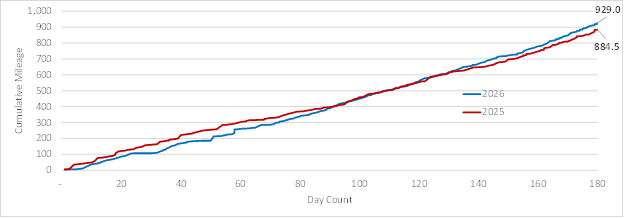
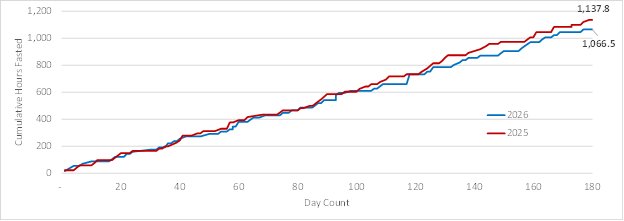
To better understand what my stomach was saying, I decided to look more closely at the data, as I thought this year I might’ve ramped both mileage and fasting intensity, which would have understandably drained my batteries. But year-to-date mileage for the first six months of 2026 totaled 929 miles, only slightly ahead of 884 the year before, which wasn’t a meaningful difference. Year-to-date cumulative hours fasted was 1065 this year, which was actually a bit lower than the year before. Translating miles and fasting into calories, the difference between 2026 and 2025 came to 2,600 kcals – a little more than 1 day’s worth of food. Huh. Was that all it took to spark a mutiny?
There was one more test to consider. I couldn’t even remember the last time I’d weighed myself. Indeed, it was so long ago, that today, when I stood upon the scale, nothing registered — the battery was dead. Once it was replaced, the readout showed the same weight I last recalled. Six pounds more than what I weighed in college.
I guess my system was stable, after all.
Ten days later, with my weekly mileage dipping somewhat due to travel, my monthly fasting hours rose slightly above the 150-200 target range – and I felt fine. Skipped breakfast, not feeling the need, and from my stomach, nary a peep.
Seems like there’s a natural balance between burning calories and ingesting them. Who would have thought?
The secret to stability is probably not to treat every inner voice as accurate all the time. Nor can we reduce the complexity of life to a set of numbers. Rather, the right environment to keep learning about our bodies (and possibly our minds) may well be an interplay between protocols, metrics, and plaintive inner voices who sometimes crave a hearty breakfast and large cookie.
Kaag,John J.. Hiking with Nietzsche: On Becoming Who You Are. Farrar, Straus and Giroux
Chasing the Grid is available on Amazon!