Intermittent Fasting Crisis – Should I Listen to my Body?

As athletes, we learn to overrule those smarmy voices, the ones that tell us to stop when it starts to hurt. But over time, we learn that sometimes they are right.

The other day I woke up early and got ready for a big hike. But something didn’t feel right. I was hungry.

Typically, I run and hike in a fasted state. Which means no breakfast. I’ll happily go all day in the mountains without food. Which means no lunch or snacks.

I evolved this policy over many years, at first because of a sensitive stomach. During ultramarathons, I was never happy with my choice of foods or the resulting blood sugar swings or feelings of nausea and bloating – no matter what I ate. So, I trained myself to run on empty. The way people did in the old days. Eventually I was able to run marathon distance without kcals, in fact I set my best times that way. Once I ran 50 miles without food or water. My time wasn’t very fast, but I survived without starving myself to death.

Later, I began to look around. More people were becoming sick, most visibly evident in the rising rate of obesity (today over 70% of the US population is overweight). Even worse, scientists pointed to obesity as root cause for chronic illnesses, like diabetes, cancer, heart disease, and dementia. I decided to prioritize metabolic health, which meant teaching my body to operate without sugary snacks for reasonable periods of time. To do this, I adopted the practice of intermittent fasting.

Today, I follow a specific protocol, which is to fast for 150 to 200 hours per month, based on minimum blocks of 16 hours. For example, finishing dinner by 8:00 pm, skipping breakfast, and then having lunch at noon would be one 16-hour fast. Ten of these in a month gets me to 160 hours, within my target range of 150-200. Then I added a second rule – a minimum 30-hour fast once per month, which entails one full day without eating anything. Five years ago, I started tracking compliance with these protocols in my training log.

But now, this morning, there was this plaintive little voice in my head whispering, “I’m hungry.” And another voice asking the question — why?

Just to be clear, intermittent fasting doesn’t make hunger pangs go away – if it did, there would be a high risk of people starving to death accidentally. What I find is that when active outdoors, hunger pangs come and go, but they’re faint, and it’s pretty easy to keep moving. Fasting is harder for me when indoors — say, I’m sitting in the living room, just a step or two away from lots of yummy stuff in the kitchen.

This morning, my stomach was whimpering for attention. The hunger pang, while not intense, felt different. Like a small child tugging at my shirt sleeve insistently.

I cast my mind back to the prior week, recalling how unenthusiastic I’d felt about the need for yet another 16-hour fasting block to stay compliant with the 150-200 hour protocol. Indeed, I’d felt sort of weary.

Maybe the unenthusiastic attitude reflected higher training volume, as I was trying to push my running mileage back up to 50 miles per week. Mileage burns calories. Back in the day, when I used to run ultra’s all the time, I’d frequently slurp down an after-dinner chocolate malt to replace the calories spent in training and racing. The goal of intermittent fasting is to sustain metabolic health, not to make yourself a scarecrow.

I’d recently bought a new pair of shorts. Now I noticed how they were hanging a little loose. Even though they were the same size I’d been wearing since college.

Maybe it was the 3-day fast I’d undergone earlier in the spring, my longest fast yet – maybe it had reduced my energy reserves. The three days felt like a very long time, but even so I remained productive, getting work done and continuing to exercise. When fasting, I feel like I have plenty of clarity and energy, but my mindset becomes conservative. Instead of buzzing around in a sugar-caffeine frenzy, I take on one task at a time. And get it done methodically. Imagine a cheetah, scanning the veldt, picking out animals in the distance. It has the energy to sprint and take down prey, but it’s not going to waste that energy on the wrong target. That’s how I feel when fasting.

As an aside, thanks to my fasting practice, I have the confidence to walk past bad options, like fast food and ultra-processed stuff. I know I can sustain myself for a day or two, stay productive, keep up with running. I’m not going to fall apart.

Why, this confidence is probably the most important benefit of intermittent fasting. Plus, there’s the thrill of self-reliance.

And then there’s the curiosity – how far can I go?

In his book, Hiking with Nietzsche, philosophy professor John Kaag recalls an adventure he undertook when 19 years of age — he went hiking in the Austrian Alps in search of inspiration. Like Nietzsche, he wanted to escape to the mountains in a quest for self-transcendence. Like Nietzsche, he felt a need to confront the void he felt within himself. The hike became intense. For the first time in his life, he camped out overnight. Walked all day. Suffered frostnip and windburn.

Kaag recalls how “thirty-one days dilated, compressed, and slipped away. I stopped eating and sleeping. My hair grew shaggy and my pants loose.” His mother, on the one occasion that he called her, thought he sounded a “little off.” There is an interesting phenomenon, when people starve or overwork their bodies – Kaag explains how “the adrenal glands give off one last burst of superhuman energy in a final attempt to stay alive.”

He studied Nietzsche in the evenings, went out into the mountains during the day. Stayed up later and later. Didn’t even feel hungry. Began to feel a fascination with the mountain chasms. Recognized that fasting is a form of self-regulation, like putting the body on a “short leash.” Recognized that fasting can also become a form of suicide — indeed, he started contemplating various methods – pills, knife, gun, continuing his fast indefinitely, or throwing himself off a cliff. Ultimately, he “chickened out” and took his remaining cash and bought a six-course dinner and a glass of wine and went to bed and slept and slept.

During WWII, the controversial scientist Ancel Keys ran an experiment on conscientious observers, placing them on starvation rations (1,500 kcals per day) for 24 weeks to see what would happen. They lost on average 25% of their body weight. Experienced severe fatigue, extreme muscle wasting, lower extremity edema, and episodes of dizziness. Not surprisingly, food became an obsession. The subjects became anxious. Depressed. Irritable. Withdrawn. Even after the experiment was over, severe lingering physical and psychological disruption plagued them for months afterwards and in some cases years.

So, here I was, sitting in the kitchen, with my stomach quietly protesting, with vague recollections of John Kaag’s youthful pilgrimage and Ancel Key’s mad experiments swirling in my mind. “Listen to your body,” everyone says. So, I reached across the table for an apple and took a bite. Then drove to a nearby diner and ordered four eggs over easy, two servings of bacon (extra crispy), and a side of avocado, after which I drove out to the mountains and hiked all day. On the way home, I stopped at a farmer’s market and bought local mushrooms, eggs, elk, bison, and venison steaks, and a large chocolate chip cookie, after which I stopped for a pizza — a rare indulgence. Got home and finished off a hunk of cheese and some cherries.

The philosophers may debate whether we are composed of body and spirit, or maybe we’re all body – regardless, we experience ourselves as in constant dialogue with a variety of voices, including friends and family and colleagues, the imprecations of advertisers and religious leaders, and now the roar of social media – as well as those quiet voices that come from somewhere inside us.

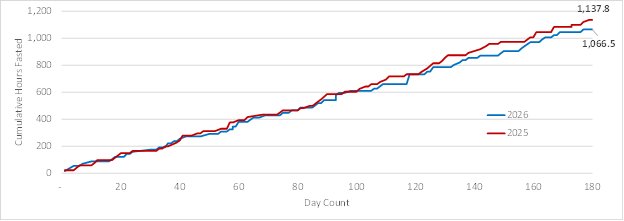
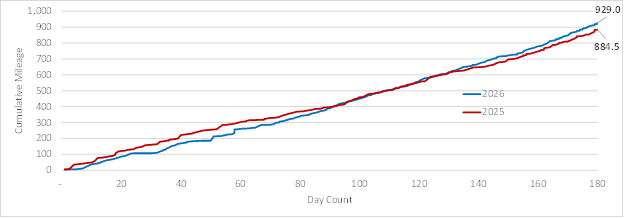
To better understand what my stomach was saying, I decided to look more closely at the data, as I thought this year I might’ve ramped both mileage and fasting intensity, which would have understandably drained my batteries. But year-to-date mileage for the first six months of 2026 totaled 929 miles, only slightly ahead of 884 the year before, which wasn’t a meaningful difference. Year-to-date cumulative hours fasted was 1065 this year, which was actually a bit lower than the year before. Translating miles and fasting into calories, the difference between 2026 and 2025 came to 2,600 kcals – a little more than 1 day’s worth of food. Huh. Was that all it took to spark a mutiny?
There was one more test to consider. I couldn’t even remember the last time I’d weighed myself. Indeed, it was so long ago, that today, when I stood upon the scale, nothing registered — the battery was dead. Once it was replaced, the readout showed the same weight I last recalled. Six pounds more than what I weighed in college.

I guess my system was stable, after all.

Ten days later, with my weekly mileage dipping somewhat due to travel, my monthly fasting hours rose slightly above the 150-200 target range – and I felt fine. Skipped breakfast, not feeling the need, and from my stomach, nary a peep.

Seems like there’s a natural balance between burning calories and ingesting them. Who would have thought?

The secret to stability is probably not to treat every inner voice as accurate all the time. Nor can we reduce the complexity of life to a set of numbers. Rather, the right environment to keep learning about our bodies (and possibly our minds) may well be an interplay between protocols, metrics, and plaintive inner voices who sometimes crave a hearty breakfast and large cookie.

Kaag,John J.. Hiking with Nietzsche: On Becoming Who You Are. Farrar, Straus and Giroux

Thanks for reading! This post is public so feel free to share it –> Share

Chasing the Grid is available on Amazon!
Intermittent Fasting Crisis – Should I Listen to my Body?

16,000 Miles Barefoot

Subscribe on Substack!

A therapist once diagnosed me as “quirky.” I’d retained him to advise me during my divorce, at my ex-wife’s suggestion, as she said I desperately needed help. The diagnosis rested on my decision to stop wearing shoes and start running and hiking barefoot. Otherwise, he thought I was fine.

But questions linger.

Today, in reviewing the last 1,000 miles of barefoot walking, hiking, and running in my training log, it’s fair to ask — what prompted this odd pursuit?

Maybe going barefoot is one of life’s secrets – a simple way to promote natural alignment and have fun. Or maybe my “quirky” personality predisposes me to adopt extreme positions and pursue them with reckless passion. If it hadn’t been the barefoot practice, which I discovered after reading Chris MacDougal’s bestseller, “Born to Run,” maybe I would have become an obsessive stamp collector or train spotter or competitive bird-watcher, or maybe I would have colored my hair, pierced my nose, and covered every square inch of my skin with tattoos.

In any case, this last block of 1,000 miles, which brings me to 16,000 barefoot miles over 13 years, started with the unbridled enthusiasm characteristic of each step in this peculiar journey. On December 31, 2025, I ran a 10k outside of Tucson, Arizona, at a conservative pace mind you, since I’d strained the rectus femoris muscle in my right quadriceps during a slip and a fall two weeks before. This accident took place in the Shawangunk Mountain and, incidentally, due to winter temperatures, I was wearing shoes. When I fell, I knew instantly that I’d torn something. I lay there for a moment, unsure how bad the damage was. There was no choice but to drag myself to my feet and limp back 3 miles to the trailhead. Over the next few days, the injured leg felt a little better, although a small bruise formed on the inside of my right thigh, indicating that there had indeed been a tear and some internal bleeding.

Nonetheless, the 10k went fine, and a few days later, I flew to Texas for the Chevron Houston Marathon, which I ran without food or water for a little extra challenge. This was barefoot race number 134 and barefoot marathon/ultra no. 24. The following month I ran 27 miles on a loop course in Las Vegas, where I met the legendary ultra-runner Ann Trason. When she saw me running barefoot, she laughed at my “stupid and painful” approach to running. But that’s like the pot calling the kettle black, because she was pushing a walker, due to a severe case of rheumatoid arthritis. A week later, I ran a 50k race in western Arizona partly barefoot and partly in shoes on account of the unremittingly rocky course.

Read about my encounter with Ann Trason

Read about my 50k in AZ

These trips helped me escape an unusually cold New York winter, at least for a few days at a time. Back home, I didn’t try to run outdoors when the temperature was below freezing. Instead, I bought a treadmill. Which turned out to be a great investment. In fact, between this machine and treadmills in hotels, I covered 122 miles during January and February, typically 3 or 5 miles at a time, but sometimes up to 10. To manage the tedium, I made a point to constantly vary the speed and inclination in micro-intervals of thirty seconds or quarter miles, adding some structure to what otherwise would have been a monotonous execution. Once I looked out through a window in the garage, where my treadmill is stationed, and watched a deer searching for something to eat in the snow.

It was an unusually severe winter, but every now and then the sun came out and the temperatures moderated. In mid-February, I took advantage of a mild weekend to run Sassquad Trail Running’s Onesiefest 5k in Mahwah, New Jersey. Conditions were ideal for winter barefoot running – the wind was calm, temperatures were hovering in the 30s, and the sun broke through the clouds. The surface was mostly hard-packed snow, which is easy to run on, and it was fun to run with a large group of kids from the Happy Feet running club of Hackensack, NJ and pass some of them, too.

A few days later, I took advantage of another mild day to climb a mountain in Harriman State Park. Once again, the trail was hard-packed snow, the sun was out, and the temperature was above freezing. To reach the summit, I had to leave the trail for a quarter-mile, and here the snow was knee-deep in places, which I punched through with care on account of sticks and rocks lurking beneath the powder. Happily, I returned to the trail before my feet got too cold and didn’t incur any damage besides a scratch on one foot.
Meanwhile, the rectus femoris muscle I’d strained back in December seemed to have mostly healed, although I noticed there was still some swelling. I went to see a physical therapist for advice on rehab, but received a shock when he looked at me with a stern face and warned there might be a serious rupture. The swelling I’d noticed was actually a bulge, where torn muscle had retracted, like a window shade rolling up. Go get it checked out by a doctor, he admonished.

Now I was worried — would my thigh muscle be permanently compromised? And how long would I be out of commission if I opted for reconstructive surgery? Feeling panicked, I rushed down to New York City to see my sports doc, and when the receptionist sent me to get an X-ray, I protested – wouldn’t an MRI be necessary to scan for soft-tissue damage? Wait for the doctor’s instructions, she told me. Impatient, I waited in the examining room. The doctor entered. Listened to my story. Had me raise my leg. And started laughing. He told me that torn thigh muscles are common among soccer players.

“It just means you’re a badass,” he explained.

“But I don’t want to be a badass,” I whimpered, “I just want my thigh back.”

He sent me home. Apparently, the rectus femoris is not an important muscle.

As an aside, “quirky” is a word of unknown origin, possibly related to the German “quer” meaning queer. At first, I’d been put off by my diagnosis, as if it meant I was unpleasantly weird. Which is, incidentally, how I used to feel in high school. However, in checking the dictionary, I found that quirky means “unusual in an interesting or appealing way.” Quirky is associated with unconventional styles, offbeat and eccentric personalities, or charming oddities, although it’s sometimes used to describe people trying too hard to be different.

Personally, I feel that everyone is different and thus many of us would appear quirky to each other if we could pursue what really interests us. But so many people seem weighed down by the spirit of conformity.

As winter morphed into early spring, I drove down to Harriman State Park on every possible occasion, determined to complete a special peak-bagging project which I’d started a couple of years earlier. The goal was to climb each of the 59 named mountains in the park. Barefoot of course. Harriman has small mountains, averaging only 1,000 feet high, but it’s a lovely place with long ridges and U-shaped glacial valleys running northeast-southwest, quiet grassy knolls, open forests with a lot of oak, abundant lakes and bogs. During these visits, I basked in the early spring sun, shivered in the cold wind, high-stepped through scratchy blueberry scrub, and meditated on the concept of “good medicine,” which is a Lipan Apache term for experiences in nature that fill you with feelings of joy and magic. By the way, the Harriman project is part of a lifetime goal to climb 1,000 mountains barefoot. (Because someone needs to do this.)

Harriman scene

Read about my Harriman project

1,000 Mountain Project

After completing the Harriman project, it was time to return to the Catskills, where I’ve made close to 300 barefoot climbs. Compared to Harriman, these mountains, ranging from 3,500 feet to just over 4,000, suddenly felt quite steep and tall. Gradually I worked my way back into better climbing trim, completing a 15-mile trek in the Blackhead Range which bagged me six peaks. It was 5,200 feet of total climbing, and by the end I was out of breath and moving slowly, but this was also the longest and toughest barefoot hike I’d done in this mountain range. I followed this up with a double ascent of Hunter Mountain, where I saw rangers head out to rescue an elderly hiker (he was OK), people driving radio-controlled model trucks on the trail, and a beautiful Black-and-Yellow Lichen Moth resting on a goldenrod bloom (a nice add to my collection of bug-on-flower photographs). Two fit-looking young dudes passed me, but where the trail turned steep, they had to stop to catch their breath, and I was quite pleased to beat them to the top.

On some weekends I visited the mountains, and on others I participated in local races ranging from 5k’s to half-marathons. In some cases, my times were better than the year before, which was encouraging. But they were slower than two years back. I think that barefoot helps in the battle with age by restoring natural alignment and reducing the risk of injury. But it does not appear to defeat the aging process, nor does it stop the passage of time, unfortunately. Speaking of which, I won my age group at a 1/2 marathon in Dallas in mid-July. It was 85 F and humid, but I felt good at the start and thought I had a shot at a new PR. By the half-way point, however, I was in trouble. Indeed, to make it back, I had to take some walking breaks — now there’s nothing wrong with that — but I’d never had to do that in such a short race before. Evidently, the heat is a little tougher for me to deal with than it used to be.

Age group win, but difficult execution in Dallas summer heat

If everyone is different, then what may differentiate a visibly “quirky” personality may well be the willingness to push the envelope more aggressively when it comes to dealing with social expectations. By this point in my journey, I’d built up the “social calluses” necessary to go barefoot in coffee shops, groceries, airports, museums, and even at fancy gala’s. But I’d continued wearing shoes at work, reasoning that work is a team sport and not the place to advertise a person’s peculiar interests. In June, I started a new job, as CFO of a small technology company, and I wanted to make a good impression on colleagues in terms of financial acumen, strategic outlook, and team spirit – not surprise them with unconventional sartorial choices.

But it felt so unnecessary and depressing, after going for my morning run without shoes and then showing up barefoot at my favorite coffee shop, to pull on shoes just to walk across a parking lot into an office building.

So, I decided to experiment with a “hybrid strategy” – to enter the building barefoot, but carrying my shoes in one hand. Now, this posture was meant to call to mind the idea of someone taking a break from shoes, not necessarily breaking with convention. Like when you see women carrying high heels in one hand, after tiring of the uncomfortable work of wearing them all day. I tried out this hybrid strategy when entering the building, stepping out for a coffee break, and then meeting a former colleague for dinner, and the results were even better than I’d hoped for: one person declared she’d like to join me on a barefoot walk, another recalled running barefoot drills back when he was on the high school cross-country team, and one just said, “that’s so cool.”

In a world of conformist pressure, the difference between quirky people and those who try harder to fit in may well be a willingness to take some risk and see what we can get away with.

I’d like to get to 20,000 barefoot miles before age claims my body for the scrap heap, as that would be making a statement to the world about the physical and mental benefits of this practice. But first, let’s see about 17,000.

Thanks for reading! This post is public so feel free to share it.

Share


Chasing the Grid is available on Amazon!
16,000 Miles Barefoot