As athletes, we learn to overrule those smarmy voices, the ones that tell us to stop when it starts to hurt. But over time, we learn that sometimes they are right.
The other day I woke up early and got ready for a big hike. But something didn’t feel right. I was hungry.
Typically, I run and hike in a fasted state. Which means no breakfast. I’ll happily go all day in the mountains without food. Which means no lunch or snacks.
I evolved this policy over many years, at first because of a sensitive stomach. During ultramarathons, I was never happy with my choice of foods or the resulting blood sugar swings or feelings of nausea and bloating – no matter what I ate. So, I trained myself to run on empty. The way people did in the old days. Eventually I was able to run marathon distance without kcals, in fact I set my best times that way. Once I ran 50 miles without food or water. My time wasn’t very fast, but I survived without starving myself to death.
Later, I began to look around. More people were becoming sick, most visibly evident in the rising rate of obesity (today over 70% of the US population is overweight). Even worse, scientists pointed to obesity as root cause for chronic illnesses, like diabetes, cancer, heart disease, and dementia. I decided to prioritize metabolic health, which meant teaching my body to operate without sugary snacks for reasonable periods of time. To do this, I adopted the practice of intermittent fasting.
Today, I follow a specific protocol, which is to fast for 150 to 200 hours per month, based on minimum blocks of 16 hours. For example, finishing dinner by 8:00 pm, skipping breakfast, and then having lunch at noon would be one 16-hour fast. Ten of these in a month gets me to 160 hours, within my target range of 150-200. Then I added a second rule – a minimum 30-hour fast once per month, which entails one full day without eating anything. Five years ago, I started tracking compliance with these protocols in my training log.
But now, this morning, there was this plaintive little voice in my head whispering, “I’m hungry.” And another voice asking the question — why?
Just to be clear, intermittent fasting doesn’t make hunger pangs go away – if it did, there would be a high risk of people starving to death accidentally. What I find is that when active outdoors, hunger pangs come and go, but they’re faint, and it’s pretty easy to keep moving. Fasting is harder for me when indoors — say, I’m sitting in the living room, just a step or two away from lots of yummy stuff in the kitchen.
This morning, my stomach was whimpering for attention. The hunger pang, while not intense, felt different. Like a small child tugging at my shirt sleeve insistently.
I cast my mind back to the prior week, recalling how unenthusiastic I’d felt about the need for yet another 16-hour fasting block to stay compliant with the 150-200 hour protocol. Indeed, I’d felt sort of weary.
Maybe the unenthusiastic attitude reflected higher training volume, as I was trying to push my running mileage back up to 50 miles per week. Mileage burns calories. Back in the day, when I used to run ultra’s all the time, I’d frequently slurp down an after-dinner chocolate malt to replace the calories spent in training and racing. The goal of intermittent fasting is to sustain metabolic health, not to make yourself a scarecrow.
I’d recently bought a new pair of shorts. Now I noticed how they were hanging a little loose. Even though they were the same size I’d been wearing since college.
Maybe it was the 3-day fast I’d undergone earlier in the spring, my longest fast yet – maybe it had reduced my energy reserves. The three days felt like a very long time, but even so I remained productive, getting work done and continuing to exercise. When fasting, I feel like I have plenty of clarity and energy, but my mindset becomes conservative. Instead of buzzing around in a sugar-caffeine frenzy, I take on one task at a time. And get it done methodically. Imagine a cheetah, scanning the veldt, picking out animals in the distance. It has the energy to sprint and take down prey, but it’s not going to waste that energy on the wrong target. That’s how I feel when fasting.
As an aside, thanks to my fasting practice, I have the confidence to walk past bad options, like fast food and ultra-processed stuff. I know I can sustain myself for a day or two, stay productive, keep up with running. I’m not going to fall apart.
Why, this confidence is probably the most important benefit of intermittent fasting. Plus, there’s the thrill of self-reliance.
And then there’s the curiosity – how far can I go?
In his book, Hiking with Nietzsche, philosophy professor John Kaag recalls an adventure he undertook when 19 years of age — he went hiking in the Austrian Alps in search of inspiration. Like Nietzsche, he wanted to escape to the mountains in a quest for self-transcendence. Like Nietzsche, he felt a need to confront the void he felt within himself. The hike became intense. For the first time in his life, he camped out overnight. Walked all day. Suffered frostnip and windburn.
Kaag recalls how “thirty-one days dilated, compressed, and slipped away. I stopped eating and sleeping. My hair grew shaggy and my pants loose.” His mother, on the one occasion that he called her, thought he sounded a “little off.” There is an interesting phenomenon, when people starve or overwork their bodies – Kaag explains how “the adrenal glands give off one last burst of superhuman energy in a final attempt to stay alive.”
He studied Nietzsche in the evenings, went out into the mountains during the day. Stayed up later and later. Didn’t even feel hungry. Began to feel a fascination with the mountain chasms. Recognized that fasting is a form of self-regulation, like putting the body on a “short leash.” Recognized that fasting can also become a form of suicide — indeed, he started contemplating various methods – pills, knife, gun, continuing his fast indefinitely, or throwing himself off a cliff. Ultimately, he “chickened out” and took his remaining cash and bought a six-course dinner and a glass of wine and went to bed and slept and slept.
During WWII, the controversial scientist Ancel Keys ran an experiment on conscientious observers, placing them on starvation rations (1,500 kcals per day) for 24 weeks to see what would happen. They lost on average 25% of their body weight. Experienced severe fatigue, extreme muscle wasting, lower extremity edema, and episodes of dizziness. Not surprisingly, food became an obsession. The subjects became anxious. Depressed. Irritable. Withdrawn. Even after the experiment was over, severe lingering physical and psychological disruption plagued them for months afterwards and in some cases years.
So, here I was, sitting in the kitchen, with my stomach quietly protesting, with vague recollections of John Kaag’s youthful pilgrimage and Ancel Key’s mad experiments swirling in my mind. “Listen to your body,” everyone says. So, I reached across the table for an apple and took a bite. Then drove to a nearby diner and ordered four eggs over easy, two servings of bacon (extra crispy), and a side of avocado, after which I drove out to the mountains and hiked all day. On the way home, I stopped at a farmer’s market and bought local mushrooms, eggs, elk, bison, and venison steaks, and a large chocolate chip cookie, after which I stopped for a pizza — a rare indulgence. Got home and finished off a hunk of cheese and some cherries.
The philosophers may debate whether we are composed of body and spirit, or maybe we’re all body – regardless, we experience ourselves as in constant dialogue with a variety of voices, including friends and family and colleagues, the imprecations of advertisers and religious leaders, and now the roar of social media – as well as those quiet voices that come from somewhere inside us.
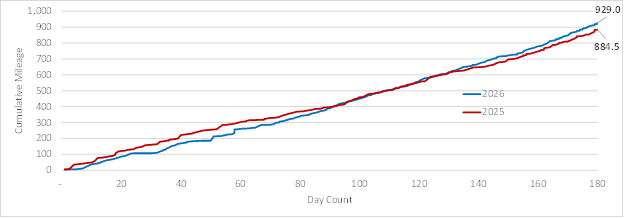
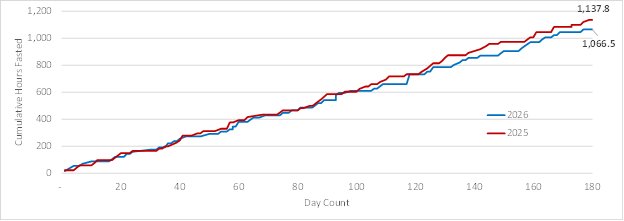
To better understand what my stomach was saying, I decided to look more closely at the data, as I thought this year I might’ve ramped both mileage and fasting intensity, which would have understandably drained my batteries. But year-to-date mileage for the first six months of 2026 totaled 929 miles, only slightly ahead of 884 the year before, which wasn’t a meaningful difference. Year-to-date cumulative hours fasted was 1065 this year, which was actually a bit lower than the year before. Translating miles and fasting into calories, the difference between 2026 and 2025 came to 2,600 kcals – a little more than 1 day’s worth of food. Huh. Was that all it took to spark a mutiny?
There was one more test to consider. I couldn’t even remember the last time I’d weighed myself. Indeed, it was so long ago, that today, when I stood upon the scale, nothing registered — the battery was dead. Once it was replaced, the readout showed the same weight I last recalled. Six pounds more than what I weighed in college.
I guess my system was stable, after all.
Ten days later, with my weekly mileage dipping somewhat due to travel, my monthly fasting hours rose slightly above the 150-200 target range – and I felt fine. Skipped breakfast, not feeling the need, and from my stomach, nary a peep.
Seems like there’s a natural balance between burning calories and ingesting them. Who would have thought?
The secret to stability is probably not to treat every inner voice as accurate all the time. Nor can we reduce the complexity of life to a set of numbers. Rather, the right environment to keep learning about our bodies (and possibly our minds) may well be an interplay between protocols, metrics, and plaintive inner voices who sometimes crave a hearty breakfast and large cookie.
Kaag,John J.. Hiking with Nietzsche: On Becoming Who You Are. Farrar, Straus and Giroux
Thanks for reading! This post is public so feel free to share it –> Share
Working in a bank a few years back, I saw that everything important was documented, allowing auditors to review decisions for compliance with policies and procedures. Which begged the question — why wasn’t I documenting the important things in my life?
So, I opened a spreadsheet in Excel and created a training log. The first entry dates back to February 15, 2013. Evidently I ran 9 miles, although there is no indication of where or why or how it went.
Back then business travel took me to Florida from time to time, and I’d sometimes take advantage of a nearby beach to run barefoot – just for the novelty. On July 10, 2013, I ran 5 miles barefoot on Vero Beach. The following February, I ran 6 miles in Boca Raton. The hard-packed sand felt frigid underfoot.
I don’t remember when I read Born to Run, but Chris MacDougall’s warning that shoes predispose us to injury struck a nerve. Since I was struggling with running-related injuries at the time, I decided to conduct an experiment, although instead of running, I decided to try a barefoot hike. On August 25, 2015, while on vacation in the Italian Alps, I walked up a nearby ski slope, and what I remember most was how the cows stared at me in wonder, as if they’d never seen a human without shoes before. Two weeks later, back home in New York, I repeated the experiment on Peekamoose Mountain in the Catskills.
And then I went off the deep end.
Roughly one year later, I reached my 1,000th mile of barefoot training, comprised of running, hiking, and walking. Speaking of documentation, this quirky accomplishment inspired me to write up a blog post in which I explained that barefoot running had been an “interesting experiment” based on the “calculated bet” that more natural form would prolong my useful running life. I admitted to some surprise at the feeling of light-footedness, the exhilaration, the sense of a more direct connection with nature. Even so, I had no idea where this odd journey was going to take me.
When I reached my 2,000th barefoot mile, I published a second blog post, and thereafter it became a habit upon reaching the next thousand-mile-marker to write about what I’d done and learned. On June 22, 2025, I reached my 14,000th mile but skipped the report as I was busy — so here is my latest update, with the barefoot odometer now at 15,000 miles. Continue reading “15,000 Miles Barefoot”→
I’ve logged a lot of miles in Andrew Brown Park, located in the prosperous Dallas suburb of Coppell, as the smooth paved trails are easy on the feet. Earlier this week, I showed up for a session of high-intensity interval training — specifically, a drill called “Yasso Splits,” which consists of 10 half-mile intervals at a fast pace, with ¼ mile recovery intervals in between. Developed by Bart Yasso, the “mayor of running” and Runner’s World’s former Chief Running Officer, Yasso Splits force you to sustain an elevated heart rate, which is thought to be good training for a faster marathon. To get through ten of these intervals takes a bit of grit.
I’ve been doing high-intensity interval training for almost 20 years, and Yasso Splits are one of my favorite workouts, although given the intensity, I approach them with a conservative attitude and, if I’m being honest, a touch of dread. On the drive over to the park, I thought through all those years of accumulated experience and weighed them against more recent fitness indicators, and after due deliberation selected a target pace for the intervals of 7:30 per mile, with the recovery intervals to be run at plus-or-minus a 10-minute pace. Then, after a moment of additional reflection, I decided to cut myself some slack – let’s go with a target range, call it 7:30-8:00 pace, with the goal being to maximize the training benefit, without taking on excessive risk.
Risk?
Whenever you run, you take on risk. Especially when running hard.
The risk consists of the possibility that you might damage muscles, ligaments, tendons, and even bones. There’s risk that an injury could derail your training goals, for example, spoil your plans for that upcoming race which you’ve been training for so intensely and which means so much to you.
There’s the risk that injuries could become chronic. Running is not just a sport, it’s a practice of self-empowerment and transcendence. If you get sidelined, you’d have to find a new path to pursue these life-affirming goals.
So, when we talk about needing “grit” to complete a tough workout, the real question isn’t pushing through pain — it’s taking on risk.
Guest post by Ru Shodai, 2024 SRT 70-mile competitor who completed 57.8 miles
I remember reading about the SRT race, years ago, and learning about the barefoot category, and wanting terribly to do it. Back then I could barely do a 10k on trails, but it was placed on my bucket list. After successfully racing North Face Endurance Challenge’s 10k race at Bear Mountain for several years, I was ready to sign up for the half, when it abruptly discontinued. Fortunately, I had discovered Red Newt Racing’s Breakneck Point Trail Runs. And ran the toughest half of my life. And was hooked. Ran that half several times, and rediscovered the SRT. In 2022, I signed up for the half. I had no idea what I was in for, but it was an amazing journey. I missed a turn, added 5 miles, stumbled into the finish, legs completely shot, and realized I had just done 18 miles on the trails. In sandals. I got my barefoot pin! I immediately wanted to sign up for the 30 miler.
A blue heron looked up from the slimy water and gave me a sly sideways look, just as the digits 11,999 started to roll. This was during a 1.6-mile barefoot stroll along the paved trails of Andrew Brown Park, Coppell, Texas. I’m kidding – I don’t actually carry an odometer. Rather I measure distances using a GPS watch and track my training (walking, hiking, running) in an excel spreadsheet with 16 tabs stored in the cloud. It’s only in the spreadsheet that I see the world in digits.
From Andrew Brown Park it was off to DFW and then there was the long flight back to New York and a dark drive home in the rain. The next morning, I emerged from boreal gloom onto the open summit of Wittenberg Mountain, where the southern view unfolds before your eyes as you step toward the edge of a flat sandstone ledge – nearly 100 miles of rolling green ridges, spring forests, hazy clouds — and it occurred to me that this, too, will end. Instead of counting up past 12,000, maybe I should be counting down from (X-12,000) to zero, where X is my total lifetime mileage. Only, I don’t know X. Not yet. But with each year it’s drawing closer. I can sense it, just like when parachuting at night, how the invisible horizon rises to greet you – that’s when you flex your knees and get ready to roll. Continue reading “12,000 Miles Barefoot”→
Guest post by 2023 SRT 70-mile winner Jordan Snyder, who set a modified course record of 15:40:05 (modified because we started the race approximately 1/2 mile ahead of the official start, to avoid an exposed area and risk of lightning — nonetheless, this was a dominant performance relative to the prior record of 16:22:52.)
I want to start by giving my thanks. To my wife, for sacrificing so much this past year to allow me to train. Her picking me up countless times while I was doing point-to-point runs on the course and taking care of the girls is the reason I did so well. To my kids for cheering me on, at every event leading up to this, making me feel like it’s all worth it. To Ken and Todd, thank you for putting on this fantastic event. This is hands down my favorite race that I have ever done. To the volunteers, you guys are amazing. The words of encouragement are appreciated more than you know. It was a real morale booster. To Katie Rhodes, your suggestions helped shape a lot of what was in my pack. Also, telling me I was more prepared than I felt took some anxiety off my shoulders. You are a great ambassador. To Kami Morgenthaler and her crew of the NYNJ Trail Conference. The section from the hunting cabin off Shin Hollow rd, down to the Bashakill, had areas where it seemed like you were just placed in the forest with no sense of direction. Her team re-blazed that entire section, making it one of the easiest parts of the course for me to run on autopilot.
Training
I want this to serve more as a guide than just a recap. Sub 15 hours is definitely achievable, and I would love for this to help someone achieve it. I went through every available race report online more times than I’d like to admit. The insight and information shared were invaluable.
I discovered the SRT in October of last year. I was searching for a trail that would get me from Port Jervis to Wurtsboro. While creating a route on Strava, I kept seeing these segments labeled as: srt1, srt2, srt3. I did not know about the SRT until this moment. For the next couple of days, it just kept bugging me until I finally decided that I was going to start training for it.
I live in Port Jervis, which is only 15 minutes from the start. I can see the monument from my house. Every day after discovering the race, I inadvertently looked at it one way or another as if it were taunting me. Everything from that moment forward was preparing for the race. I had never done an ultra event, let alone an official half marathon. The longest I’d run at that point was 31 miles, but that wasn’t a race. I just started running less than two years ago.
I signed up for two ultras pre-SRT to prepare myself for the distance and vert. A 12-hour endurance race in March, where I finished with 63 miles and 6k of vertical gain. Then, a 4-hour vert-heavy race in May, where I finished with 19 miles and 7k of vertical gain. After that, I started the build phase in June. I usually run 60-70 miles a week with little elevation. My build phase began at 60 miles a week with 10k of elevation gain. Twice a week, my long runs were on various sections of the SRT. From that, I added 5 miles a week while also trying to add more elevation until peaking at 120 miles and 20k of elevation just before tapering. I was doing strength training 4 to 5 times a week, focusing on core strength and ankle mobility.
The build-up went according to plan except for one issue. At the end of July, while building up to 90 miles, I was doing a 15-mile run from checkpoint 2 in Wurtsboro to the top of Sam’s Point. I’ve done this section countless times, so it was just a typical easy run. I was just about to descend the second hump before the climb up to the fire tower when I slipped on this large flat boulder that looked like a surfboard standing up on its side. I landed on my back. It hurt pretty bad, but I could keep moving, so I pushed through and finished the run, about ten more miles. I didn’t realize how bad it was until I got to south gulley trail. I wasn’t able to run again for almost two weeks. I could barely walk at this point. It took five chiropractor visits and hours of mobility work to feel comfortable again.
After feeling confident with a 78-mile week, I ramped it up to three 100+ weeks. One of my best training weeks was three back-to-back 20-mile-long runs. I wanted to go into the race feeling as if I didn’t need to use any navigation tools at all. I’ve run every 10-mile section 5-10 times. I’ve done two 38-mile runs from High Point to checkpoint 3. I’ve done one 33-mile run from checkpoint 3 to the finish. Some weeks, I was running 4-5 times on the SRT. I know the course forward and backward like the back of my hand. For me, knowing when the next challenging climb was coming up was beneficial. One of my favorite training spots was South Gulley Trail. I would do two to three repeats on it. It’s a lot of vertical gain in a short period.
Kit
Clothing
Ultraspire Alpha 5.0 running vest
Shoes- Hoka Speedgoat 5
Socks- Drymax Speedgoat Lite Trail Running 1/4 Crew Socks. An extra pair was packed in a ziplock bag to change into at checkpoint three.
Shirt and shorts- They were both last-minute changes because of the rain. I bought them on Amazon because they were marketed as “moisture-wicking and fast-drying.” This was false.
Rain jacket- Outdoor Research Helium rain jacket. Even though it was raining at the start, I never ended up using it the entire race.
Food
The goal for nutrition was 400 calories an hour and 90 grams of carbs. The food listed below can sustain me for 17 hours.
10 packs of Skratch raspberry energy chews. I divided them into two bags, 1 for the first half and easily accessible. The second one would take its place when I reorganized my pack at checkpoint 3. I would eat 14 pieces once an hour at the 30-minute mark.
10 packs of Skratch sour cherry Caffeinated energy chews. Same deal, so four separate bags. I would rotate between caffeinated and non-caffeinated each time.
16 Skratch salted maple and mallow rice cakes to be eaten once an hour on the hour.
2 Cliff Bar crunchy peanut butter protein bars. (For checkpoint 3)
2 Katadyn BeFree 0.6L Ultralight soft flasks with filter, drinking half the flask every 30 minutes after eating.
Electrolytes came mostly from salt caps, taken every 2 hours.
Electronics
Watch- Garmin 955 solar. The course was loaded onto my watch as an emergency, but I never needed it. I focused more on pace and heart rate data.
Headlight- Black Diamond Spot 400 with two extra sets of lithium-ion batteries. I could have made do with only one set, but it was better to be safe than sorry. I changed them the first time at checkpoint 2. I didn’t need to change them a second time, but I opted to swap them again at checkpoint 3 to have no problems going up South Gulley Trail.
Power bank- it was just a cheap one to charge my watch. I had no intentions of using my phone, so the weight savings on a smaller one was a nice benefit.
Charging cable for the watch only.
Phone- I had my phone off the entire time, only turning it on to check in with my wife.
Miscellaneous
Emergency space blanket. If it were colder, it would’ve come in handy, but the temperatures were just right at checkpoint 3. Happy to have it, though.
Body glide anti-chafing balm. (Useless)
10 ibuprofen.
Wet wipes in a ziplock bag.
A butter knife. More on that later.
Pre-race
The week leading up to it was mostly uneventful. I was getting 10+ hours of sleep and eating very healthy. I started wearing an 8lb weighted vest, only taking it off to sleep. I’m not sure how beneficial some might say that was. But I will say the total weight on my race vest was 10 lbs, and on race day, it felt like nothing.
Five days before the race, I spent an hour pruning brambles on a quarter-mile section of the trail. It’s the downhill section of Huckleberry Ridge just before you get onto Old Mountain Rd. As nice as it was not to have my legs cut up, it was not worth the severe poison ivy I have on both legs.
Three days before the race, I started upping my intake of electrolytes heavily.
The day before the race, I checked on the main streams I planned on filling up at, to make sure they were flowing. It wasn’t necessary, though, because we had an hour downpour that night and on race day as well. All water sources were flowing.
I slept well the night before and had a nap mid-day. I ate a massive serving of what my wife calls cheesy taco rice, one of my favorite meals. At 6 p.m., I wrote the split times, total time, and time of arrival that I wanted to hit for each section on my right arm in permanent marker. On my left arm, I had my wife write down words of inspiration, as well as having my daughters (23 months and 3 year-old) draw what they wanted. We then headed up to High Point.
I met Todd and two other volunteers at the start, receiving my bib and t-shirt. Then Todd delivered some bad news to me. Because of the Thunderstorms, we were starting at the trailhead of Monument Trail instead of the official start. My main goal was to finish strong, but I’d be lying to myself if I said the course record and FKT weren’t on my mind. All of my section paces were set up to do just that. Todd then stated that because of the storm, it would be unlikely for anyone to set the record anyway. For a brief moment, I did think about asking Todd if all three of us agreed on it; we could do it from the official start. Not wanting to be selfish and risk the safety of others, I decided against saying anything. Ken gave us a quick race briefing, and then we were off.
Srt 1
I split the race into eight sections, according to the segments on Strava. They are named srt1 to srt6, undivided lot trail, and SRT Chapel to finish. The first section is 10 miles from the start, down to the bottom, where you meet up with the train tracks. My split goal for this was 1:55.
There were three of us doing the late start: Russ, Zach, and myself. I already knew of Russ from reading his race reports many times. I had stalked Zach on Strava and knew he and Russ would move swiftly through the course. When Ken sent us off, I didn’t want to lead the way in fear of going out too fast. Russ took the lead, Zach followed, and I took third. On our way down to Greenville Turnpike, we exchanged general small talk. The pace being set was comfortable. As we made our way off the road section and into the first part of Huckleberry Ridge, Russ asked if I wanted to lead us through. Reluctantly, I did. I didn’t want to pace us yet. This section is about 2.5 miles with 500ft of vert. I’ve run it countless times, and if you’ve never been on it, it’s easy to get turned around. On three occasions, I noticed them falling behind, but I wasn’t ready to run alone. I walked until they caught up and then started running again. We made it to the downhill section I had trimmed, telling them about my poison ivy. We ran steadily up to Lakeside Drive and back into the woods. Russ retook point. We made it to the bottom, aligning us with the train tracks, which is the end of this section. We finished it in 1:56. Since the section was shorter because of the modified start, it meant I was behind by 5-10 minutes on this section.
Srt 2
This section is a little more than 9 miles, and it ends at the trailhead for the Bashakill. I still was not ready to run alone, so I didn’t let the deviation from the first split affect me. The goal for this split was 1:40. Russ led us up the Jeep trail past the creepy cabin until we turned left onto the single track, where he asked me to lead again, so I did. This part is only a mile long but can be confusing. I informed them we had three options for water sources that we needed to choose from in this section; otherwise, we wouldn’t have water until the Bashakill. Russ was fine on water, but Zach and I were both looking to fill up. With my soft flasks out and already unscrewed, all I needed to do was scoop and go. When I looked up, though, I realized Russ was not waiting for anyone. I looked back and saw Zach was still filling up, and I decided to continue with Russ to the Guymard Turnpike crossing. Just before we reached the intersection, Russ told me he hadn’t eaten anything yet, and his stomach wasn’t feeling right. This took me aback because his pace was pretty good up to that point. He then informed me that he would slow down on the old rail bed climb. I decided to set my own pace from now on. This is where I started to go by a majority of the 6:30 starters. I felt terrible running past them while they were making their way up. It’s demoralizing getting passed by someone when you’re going at your pace. I introduced myself to them and tried to offer words of encouragement. I went past 6 of them up to checkpoint 1. Arriving at checkpoint 1, I asked Ken how many people were ahead of me. He informed me there were four, but it was still early in the race, and I shouldn’t be worried about that. Knowing that he was right, I then ran down County Rt. 61 at 6:30 mile pace passing two more people before climbing up gobblers knob. Gobblers knob to the Bashakill was uneventful, although I thought I heard a coyote. I finished this split in 1:39:45.
Srt 3
This section is 7.5 miles and ends just before checkpoint 2. The goal for this split was 1:10. Upon entering the Bashakill, I was welcomed by a trail magic set up with several jugs of water. It was a lovely thing to see, but at this point, I didn’t need water, so I continued. This section is tedious and slow because of the roots and old railroad ties, so there’s not much to say. I finally saw a glimpse of a headlight at around mile 22, so I picked up the pace. I didn’t want to go through the creepy tunnel under the highway alone, so I did my best to get to him before it. I finally caught up to him 1000 feet before we went through it. That was quite a mental achievement for me, timing it that perfectly. His name was Ted. I had also stalked him on Strava and knew he was a strong runner. I was happy to see he was in second place at that point. In my perspective, he was crushing it. I asked him who was in front of him. He told me it was Pete. After some small talk, I informed him I would keep going and picked up the pace again.
My second water fill-up was a lake on South rd. As I popped out, Ted had caught back up to me, and I informed him this was the last easy resupply until we were on Wurtsboro Ridge. He said he was fine, and we stayed together until checkpoint 2. He let me know he was going to stop for 5 minutes at this checkpoint. I stopped to change my batteries and carried on. The split for this section was 1:11:39
Srt 4
This section is 11.5 miles and ends just before checkpoint 3. This section is challenging. It is four steady climbs and descents known as the camel humps. The goal for this split 3 hours even. At this point, I was 7 minutes behind my overall goal. I needed to pick the pace up a little bit. Before departing, I asked the volunteer how far ahead Peter was. He told me about 20 minutes. This section being so demanding, 20 minutes could be just 1 mile, so I wasn’t stressing about it. Just like with everyone else, I had also stalked Peter on Strava and knew he was not someone to take lightly. I knew there was a possibility I wouldn’t see him at all in this section. But I also set a goal to catch him before the climb up to the fire tower.
The first hump went smoothly. I thought I heard a bear growling, but I kept moving. The second hump also went smoothly. Lightning in the distance on the open ridge was amazing as it lit up the sky. As I was starting to descend, I still had yet to see any sign of Peter. I wondered if I was going to catch him at all. But, as soon as I started to climb the third hump, I finally saw his headlamp starting the switch back before you cross over to Ferguson Rd. This was another mental boost, guessing almost perfectly where I thought I would catch up to him. I’ve never run this section in the dark, and it was so amazing to see how high someone was only by their headlight visually. It looked fake. This climb is the second most challenging climb on the entire trail, IMO. It’s 700 feet of vert in .75 of a mile. This was not the part to chase him down. It felt like he had kicked the pace up when he saw me, though, because I didn’t see him until just before the fire tower. He popped out of the woods, coming from the wrong direction. We talked briefly until he told me he had a gear malfunction. I stopped to make sure he was okay before carrying on alone.
At this point, it felt unreal that I was leading the race. This was short-lived because, within a couple of minutes, Peter came flying up behind me. At that exact moment, I heard what I thought was a bear running away from me. The footsteps were super heavy and not jumpy like a deer. I started yelling, “Woah bear!” Peter asked me if I had seen one, and I replied that I only heard it. He also shouted weird words to an animal that couldn’t understand us, and we carried on finishing the third hump. The fourth climb is very gradual but takes forever. It was nice to have company through it. I’ve never run with anyone through this section. Finishing the fourth hump is an extremely steep descent, followed by two miles of easy downhill jeep trails. Just before checkpoint 3, I looked at the time and realized that not only did I make up for the 7 minutes, we were way ahead of schedule. I didn’t want to be the first one at the checkpoint, so I told Peter I had to make a pitstop. I stopped for a minute to comprehend how perfect everything was playing out and carried on to the checkpoint. The split for this section is 2:36:31
Checkpoint 3
Upon arriving at checkpoint 3, I called my wife to fill her in briefly. She was relieved I was okay and excited to hear that I was hitting my splits. We talked for 5 minutes, but then it was time for me to get to work. This checkpoint was not a place of rest for me. I didn’t want to get stiff from sitting there. I took off my socks and shoes. I emptied my vest and plugged my watch in. I swapped all my empty nutrition bags from my side vest pockets with full ones. I lubed up my quads and hamstrings with body glide. I took out the butter knife and used the dull side of the handle to work out tight areas of my muscles. It may seem weird, but I swear by this, especially around the knees. It’s an instant relief for general knee soreness. After that, I began my stretching routine. Lateral and forward leg swings, deep static Asian squats, lunges, and full ankle flexion rotations. I would do this for 20 minutes, take a walk break and go again.
After the first set, I walked over to the table with the check-in sheet. I asked Ken if a line through a person’s name meant they dropped, and he said yes. Going through the list, I get to the bottom, seeing that Russ had dropped. I was shocked to find out he dropped out at checkpoint 1. I was expecting a grueling back and forth with him for the remainder of the race.
Around 4 am, Zach arrived, and we talked for a bit before he opted to take a nap. Maybe 10 minutes later, Ted’s dad had shown up. He was waiting for him to pass through. He stated that he was going to slow down for that section. Around 4:50 am, I put my shoes back on and packed up. I started giving Zach 1-minute interval warnings in the last 5 minutes. At 4:59 am, I stood up and waited for the green light to start up again. Ken and the park ranger gave us their blessing, and I crossed over Rt. 52 towards South Gulley. Peter was already over there because he also opted to rest for his 2 hours. I told him we were good to go, and off we went.
Srt 5
This section is 12.75 miles and ends just before Rainbow Falls. This is arguably the most challenging section. Almost 3000ft of vertical gain. 1800ft of it is in the first three miles. South Gulley Trail. It tends to surprise people how difficult it is, even when they know it’s coming. The goal for this split was 3:05. After telling Peter we were good to go, I headed into the woods. I felt strong. Stronger than I thought I would have. It felt like I had just run one of my regular 10-mile runs. I led us into the woods, and at this point, I didn’t want to wait for anyone anymore. After five minutes, I no longer saw headlamps. I didn’t see any other racers for quite a while. The thought of doing so well and feeling so strong kept my morale at an all-time high. I made it to the peak of Sam’s Point before the sun even rose. I was moving so well that by the time the sun did rise, the dwarf pines covered any view I could see of it. This just motivated me even more. From here, I just started making mini-goals for myself instead of thinking about the finish line. I just have to make it to VerKeerderKill Falls, check. Now I need to make it to Mud Pond, check. Then into the cave and up Castle Point, check. Before I knew it, I was already at the trailhead for Rainbow Falls. The split for this is 3:01:43.
Srt 6
This section is 9.78 miles and ends before the start of Undivided Lot Trail. It’s not very difficult, but Jenny Lane Trail always slows me down. There are a lot of rocks protruding from the ground that tend to catch your feet. The goal for this split was 2:25. The first half of this section went smoothly. I kept doing my mini-goals. Make it up Rainbow Falls, check. Make it to the Trailhead of Jenny Lane, check. From here, things started to feel off. My stomach started to turn, and the chafing in my private area became unbearable. I was still able to run, but it was becoming an issue.
My nutrition plan until this point was going perfectly. Every thirty minutes, eat. I think the lack of options, coupled with it being primarily simple sugars, was the issue. I continued through Jenny Lane, my least favorite part of the entire trail. I finally arrive at checkpoint 4 where the volunteers ask me how I’m feeling. I tell them my legs feel strong, but the chafing is getting to me. I crossed 44/55, entering the start of High Peters Kill Trail. HPK is net downhill but has a decent climb in the middle. This would be the last time I ate. After 9 am, if I thought about my food, I would get nauseous. All I could think about was that glorious pizza waiting for me.
While going over my time in relation to where I was, I started to realize I was falling behind on the FKT time. I started overanalyzing the splits on my arm, and when I looked up, things didn’t look familiar. The trail seemed too overgrown for where I was. I looked at my watch first, and it showed I had gone off course. I didn’t hear it beep at me. I open the Avenza map, and I had only gone off course by about .05 of a mile. I felt pretty foolish in doing so, but I had done it to myself. I was on Hidden Pond Trail. I quickly turned around and got back on course. This would be the first and only time I went off course.
I traversed down to the stream and then started to climb up. I noticed that climbing was making me slightly nauseous. I kept up my fluids and started taking salt caps at hour intervals. But even thinking about those energy chews made my stomach turn. On the downhill section towards checkpoint 5, I finally ran into my first hikers of the event. They gave me some perplexing looks, and I opted not to tell them that in about 45 minutes, hundreds more would be coming this way. I made it to checkpoint 5 around 10:15, and I asked if they knew if Ted had made through to checkpoint 4 yet. They didn’t know, so I continued. I was hoping he was doing well. I started the gradual climb up towards Undivided Lot Trail. Looking at the time, I had fallen behind on this split. I had to take short walk breaks because of my stomach. I finally make it to the trailhead of ULT. The split for this section was around 2:35.
Undivided Lot Trail, and SRT Chapel to Finish
These two sections are split up on Strava. ULT is 2.73 miles, and Chapel to finish is 6.8 miles. ULT split goal was 35 minutes, C2F split goal was 1:35.
Just like the course from this point being net downhill, the race really went downhill for me. Once you start on ULT, it’s a slightly technical downhill until you reach a short rock scramble. I was okay until I hit that scramble. It felt like it was never-ending. I had to stop every step I took because of my stomach. Once I reached the top, I felt so queasy that I couldn’t run even on the flats for another 5 minutes. That first mile took almost 20 minutes. On a normal day, that mile would be a 10 min/mile, even with the scramble. Seeing that mile split pop up on my watch was frustrating, to say the least. My legs felt so strong, but the nausea stopped me from running. I tried pushing the 2-mile downhill at a blistering pace of 12 min/miles. I got down to the bottom, seeing the chapel to my right, which is the end of ULT. The split was around 40 minutes. Not terrible, but this would mean I would need to run Chapel to Finish in 1 hour flat to hit the FKT. It’s definitely possible because I’ve done it in one of my training runs. But the way my stomach was, it wasn’t in the cards for that day.
I shifted my focus to the course record. After some more mental math, I needed to finish C2F in two and a half hours, 22 min/miles. Even walking, I could do that. No need to stress what I couldn’t control. I would walk when I needed to and run when I could. From the chapel to Spring Farm checkpoint is an easy climb that’s less than a mile. I took short breaks but had to walk the entire section. Exiting the woods, I began running towards the checkpoint. I saw Ken and asked if there would be pizza at the finish. To my delight, he said yes. As nauseous as I was, I could only think about real food.
From here to the downhill after Bonticou Crag sucked. I averaged 19-minute miles for those three miles. Just as I was descending, I finally saw the first half-marathon runner. He was flying. I asked him how long ago he’d seen a 70 miler. He said he saw him back by the beginning of ULT, which was close to 35 minutes ago. He described who I believed to be Peter. I told him he was crushing it, and he could be on course record pace. I wasn’t sure if he was. I was just trying to motivate him. I initially thought when I saw the first runner pass me, it would be demoralizing. It actually reignited my drive. The nausea was still there, but I was able to run again. Albeit slowly, it felt good.
With only three miles left, I was so excited to see my wife and kids finally. From there, down to where you pop out on the rail trail, six other half-marathoners passed me. I cheered them all on as they flew by. As I crossed the bridge, I couldn’t contain my excitement. It felt so strange that I wasn’t just finishing the race but winning it. All those months of training, hours away from my family, they weren’t for nothing. I finally can see what I’ve been waiting to see for 17 plus hours, my family. I run towards them and wave as my wife points me towards the finish line. My 3-year-old daughter shouts, “I wanna run with you, Daddy!” I turn around to grab her hand and say, “You wanna run? Let’s go!” Crossing the finish line with my daughter was one of the happiest moments of my life. The split for C2F was 1:51.
After we crossed the road, I shouted, “Where’s the pizza?” It turns out I had beaten the pizza there. I felt pretty successful in doing so. After exchanging some small talk with Ken, Todd, and some other half-marathon runners, I got to meet Ru’s parents. She was running the 30 miler. They were handing out the finisher medals. I can only hope to have the joy and excitement that they have for their daughter when my children get older. They are inspiring.
I walked over to our car with my family. It started raining hard, so my wife put the kids in the car. I lay down on the ground and just let the rain hit me for a couple of minutes. It felt good to stop moving, but I knew I had to get going. I got up and finally grabbed my pizza. I could’ve eaten a whole pie at that point, but I didn’t want to be greedy. I grabbed three slices and some ginger ale. I accepted the best trophy of any race, the tomahawk. I took some pictures for the award ceremony, and then we drove home and filled my wife in on what had just transpired.
Post-race thoughts
The day after the race, it didn’t even feel like I ran 70 miles. My legs felt fine, and my stomach was back to normal. The only remnant of the race was the chafing. It was so bad I had to walk like a cowboy to avoid pain.
On Monday, I was able to run at my regular heart rate and pace with no problem. After two miles, the chafing started to hurt, so I stopped. By Wednesday, it healed well enough that I could do a nine-mile run without a problem. From then on, it was back to normal.
Now for my post-race thoughts. I finished the race in 15:40:05 and the FKT attempt in 17:40:17. I firmly believe sub 15 hours is possible. I wouldn’t change much in my training. I think the 10k+ elevation per week was detrimental to my success. I would use something other than body glide. It works perfectly on dry days, but with rain, it was useless.
Nutrition… I made a colossal mistake with nutrition. I only had two different types of food, both simple sugars. While they worked for the first ten hours, my stomach couldn’t take it after that. A more comprehensive range of food and ginger root would’ve made it smoother.
I would like another shot at the FKT. When they changed the start time to 7:30 instead of 8:00, I had to adjust my second-half splits to be faster. I initially wanted my second half to be slow. If we had started at 8 pm, I would’ve taken the FKT by seven minutes. But as the old saying goes, “If ifs and buts were candy and nuts, we’d all have a Merry Christmas.” I’m more than happy with what transpired on race day. If they change the start time back to 8 pm or even later, I’d have another go at it. If it’s not possible, I would like to have a go at the half-marathon course record.
I’m certainly not done with the SRT. It holds a special place in my heart now. I might try for the FKT on my own. Not being tied down to a specific date and being able to run in good weather would make it easier for sure. It’s been a month now, and I’m still chasing the runners high from that day that I haven’t been able to recreate. I’ve run a couple of 5k road races where I even set a PR in one. It felt like nothing compared to the SRT. I will definitely be back in 2024. Thanks again, Ken and Todd.
Left to right, Co-director Todd Jennings, Jordan Snyder, NY-NJ Trail Conference Volunteer Kami Morgenthaler,
Josh Dickson is a UK-based therapist, thought leader in the field of human potential psychology, and student of “flow,” the super-productive state of consciousness experienced by athletes and other high-performers. Core to his practice is the idea of “mindfulness,” which is sought traditionally through gentle and voluntary techniques, like relaxation. But in a series of recent articles, Dickson brings up a different approach, which he calls “forced mindfulness.” Forced in that this kind of mindfulness requires “conscious and intentional effort” to deal with intensity — sense of urgency — the risk of pain.
The other day Josh asked me, might barefoot running be a form of forced mindfulness?
169 years later, Thoreau’s commandment still echoes across the surface of Walden Pond — “Simplify. Simplify!” The logic has stood the test of time. Seriously, could anyone want more complexity in life?
But that doesn’t mean simplifying is easy.
To simplify means to “make something easier to understand,” according to the first online dictionary definition that popped up when I typed the word into the search bar. Understanding takes effort. And time. Both of which are in short supply. So simplifying is a good thing — indeed, it’s the key to solving problems. In this regard, simplify has a similar meaning to compute. Continue reading “If you want to be a Minimalist, you’ve got to be Fit”→
After due deliberation, I made my decision. The BMW Dallas Marathon, if I successfully completed it, would be my 101st race of marathon distance or longer.
Of course, my mind was immediately filled with images of dalmatians. I made an effort to clear my thoughts of such clutter because these numbers are important.
You see, for an aging marathoner like me, 100 holds this significance — that beyond it there lies no obvious next stopping point. To go past 100 marathons would be like pushing an aircraft to Mach 1 and then breaking the sound barrier — which produces an impressive bang no doubt — but that doesn’t mean you’ve reached the maximum possible speed. (OK, I confess to being fascinated with fighter jets and pilots.) Continue reading “Running the BMW Dallas Marathon”→
Surprise. On the way to (yet) another race, I’ve pulled off the New Jersey Turnpike — desperate for coffee, water, a break from unpredictable traffic (speeds of up to 95 MPH) — and here I find myself, suddenly, in the Walt Whitman Service Area. Whitman being, to some, the greatest artist America has produced. The singer of the open road. The poet of Democracy. I did not know there was a Service Area named for him. After the race I’m planning to visit his gravesite, which lies a few miles distant. First, though, I must complete the Delaware Running Festival Marathon in nearby Wilmington, my 100th event of marathon distance or longer. Which begs the question — what next?