A therapist once diagnosed me as “quirky.” I’d retained him to advise me during my divorce, at my ex-wife’s suggestion, as she said I desperately needed help. The diagnosis rested on my decision to stop wearing shoes and start running and hiking barefoot. Otherwise, he thought I was fine.
But questions linger.
Today, in reviewing the last 1,000 miles of barefoot walking, hiking, and running in my training log, it’s fair to ask — what prompted this odd pursuit?
Maybe going barefoot is one of life’s secrets – a simple way to promote natural alignment and have fun. Or maybe my “quirky” personality predisposes me to adopt extreme positions and pursue them with reckless passion. If it hadn’t been the barefoot practice, which I discovered after reading Chris MacDougal’s bestseller, “Born to Run,” maybe I would have become an obsessive stamp collector or train spotter or competitive bird-watcher, or maybe I would have colored my hair, pierced my nose, and covered every square inch of my skin with tattoos.
In any case, this last block of 1,000 miles, which brings me to 16,000 barefoot miles over 13 years, started with the unbridled enthusiasm characteristic of each step in this peculiar journey. On December 31, 2025, I ran a 10k outside of Tucson, Arizona, at a conservative pace mind you, since I’d strained the rectus femoris muscle in my right quadriceps during a slip and a fall two weeks before. This accident took place in the Shawangunk Mountain and, incidentally, due to winter temperatures, I was wearing shoes. When I fell, I knew instantly that I’d torn something. I lay there for a moment, unsure how bad the damage was. There was no choice but to drag myself to my feet and limp back 3 miles to the trailhead. Over the next few days, the injured leg felt a little better, although a small bruise formed on the inside of my right thigh, indicating that there had indeed been a tear and some internal bleeding.
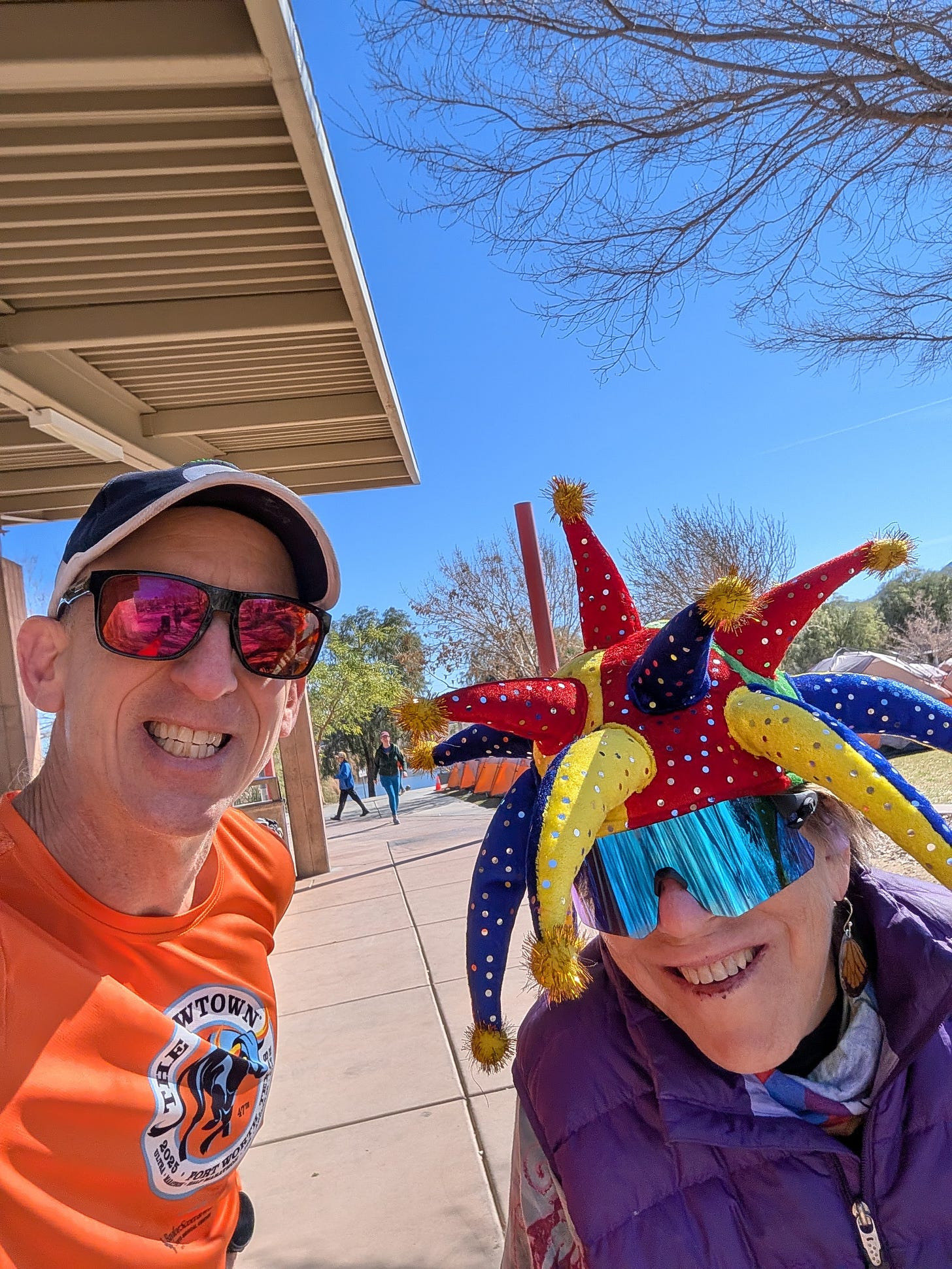
Nonetheless, the 10k went fine, and a few days later, I flew to Texas for the Chevron Houston Marathon, which I ran without food or water for a little extra challenge. This was barefoot race number 134 and barefoot marathon/ultra no. 24. The following month I ran 27 miles on a loop course in Las Vegas, where I met the legendary ultra-runner Ann Trason. When she saw me running barefoot, she laughed at my “stupid and painful” approach to running. But that’s like the pot calling the kettle black, because she was pushing a walker, due to a severe case of rheumatoid arthritis. A week later, I ran a 50k race in western Arizona partly barefoot and partly in shoes on account of the unremittingly rocky course.
These trips helped me escape an unusually cold New York winter, at least for a few days at a time. Back home, I didn’t try to run outdoors when the temperature was below freezing. Instead, I bought a treadmill. Which turned out to be a great investment. In fact, between this machine and treadmills in hotels, I covered 122 miles during January and February, typically 3 or 5 miles at a time, but sometimes up to 10. To manage the tedium, I made a point to constantly vary the speed and inclination in micro-intervals of thirty seconds or quarter miles, adding some structure to what otherwise would have been a monotonous execution. Once I looked out through a window in the garage, where my treadmill is stationed, and watched a deer searching for something to eat in the snow.
It was an unusually severe winter, but every now and then the sun came out and the temperatures moderated. In mid-February, I took advantage of a mild weekend to run Sassquad Trail Running’s Onesiefest 5k in Mahwah, New Jersey. Conditions were ideal for winter barefoot running – the wind was calm, temperatures were hovering in the 30s, and the sun broke through the clouds. The surface was mostly hard-packed snow, which is easy to run on, and it was fun to run with a large group of kids from the Happy Feet running club of Hackensack, NJ and pass some of them, too.
Now I was worried — would my thigh muscle be permanently compromised? And how long would I be out of commission if I opted for reconstructive surgery? Feeling panicked, I rushed down to New York City to see my sports doc, and when the receptionist sent me to get an X-ray, I protested – wouldn’t an MRI be necessary to scan for soft-tissue damage? Wait for the doctor’s instructions, she told me. Impatient, I waited in the examining room. The doctor entered. Listened to my story. Had me raise my leg. And started laughing. He told me that torn thigh muscles are common among soccer players.
“It just means you’re a badass,” he explained.
“But I don’t want to be a badass,” I whimpered, “I just want my thigh back.”
He sent me home. Apparently, the rectus femoris is not an important muscle.
As an aside, “quirky” is a word of unknown origin, possibly related to the German “quer” meaning queer. At first, I’d been put off by my diagnosis, as if it meant I was unpleasantly weird. Which is, incidentally, how I used to feel in high school. However, in checking the dictionary, I found that quirky means “unusual in an interesting or appealing way.” Quirky is associated with unconventional styles, offbeat and eccentric personalities, or charming oddities, although it’s sometimes used to describe people trying too hard to be different.
Personally, I feel that everyone is different and thus many of us would appear quirky to each other if we could pursue what really interests us. But so many people seem weighed down by the spirit of conformity.
As winter morphed into early spring, I drove down to Harriman State Park on every possible occasion, determined to complete a special peak-bagging project which I’d started a couple of years earlier. The goal was to climb each of the 59 named mountains in the park. Barefoot of course. Harriman has small mountains, averaging only 1,000 feet high, but it’s a lovely place with long ridges and U-shaped glacial valleys running northeast-southwest, quiet grassy knolls, open forests with a lot of oak, abundant lakes and bogs. During these visits, I basked in the early spring sun, shivered in the cold wind, high-stepped through scratchy blueberry scrub, and meditated on the concept of “good medicine,” which is a Lipan Apache term for experiences in nature that fill you with feelings of joy and magic. By the way, the Harriman project is part of a lifetime goal to climb 1,000 mountains barefoot. (Because someone needs to do this.)
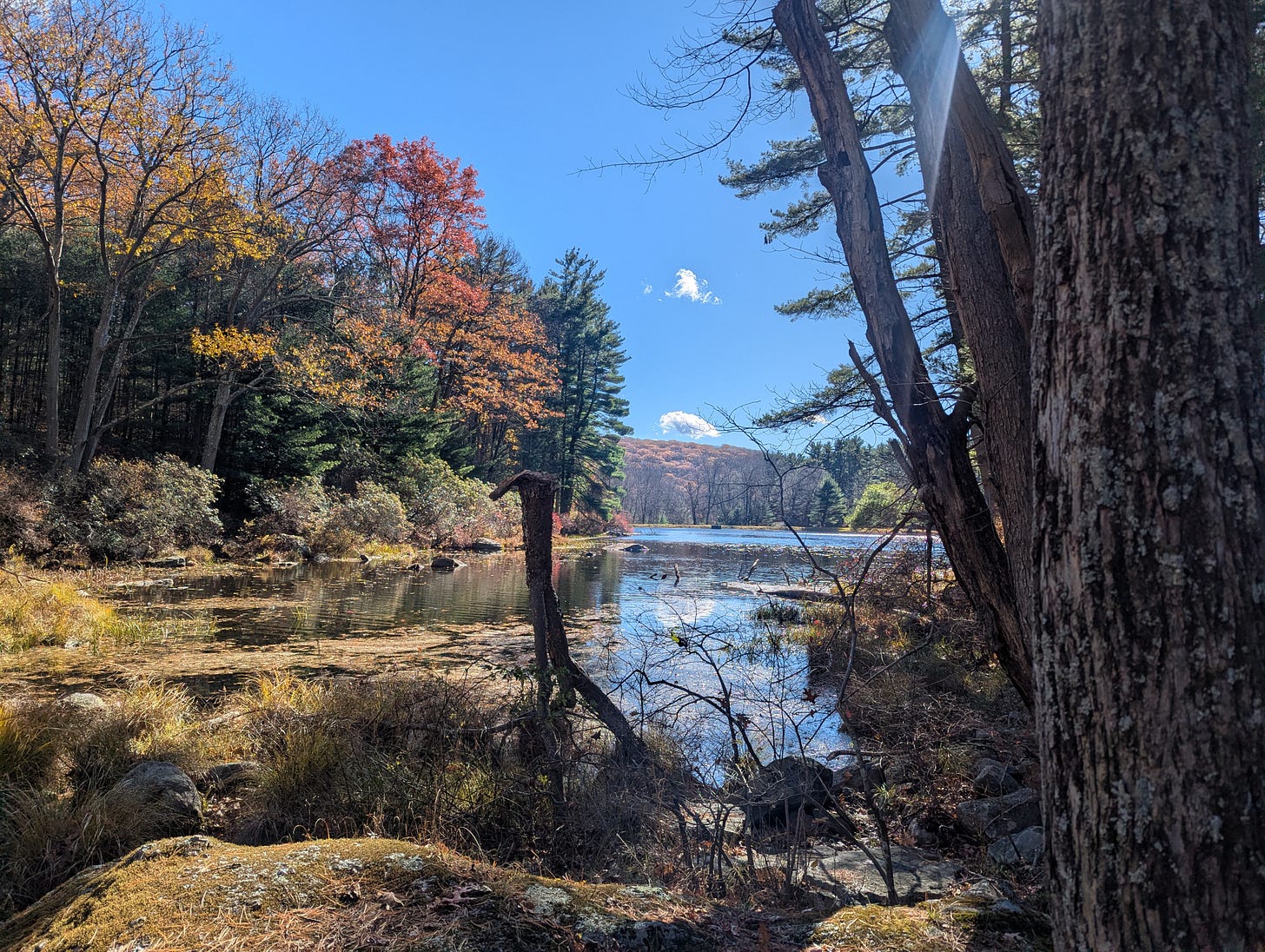
Harriman scene
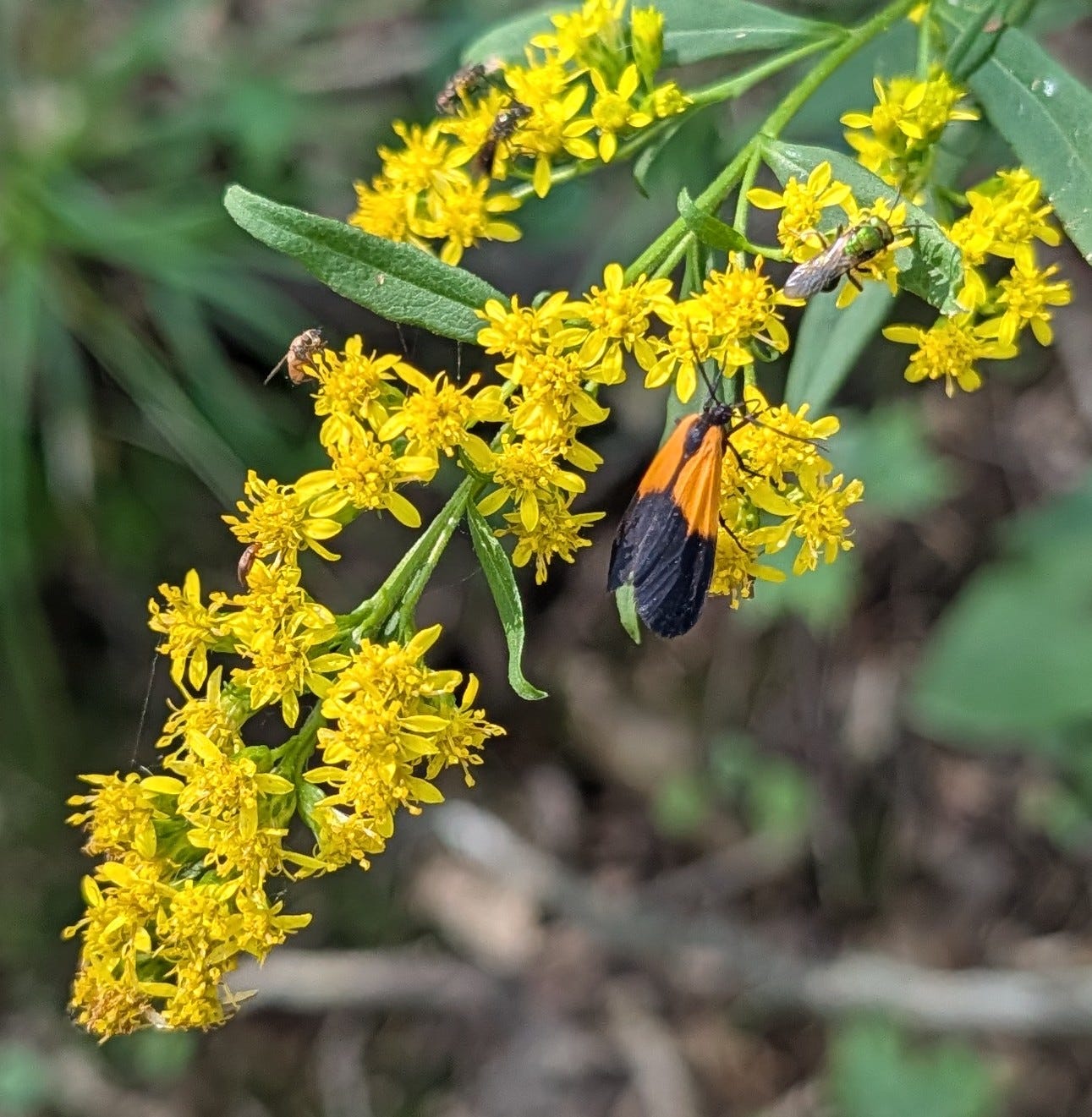
After completing the Harriman project, it was time to return to the Catskills, where I’ve made close to 300 barefoot climbs. Compared to Harriman, these mountains, ranging from 3,500 feet to just over 4,000, suddenly felt quite steep and tall. Gradually I worked my way back into better climbing trim, completing a 15-mile trek in the Blackhead Range which bagged me six peaks. It was 5,200 feet of total climbing, and by the end I was out of breath and moving slowly, but this was also the longest and toughest barefoot hike I’d done in this mountain range. I followed this up with a double ascent of Hunter Mountain, where I saw rangers head out to rescue an elderly hiker (he was OK), people driving radio-controlled model trucks on the trail, and a beautiful Black-and-Yellow Lichen Moth resting on a goldenrod bloom (a nice add to my collection of bug-on-flower photographs). Two fit-looking young dudes passed me, but where the trail turned steep, they had to stop to catch their breath, and I was quite pleased to beat them to the top.
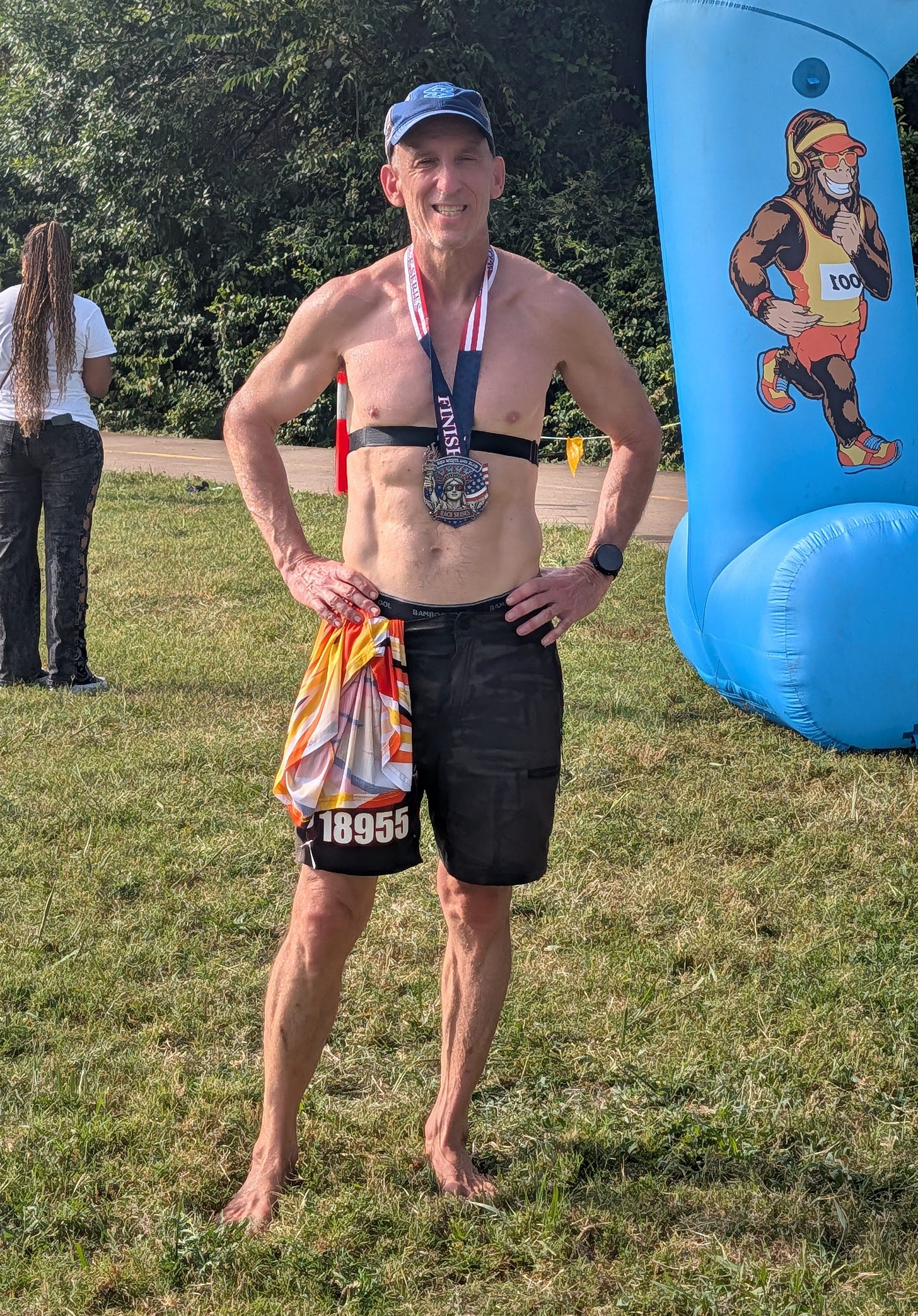
On some weekends I visited the mountains, and on others I participated in local races ranging from 5k’s to half-marathons. In some cases, my times were better than the year before, which was encouraging. But they were slower than two years back. I think that barefoot helps in the battle with age by restoring natural alignment and reducing the risk of injury. But it does not appear to defeat the aging process, nor does it stop the passage of time, unfortunately. Speaking of which, I won my age group at a 1/2 marathon in Dallas in mid-July. It was 85 F and humid, but I felt good at the start and thought I had a shot at a new PR. By the half-way point, however, I was in trouble. Indeed, to make it back, I had to take some walking breaks — now there’s nothing wrong with that — but I’d never had to do that in such a short race before. Evidently, the heat is a little tougher for me to deal with than it used to be.
Age group win, but difficult execution in Dallas summer heat
If everyone is different, then what may differentiate a visibly “quirky” personality may well be the willingness to push the envelope more aggressively when it comes to dealing with social expectations. By this point in my journey, I’d built up the “social calluses” necessary to go barefoot in coffee shops, groceries, airports, museums, and even at fancy gala’s. But I’d continued wearing shoes at work, reasoning that work is a team sport and not the place to advertise a person’s peculiar interests. In June, I started a new job, as CFO of a small technology company, and I wanted to make a good impression on colleagues in terms of financial acumen, strategic outlook, and team spirit – not surprise them with unconventional sartorial choices.
But it felt so unnecessary and depressing, after going for my morning run without shoes and then showing up barefoot at my favorite coffee shop, to pull on shoes just to walk across a parking lot into an office building.
So, I decided to experiment with a “hybrid strategy” – to enter the building barefoot, but carrying my shoes in one hand. Now, this posture was meant to call to mind the idea of someone taking a break from shoes, not necessarily breaking with convention. Like when you see women carrying high heels in one hand, after tiring of the uncomfortable work of wearing them all day. I tried out this hybrid strategy when entering the building, stepping out for a coffee break, and then meeting a former colleague for dinner, and the results were even better than I’d hoped for: one person declared she’d like to join me on a barefoot walk, another recalled running barefoot drills back when he was on the high school cross-country team, and one just said, “that’s so cool.”
In a world of conformist pressure, the difference between quirky people and those who try harder to fit in may well be a willingness to take some risk and see what we can get away with.
I’d like to get to 20,000 barefoot miles before age claims my body for the scrap heap, as that would be making a statement to the world about the physical and mental benefits of this practice. But first, let’s see about 17,000.
Chasing the Grid is available on Amazon!