Inspired by Henry David Thoreau’s essay “Autumnal Tints”, last fall I’d headed out in early September, while the mountains were still green, in search of the first red maples turning scarlet. That experience got me thinking: while we all love the fall foliage, what about winter colors? And spring?
Plateau in the Snow
Spring arrived on March 21st, and what a relief to put aside spikes and snowshoes and head to the mountains unencumbered. Rain was in the forecast, but with a new Goretex jacket and plenty of warm gear, this didn’t faze me in the least. Friday evening of March 31st saw me on the road to the Catskills for a nighttime attempt on the eastern mountains of the Devil’s Path. Continue reading “Plateau in the Snow”
Cold Snow, Warm Feet
I was supposed to join a hike in Harriman but discovered at the last minute that Odie the Labradoodle wouldn’t be welcome. It wasn’t personal: some groups have developed policies, out of respect to certain members, that limit who can accompany a group hike. So Odie and I headed north instead, for our first spring hike in the Catskills.
Notes from a hike: Nightime bushwhack of Panther and Slide
Men talk glibly enough about moonshine, as if they knew its qualities very well, and despised them; as owls might talk of sunshine.
— Henry David Thoreau, “Night and Moonlight,” 1883
- Met Alan and Amy for dinner in Phoenicia, and then the three of us proceeded to the Woodland Valley Campground. It was 8:15 and pitch black, with rain in the forecast, which at elevation might well manifest itself as heavy sleet driven by gale-force winds, and accordingly I’d warned Alan and Amy to prepare for the worst — but they are experienced hikers and were totally unfazed. After gearing up, we headed out on the trail in high spirits.
Continue reading “Notes from a hike: Nightime bushwhack of Panther and Slide”
Views of and from Peekamoose
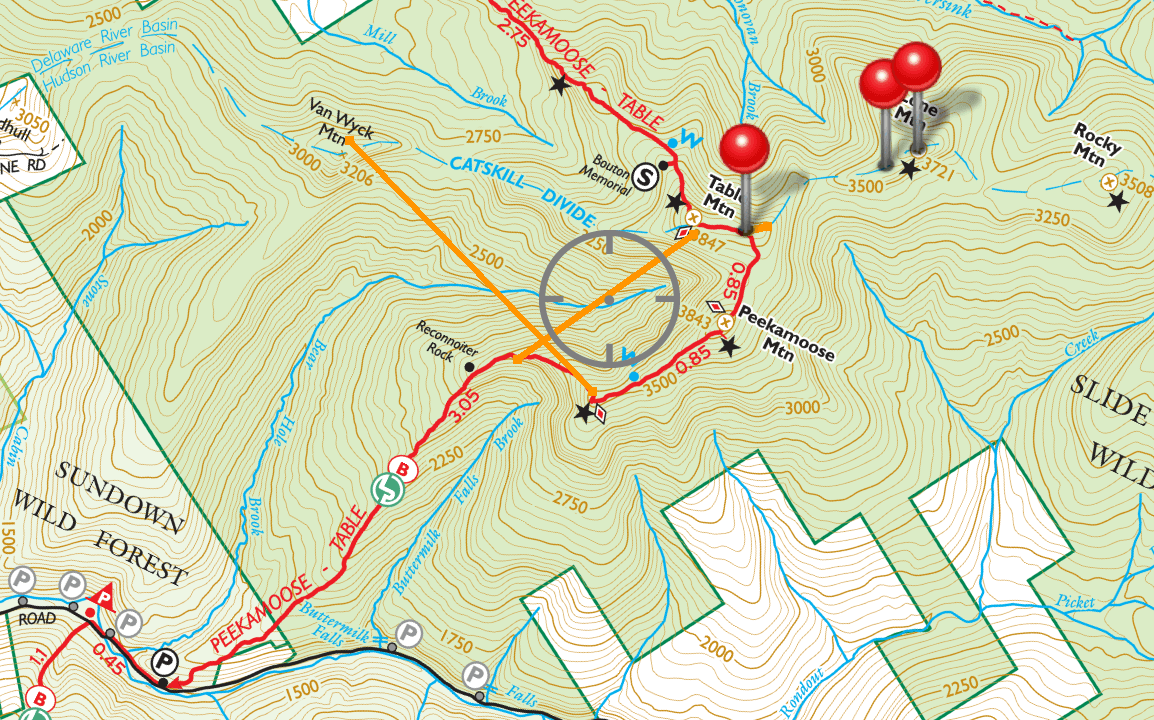
To complete the Grid requires climbing the Catskills’ thirty-five high peaks during every calendar month, and part of the purpose of this exercise is to observe new aspects of the mountains at different times of year and under different conditions. In this regard, last weekend’s trip up Peekamoose Mountain was productive: clear skies and leafless forests helped me better grasp the topography of the mountain and surrounding areas.
(Comments below refer to this screenshot taken from the NY-NJ Trail Conference Catskills map installed on my phone.)
Halcott, from a different angle
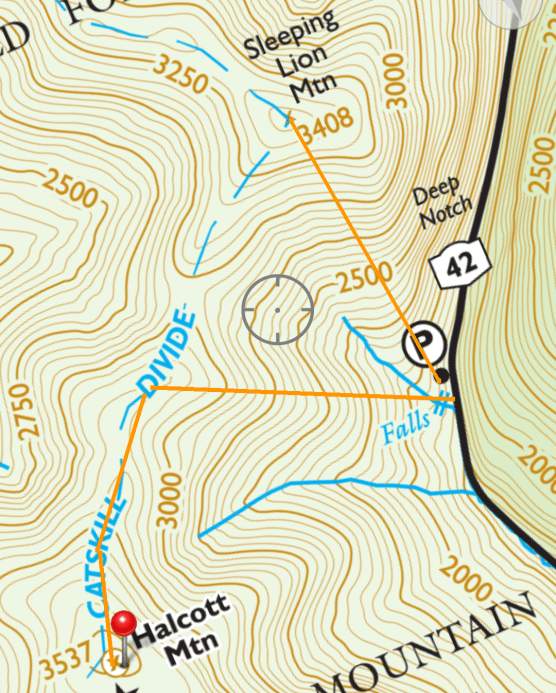
I’d climbed Halcott several times from the west, but driving along route 42 one day I noticed a small parking area on Halcott’s eastern flank, where the road cuts through a steep-walled mountain gorge. This area is labeled on the map as “Deep Notch,” and appropriately so: the mountain walls rise 1,500 feet to the summit of Halcott’s neighbor, Sleeping Lion Mountain, reaching grades in some points of 100% (equivalent to a 45-degree incline). But if you could make it up to Sleeping Lion, it occurred to me, a long, flat ridge would take you straight to Halcott. This was intriguing…
Chasing the Wind
The way the winds dash about among the Catskill Mountains’ highest peaks, it sometimes seems like each gust has a separate purpose: one tussles with a particular tree, another darts down the slopes, while others roar overhead en route to distant locations.
A couple of weeks ago the weather forecast caught my attention: a major front was moving across the region, and heavy rains were predicted. I thought of how John Muir once hiked out into the Sierra Mountains to observe a gale: “When the storm began to sound, I lost no time in pushing out into the woods to enjoy it. For on such occasions Nature has always something rare to show us….”
Accordingly, I pulled out the map and began planning a quick hike in the Blackhead Range, timed to be in and out before the brunt of the storm burst upon the scene.
The Mountains are Calling, and We Must Run
One day I stood in the Shawangunks and stared at the Catskills. It was a cold winter day, and the distant mountains seemed carved out of blue crystal and white diamond. I remember feeling a surge of adrenaline, as if I could at that moment head off and run the thirty miles from here to there, although the icy wind dissuaded me.
This experience made me think of John Muir’s famous line in an 1873 letter to his sister, “The mountains are calling, and I must go.” He used similar expressions in his account of his first summer in the Sierras, when during 1869 he accompanied a sheep herd into the mountains. For example, when he first got high enough up in the foothills to look deep into the Merced Valley, he perceived “a glorious wilderness that seemed to be calling with a thousand songful voices.” Similarly, his diary entry from July 8 of that year notes: “Many still, small voices, as well as the noon thunder, are calling, ‘Come higher.'” In fact, every aspect of the natural wilderness called to him:
How interesting everything is! Every rock, mountain, stream, plant, lake, lawn, forest, garden, bird, beast, insect seems to call and invite us to come and learn something of its history and relationship.
Continue reading “The Mountains are Calling, and We Must Run”
Finding Black Birch on the Long Brown Path
Sunday was beautiful: sunny, calm, warm (in the 50s!) — a respite from the snow, ice, gusting winds, and heavy cloud cover more typical of February in New York. A great day to be alive and outdoors.
Driving back to the city with Odie the Labradoodle, I pulled over at a trailhead on the Long Path, figuring we’d sneak in a two- or three-mile hike. The snow had largely melted, leaving only scattered patches, so I took off sandals and stepped gingerly onto the path and found it to be a manageable mix of dirt and mud that had warmed up nicely in the morning sun. Odie scampered ahead, while I sauntered along, and soon we were clambering up the lichen-crusted granite rock face that marks the summit of Long Mountain, a 1,155-foot peak in Harriman State Park. Carved into the rock is a memorial to Raymond Torrey:

Continue reading “Finding Black Birch on the Long Brown Path”
Notes from a hike
Time is short and so in lieu of writing up a narrative, here are some notes and images from a recent traverse of Graham, Balsam Lake, Hunter, East Rusk, Rusk, and SW Hunter — 27 miles that left me tired and hungry, but which contained several memorable moments, thanks to glorious February sunshine, dramatic winds, and the unavoidable adventures associated with nighttime bushwhacking.
The pleasure and value of every walk or journey we take may be doubled to us by carefully noting down the impression it makes upon us….It was not till after I got home that I really went to Maine, or to the Adirondacks, or to Canada. Out of the chaotic and nebulous impressions which these expeditions gave me, I evolved the real experience. There is hardly anything that does not become much more in the telling than in the thinking or in the feeling.
— John Burroughs
 The Long Brown Path