The other day the idea occurred to me to total up the numbers in my training log. The calculation showed that I’d recently completed my 1,000th mile barefoot. I reflected on the odyssey that had led to this unexpected milestone, and an account seemed in order.
Barefoot
Searching for the Heart of the Southern Catskills
Slide Mountain is the Catskills’ highest peak, and one I’ve climbed many times, including both summer and winter, day and night — but always following the trail from Big Indian Valley. One day I was rereading “In the Heart of the Southern Catskills,” John Burroughs’ account of his first ascent of Slide Mountain in 1885. Burroughs had long been intrigued by Slide, but he wasn’t going to take a trail. Rather, he chose the more remote Woodland Valley as his starting point and then made his way to the summit through unmarked forest. Moving off trail like this is today called “bushwhacking,” and depending on the terrain, it can be exhilarating — or extremely challenging.
I put down the essay and thought for a moment. As a member of the Catskill 3500 Club, I had climbed the 35 highest peaks in the Catskills, of which a dozen or so require bushwhacking because there is no trail. But it had never occurred to me to seek a bushwhack route when an established trail was available. Why would you do that?
Then a light bulb went off: because it would be a totally new experience.
Pulling out the map, I measured a straight shot from the Woodland Valley Campground to Slide’s summit, about 2.5 miles in distance and 2,000 feet in elevation gain. Towards the top, the grade got steep, I noticed, exceeding 40% in places.
Two weeks later, a little before 9:00 AM, I was pulling into the parking area at Woodland Valley Campground to meet my friend Alan. Our goal: to reenact Burroughs’ bushwhack ascent of 1885 …

Continue reading “Searching for the Heart of the Southern Catskills”
Hiking the SRT 1/2 Marathon Course

As race director for the SRT Run/Hike, I’m interested in encouraging participation in the event and seeing more people experience the Shawangunk Ridge Trail (SRT), which is one of my favorite trails in New York. To be fair, the full 70-mile division isn’t for everyone: not only does it require significant endurance to cover such a long distance, but also you’ve got to be mindful about navigation, nutrition, and hydration, since we don’t provide aid stations or course markings. This isn’t everyone’s cup of tea.
But the half-marathon division should be accessible to a lot of people, and with a start-time of 10:30 AM and the final cut-off at midnight, you have 13.5 hours to complete the course, which requires moving at barely a 1 MPH average pace. To demonstrate just how generous this time limit is, I chose a beautiful fall day recently to see if I could complete the 1/2 marathon course within the time limit, without food, water,* or even shoes.
As a novice barefooter, I knew the going would be slow, but I couldn’t think of a better way to spend the day than experiencing the sights, sounds, and textures of New York’s most magical trail.
Return to Peekamoose
East coast naturalist John Burroughs once wrote, “To learn something new, take the path you took yesterday.” With this thought in mind, I returned recently to Peekamoose Mountain, one of my favorites in the Catskills, and a peak whose trail I’ve taken many times. On this occasion, the plan was to survey the bushwhack from Peekamoose to Lone Mountain, so that I can improve my time when I next attempt the Catskill 35, as well as experience the sights and sounds of a beautiful late summer day.
Askeisis in the Catskills
This is a revised version of an earlier post in which I described an adventure in the Catskills undertaken in part as an experiment in “askeisis,” the ancient Greek concept of physical and spiritual training. The revised version was published Saturday in Stoicism Today, a blog sponsored by University of Exeter on the topic of ancient Greek and Roman Stoic philosophy applied to modern living.
To read the post, click here:

Stepping Through Spring Flowers on Sherrill Mountain
Last Saturday, I climbed Sherrill Mountain, the final peak in my quest to complete all 35 of the Catskills’ highest mountains barefoot. It was also one of the most difficult, with briars, nettles, and steep slopes cloaked in dense thickets. But discovering new spring flowers made up for some of the strain.
After parking on Spruceton Road, the first challenge was crossing an open field with lumpy grass hummocks interspersed with briars. Then it was into the forest, where the briars gave way to the spring’s first growth of stinging nettles. I was wearing sensible long pants, but as for the feet, there was nothing to do but step thoughtfully.
I steered to the right of a little stream and began to climb straight uphill until eventually the nettles were left behind and I emerged into a grove of hemlocks. The last time I’d climbed Sherrill, I’d learned an important lesson, that it’s much better to turn and head up along top of a ridge, even if it means a little longer distance than following a straight line to the summit. On the prior visit, I’d stuck to the azimuth until I found myself cutting laterally across the face of a steep slope, where the slanted footing was slow and treacherous. I vowed not to make that mistake again.
Now I glanced at the map on my phone and realized that in my haste to head uphill, I had turned too early and was climbing the wrong ridge. To get back on course, I’d have to cut laterally across the face of a steep slope until I rejoined and then crossed that little stream. In my effort to avoid the mistake I made last time, I’d ended up making the same mistake.
After patiently picking my way along the slope, I hopped across the stream and headed up slope, now back on track. This was a difficult climb, as the slope was not only steep, but also carpeted with an extremely dense thicket of young beech and birch saplings, with plenty of hobble-bush thrown in for extra vexation. The only explanation for such thick young growth was that the hillside had burned in recent years, and it did seem that here and there a charred stump or log was visible poking up through leaves.

After a long time, I made it onto the ridge and turned left to head towards the summit. I reached a clearing and saw the summit up ahead after a short rise. But after climbing the rise, I saw higher ground further on. Along the way, I noticed familiar wild flowers, including Purple and Painted Trilliums, as well as unfamiliar species. Looking down, I saw a strange-looking plant with tiny white flowers shaped like pantaloons — but I didn’t have time to stop and examine it. Instead, I kept moving until I reached another clearing on a shoulder of the mountain, but upon checking the map, there was still one last rise in front of me.
I did eventually reach the summit and signed in at the canister. The trip had taken 2.5 miles, which was about double what I’d estimated from a quick glance at the map before heading out. That plus almost 2,000 feet in elevation gain made Sherrill one of the more difficult bushwhacks I’ve completed, with or without shoes.
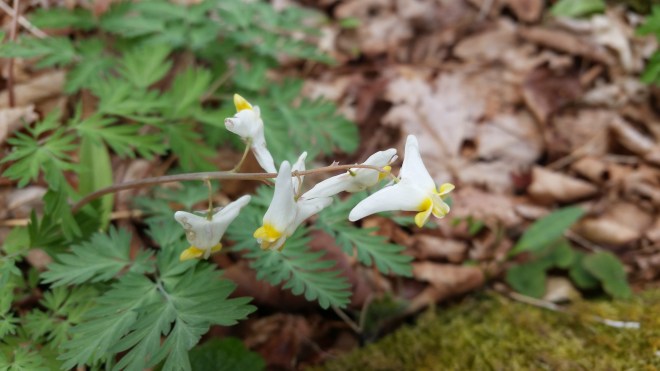
The return trip took almost as long, even with sandals, but with the mission complete, I took the time to photograph some of the spring flowers. Crossing the open field, with the car finally in sight, I snagged a toe on a briar, necessitating a band-aid. No major harm done, although sensible people will likely continue to prefer shoes when bushwhacking in the Catskills. Upon returning home, I submitted a inquiry to the Catskill 3500 club, asking if they would award a certificate for completing all 35 of the highest peaks barefoot, but have yet to hear a response.
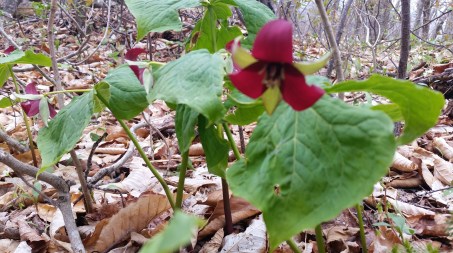
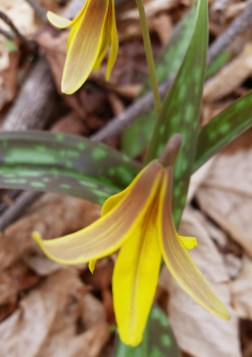


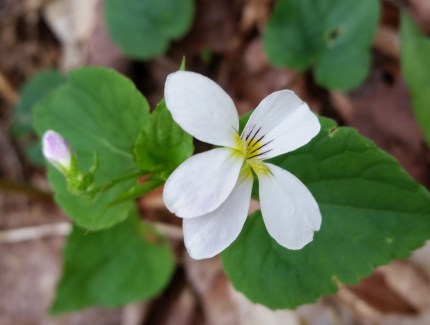

Three More Peaks and Signs of Spring
Following an unsuccessful attempt on the Catskills 9, I returned two weeks later to bag the three peaks I had missed, namely Slide, Cornell, and Wittenberg. It was six miles barefoot over steep and rocky trails, and then six miles return in Luna sandals, but a relatively uneventful journey without physical or mental drama. It was also a chance to appreciate the mountains, make new discoveries, and enjoy the signs of spring.

Bringing “Askeisis” to the Catskills 9
(Note: a revised version of this post has been published in the blog Stocism Today)
Saturday evening after dinner I drove out to the Catskills to make another attempt on the “Nine,” a 19-mile circuit that crosses nine mountain peaks, with the special distinction that five of the peaks are accessed off trail, that is by bushwhacking through the forest. I’d run the Nine twice before during the day and once at night and also bagged eight of the nine during the winter. But this time I’d be going without shoes, part of a quixotic quest to climb all 35 of the Catskills’ highest peaks barefoot.
Madness perhaps, but not without method. Ancient Greek philosophers advocated the practice of “askeisis,” which means “rigorous training.” Especially favored were practices that entailed endurance, resistance to the elements, or going without food and water. Askeisis is the root of the modern word “asceticism,” and while the Greek concept was not associated with a lifestyle of self-denial, it was thought that rigorous training would lead to both athletic and spiritual development. The ultimate goal was to achieve the states of “ataraxia” (tranquility, serenity, freedom from worry) and “apatheia” (equanimity, composure, freedom from unruly passions).
As a runner, I’m often looking for a chance to add some askeisis into my adventures, recognizing that my spiritual development needs all the help it can get. On this trip I’d carry no food or water, and with the weather forecast calling for a low of 36 F, sleeping outside in the cold sounded like another fun option (John Muir used to go for days in the Sierras during chilly fall weather, without bringing blanket or coat). After further thought, I grabbed a light sleeping bag and tossed it in the pack.
Burroughs on Barefoot
If you don’t know the man, John Burroughs was America’s most popular nature writer in the late 19th and early 20th century. The other day I was flipping through one of his early essays and came across this commentary:
Occasionally on the sidewalk, amid the dapper, swiftly moving, high-heeled boots and gaiters, I catch a glimpse of the naked human foot. Nimbly it scuffs along, the toes spread, the sides flatten, the heel protrudes; it grasps the curbing, or bends to the form of the uneven surfaces,—a thing sensuous and alive, that seems to take cognizance of whatever it touches or passes. How primitive and uncivil it looks in such company,—a real barbarian in the parlor! We are so unused to the human anatomy, to simple, unadorned nature, that it looks a little repulsive; but it is beautiful for all that.
— John Burroughs, Winter Sunshine
Seven Miles to Doubletop
Spring had arrived early, it was quiet at work, and so I made plans to take Friday off and head to the Catskills, with the goal of bagging two or maybe three more mountains in my quest to hike all thirty-five of the highest peaks barefoot. The forecast called for temperatures in the 50s, reports indicated that all the ice was gone, and the 90% chance of rain seemed only a minor consideration. How could a person not want to be in the woods on a day like this? And what about a dog? Feeling in good spirits Friday morning, I hopped out of bed, gave a shout for Odie the Labradoodle — and off we went, arriving in due course at the Seager trailhead deep in the western Catskills.
 The Long Brown Path