Last weekend, the weather was unseasonably warm for mid-March, with afternoon temperatures in the 60s. It was a great day to wander through the Catskills adding additional peaks to the list of completions. Rounding a bend on the trail between Balsam Lake and Graham mountains, I glanced to the right and spotted a marvelous moss tumbling down the side of an embankment, a cascade of silver feathery fronds.
I rolled across the finish line in 3:57, precisely in line with the modest goal of breaking four hours. The year before, my time was just over four hours, as best I could recall, and I distinctly remembered a deep sense of frustration as I struggled to stay on pace. It was nice to see some improvement — especially after a string of races in recent months with disappointing times.
Caumsett is a 50k (31-mile) race that takes place along a 3.1-mile loop in Caumsett State Park on Long Island’s northern shore. It’s a pretty course on a paved path through woods and fields, and the day was sunny, calm, and cool — beautiful conditions for racing. Except for a blister, I had felt good throughout the run, managing to complete it with no fluids or calories. Waiting for the final results, I thought I had a shot at #3 in my age group.
So I was a little surprised when a friend asked, what went wrong?
The Stoic philosopher and Roman emperor Marcus Aurelius once wrote,
It is in your power, whenever you choose, to retire into yourself. For nowhere either with more quiet or more freedom from trouble does a man retire than into his own soul
— Marcus Aurelius, Meditations
This advice reminds me of one of the messages in the Bhagavad Gita, a two-thousand year-old Hindu text:
Wherever the mind wanders, restless and diffuse in its search for satisfaction without, lead it within, train it to rest in the Self. Abiding joy comes to those who still the mind.
— Vishnu, Bhagavad Gita
I’ve been trying to put this advice into practice. Walking down the street in the face of an icy winter wind, I make an effort to relax. Instead of fretting at subway delays, I imagine shifting my brain into neutral gear.
The other day, arriving at a restaurant a few minutes before my wife, I took a deep breath and put away my phone…
I recently stumbled across a blog post from April 2015 in which NY Times writer Gretchen Reynolds was discussing the “right dose” of exercise to increase longevity. Her article was based on two new “impressively large-scale” studies that she thought would provide “clarity” on the topic.
It’s a principal of toxicology that “the dose makes the poison.” In other words, drugs that are beneficial in small does may be toxic if you take more than the prescribed amount. For many people, exercise might as well be a toxic chemical: they want to know what is the minimum dosenecessary to stay healthy. Even better if they could take a pill and not have to break a sweat.
Exercise?
My attitude is different. It seems sad to me that a natural activity like exercise would be “dosed” like a pharmaceutical. And in any case, I’m skeptical about scientists who claim they can measure such things.
My faith in humanity was restored, however, when I read the post’s top-ranked comments: readers had raised interesting questions about the studies’ logic, disputed the purpose of the article, and taken Reynolds to task for naivete.
In fact, after reflecting on the comments, I’ve concluded that the “right dose” of exercise is the maximum amount possible…
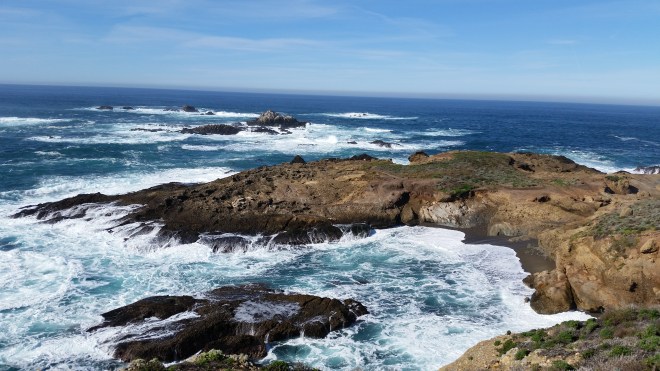
I recently returned to Fort Ord for the first time in 30 years to participate in a trail race and arriving a day early, headed out for Point Lobos State Natural Reserve, which is located just south of Monterey along the northern California coast. It’s one of the most beautiful spots I’ve ever encountered.
A few weeks ago, I learned to my surprise that a trail race was going to take place at Fort Ord, California . It would be almost exactly thirty years from the day in 1986 when I reported for duty as a young officer with the 7th Infantry Division (light). Upon arrival at Fort Ord, I had briefly marveled at the coastal mountains of northern California and then quickly found myself crossing the beautiful, rugged terrain in runs, on road marches, and during tactical movements, learning a great deal about discipline and physical endurance as a member of the 7th infantry “light fighters.”
A lot had changed in thirty years. After a brief stint in the army, I had moved on to a career in finance. Meanwhile, the Army had deactivated the 7th Infantry Division, and Fort Ord had been transformed into a national park.
I couldn’t resist. In due course, I was registered for The Ordnance 100-kilometer (61-mile) trail race, organized by Inside Trail. It would be a chance to experience once again Fort Ord’s rocky canyons, emerald hills, and sandy trails, as well as reflect on the idea of “going light,” not only as a soldier, but now as a runner.
In his prime, John Burroughs (1837-1921) was one of the most popular writers in America, with a huge following of readers and relationships with the likes of Theodore Roosevelt, Henry Ford, Thomas Edison, and railroad tycoon E. F. Harriman. His passion was the birds, forests, rivers, and mountains of his native Catskills, and his writings reveal a scientist’s powers of observation and a nature-lover’s emotional connection to the land. In 1919, at age 82 he appeared in a short film, shown leading a trio of young children around his Catskill farm. He points out butterfly, chipmunk, grasshopper, and then the following words appear on the screen:
I am an old man now and have come to the summit of my years. But in my heart is the joy of youth for I have learned that the essentials of life are near at hand and happiness is his who but opens his eyes to the beauty which lies before him.
Today, these words are remembered by a dedicated group of Burroughs enthusiasts. But despite his enormous popularity, his hasn’t become a household name like other American naturalists such as Henry David Thoreau or John Muir. I wondered, why?
A recent post on New York Magazine’s website gushed about ultra-marathoners who run in a state of “flow,” a term coined by psychologist Mihaly Csikszentmihalyi to describe the experience of people who are focused, productive, and happy. According to the author, even casual runners recognize flow as “getting in the zone, cranking out your best stuff, and just being awesomely lost in a creative process.” Endorphin-induced feelings of accomplishment, focus, and strength produce in the runner a “near-spiritual feeling of Zen and nirvana,” the author asserts. The premise seems simple: run, experience flow, and you’ll become happier and more productive.
But if you read Csikszentmihalyi’s work, you’ll find it’s not that easy.
Genuinely happy individuals are few and far between.
— Mihaly Csikszentmihalyi, Flow: The Psychology of Optimal Experience
Mihaly Csikszentmihalyi. Source: Association for Psychological Science
As someone who enjoys running in the mountains, I find myself drawn to Henry David Thoreau’s vision of nature and wildness. But when you follow in Thoreau’s path, you discover that his admirers include not only outdoors enthusiasts, but also people with more extreme views. Consider the philosopher and writer John Zerzan, a self-proclaimed anarchist and primitivist, who criticizes industrial mass society as inherently oppressive and warns us that technology is leading humanity into an increasingly alienated existence, at the same time that it threatens to destroy the natural environment. To be sure, the anarcho-primitivist movement counts few members, but does that mean it’s safe to ignore Zerzan and his warning?
Portrait of John Zerzan by Bata Nesah, Belgrade, 2013
After slipping and sliding on microspikes that didn’t have spikes, I got a pair of the real thing from Catskill Mountain Storehouse and took them out for a 10-mile spin in the Blackhead Range. The reward for the effort was amazing views in all directions, with recognizable landmarks 20, 30 and perhaps even 90 miles away.





 The Long Brown Path