Discovering the Grid

Low hills flank the Thru-way, and through the car window you see mostly trees.  On the drive up this morning, the sky is clear, and the sun’s rays are pouring down with such intensity that every detail of the passing trees stands out:  stout trunks spattered with lichen and tangled with vines, leafless branches reaching, twisting, interweaving.  The clarity is astonishing:  it’s like a geometric pattern, brightly-lit but bewildering.

However, there’s a spot just north of New Paltz where the road dips and the hills pull back, and for a moment a vista of the Catskill Mountains is revealed.  This morning they appear huge and rounded, a soft mottled mix of brown and tan, flanks dappled with blue cloud shadows.  The detail has seemingly melted away with distance, and the mountain plateau looks like some kind of lost world – but the vision is divulged for only an instant before the road rises back into the hills again.

Of course, closer to the mountains more details emerge; the ridge tops resolve into jagged lines of spruce and fir tinged white.  I arrive at the Devil’s Tombstone Campground full of enthusiasm, imagining all the peaks I could climb today, but on opening the car door, feeling the cool air, and staring down at the ice sheet that covers the parking lot, some reality seeps back in.  Also, with a few aches and pains to be mindful of, maybe it’d be smarter to take it easy.

Continue reading “Discovering the Grid”

Discovering the Grid

The Barefoot Sisters

In the late spring of 2000, Lucy and Susan Letcher summitted Maine’s Mt. Ktaadin and then began a southward trek along the Appalachian National Scenic Trail.  Adopting the trail names “Isis” and “jackrabbit,” they hiked through the summer, fall, and winter, reaching Georgia’s Mt. Springer the next spring, and then turned around and hiked back to Ktaadin, completing what’s called a “yo-yo” (a double-traverse of the AT).  Their story is chronicled in a two-volume book set entitled “Southbound” and “Walking Home,” which I recently read and enjoyed immensely.

What was somewhat different about their experience, and the reason of course they’re called “the barefoot sisters,” is that they completed most of the hike without shoes, and this gives their story an extra dimension from other AT narratives.  Barefoot hiking is a relatively unusual activity, although it’s not completely unheard of:  noticing their lack of footwear a Baxter State Park ranger commented, “There are a few that do that. I don’t know how. Well, if it works for you, more power to you.”

barefoot-sisters
Isis and jackrabbit.  Credit:  Barefoot Hikers of PA

Continue reading “The Barefoot Sisters”

The Barefoot Sisters

Light and Ice in Minnewaska

John Burroughs once wrote that to be an observer is to “find what you are not looking for.”  With this thought in mind, I set off for a trail run in Minnewaska State Park Preserve a couple of weekends ago, with no particular goal but to cover some ground and open my eyes.  Perhaps I’d observe something that I wouldn’t have even thought of looking for.

Continue reading “Light and Ice in Minnewaska”

Light and Ice in Minnewaska

Crows

(I was reading one of John Burroughs’ essays, and his description of the American Crow caught my eye, and made me think of my friend Tom Bushey, who loves to photograph them.  Thank you, Tom, for letting me post some of those images here.)

Hardy, happy outlaws, the crows, how I love them! Alert, social, republican, always able to look out for himself, not afraid of the cold and the snow, fishing when flesh is scarce, and stealing when other resources fail, the crow is a character I would not willingly miss from the landscape. I love to see his track in the snow or the mud, and his graceful pedestrianism about the brown fields. He is no interloper, but has the air and manner of being thoroughly at home, and in rightful possession of the land. He is no sentimentalist like some of the plaining, disconsolate song-birds, but apparently is always in good health and good spirits. No matter who is sick, or dejected, or unsatisfied, or what the weather is, or what the price of corn, the crow is well and finds life sweet. He is the dusky embodiment of worldly wisdom and prudence. Then he is one of Nature’s self-appointed constables and greatly magnifies his office. He would fain arrest every hawk or owl or grimalkin that ventures abroad. I have known a posse of them to beset the fox and cry “Thief!” till Reynard hid himself for shame.

— John Burroughs “Winter Sunshine,” 1875


tb-crows-1
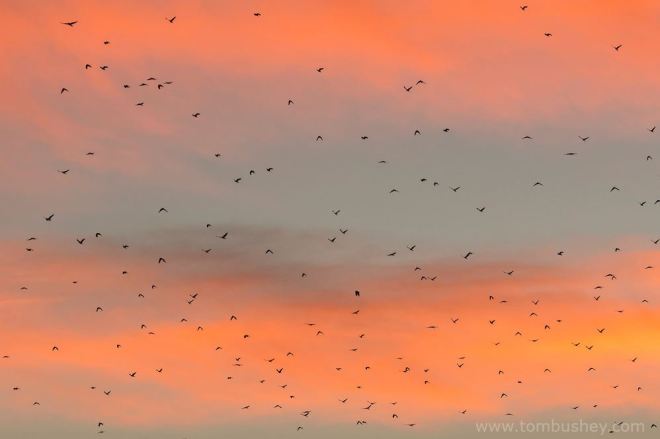
Middletown, NY – Crows fly in front of clouds at sunset Nov. 18, 2016.  Tom Bushey Photography


tb-crows-2
Crows gather in tree branches at sunset, Middletown, NY, November 12, 2016.  Tom Bushey Photography


tb-crows-3
Crows gather in tree branches with the crescent moon in the background, Middletown, NY, November 3, 2016.  Tom Bushey Photography

Note:  during fall and winter months, crows roost together in the thousands, and even in some rare instances, in the millions.  They begin gathering together in late afternoon in  a location separate from the roost, then as darkness falls, they move to the location where they’ll spend the night.  Experts think this is a behavior that helps them defend against their primary predator, the Great Horned Owl, and possibly, too, a strategy for sharing information about food sources.

Visit Tom’s gallery of American Crow images


Crows

Searching for the Heart of the Southern Catskills

Slide Mountain is the Catskills’ highest peak, and one I’ve climbed many times, including both summer and winter, day and night — but always following the trail from Big Indian Valley.  One day I was rereading “In the Heart of the Southern Catskills,” John Burroughs’ account of his first ascent of Slide Mountain in 1885.  Burroughs had long been intrigued by Slide, but he wasn’t going to take a trail.  Rather, he chose the more remote Woodland Valley as his starting point and then made his way to the summit through unmarked forest.  Moving off trail like this is today called “bushwhacking,” and depending on the terrain, it can be exhilarating — or extremely challenging.

I put down the essay and thought for a moment.  As a member of the Catskill 3500 Club, I had climbed the 35 highest peaks in the Catskills, of which a dozen or so require bushwhacking because there is no trail.  But it had never occurred to me to seek a bushwhack route when an established trail was available.  Why would you do that?

Then a light bulb went off:  because it would be a totally new experience.

Pulling out the map, I measured a straight shot from the Woodland Valley Campground to Slide’s summit, about 2.5 miles in distance and 2,000 feet in elevation gain.  Towards the top, the grade got steep, I noticed, exceeding 40% in places.

Two weeks later, a little before 9:00 AM, I was pulling into the parking area at Woodland Valley Campground to meet my friend Alan.  Our goal:  to reenact Burroughs’ bushwhack ascent of 1885 …

slide-map
Orange line indicates proposed bushwhack route

Continue reading “Searching for the Heart of the Southern Catskills”

Searching for the Heart of the Southern Catskills

My Autumnal Tints

I picked up a beech leaf and examined it:  the leaf was pale yellow in the center and dark brown around the edges.  I knew that soon these leaves would carpet the forest floor in layers of beige, but for now, the forest was sparkling in the late October sunlight, and the beech trees glowed like gold.

The scene brought to mind Henry David Thoreau’s 1860 essay “Autumnal Tints,” in which he wrote, “There is just as much beauty visible to us in the landscape as we are prepared to appreciate.”  He meant that by diligent study of nature we learn to appreciate its beauty.  He summed up the essay by encouraging readers to pay attention to nature:

When you come to observe faithfully the changes of each humblest plant, you find that each has, sooner or later, its peculiar autumnal tint; and if you undertake to make a complete list of the bright tints, it will be nearly as long as a catalogue of the plants in your vicinity.

— Henry David Thoreau, “Autumnal Tints”

And so, this fall, I tried to do as Thoreau suggested, that is, as I hiked, ran, and drove through the eye-shocking autumnal displays in upstate New York’s Shawangunk and Catskill mountains, I tried to  “observe faithfully.” Here is my list of the brightest tints….

Continue reading “My Autumnal Tints”

My Autumnal Tints

Long Path Race Series: Announcing the 2016 Disciples of the Long Brown Path

We are pleased to announce the winners of the 2016Long Path Race Series! We call these winners Disciples in a nod to Raymond Torrey, Trail Conference founder and promoter of both the Appalachian Trail and the Long Path, whose memorial plaque on Long Mountain remembers him as a “Great Disciple of the Long Brown Path.”  The idea is that people who are humble enough to learn from nature can do great things.

Torrey_Memorial_Plaque.jpg
Memorial Plaque on Long Mountain

Continue reading “Long Path Race Series: Announcing the 2016 Disciples of the Long Brown Path”

Long Path Race Series: Announcing the 2016 Disciples of the Long Brown Path

What’s a Totoro?

The acclaimed Japanese animated filmmaker Hayao Miyazaki’s 1988 classic My Neighbor Totoro tells the story of two young sisters who encounter friendly forest spirits in postwar rural Japan.  The film has won numerous awards, and the Totoro has been ranked among the most popular animated characters.

There are many reasons for the film’s success, including the carefully crafted animation, the endearing portrayal of the two sisters, the lush watercolor backgrounds, and the pastoral simplicity of the setting.  After watching the movie recently, I asked myself, what is a Totoro?  And what was Miyazaki’s purpose in creating this movie?

Continue reading “What’s a Totoro?”

What’s a Totoro?

Hiking the SRT 1/2 Marathon Course

20161009_085022
SRT 1/2 Marathon Start

As race director for the SRT Run/Hike, I’m interested in encouraging participation in the event and seeing more people experience the Shawangunk Ridge Trail (SRT), which is one of my favorite trails in New York.  To be fair, the full 70-mile division isn’t for everyone:  not only does it require significant endurance to cover such a long distance, but also you’ve got to be mindful about navigation, nutrition, and hydration, since we don’t provide aid stations or course markings.  This isn’t everyone’s cup of tea.

But the half-marathon division should be accessible to a lot of people, and with a start-time of 10:30 AM and the final cut-off at midnight, you have 13.5 hours to complete the course, which requires moving at barely a 1 MPH average pace.  To demonstrate just how generous this time limit is, I chose a beautiful fall day recently to see if I could complete the 1/2 marathon course within the time limit, without food, water,* or even shoes.

As a novice barefooter, I knew the going would be slow, but I couldn’t think of a better way to spend the day than experiencing the sights, sounds, and textures of New York’s most magical trail.

Continue reading “Hiking the SRT 1/2 Marathon Course”

Hiking the SRT 1/2 Marathon Course