Burroughs on “Observing”

The east coast naturalist John Burroughs was a passionate observer of the forests, animals, and especially the birds of his native Catskill Mountains.  He wrote unabashedly, “I find I see, almost without effort, nearly every bird within sight in the field or wood I pass through (a flit of the wing, a flirt of the tail are enough, though the flickering leaves do all conspire to hide them).”

This was no idle boast.  Theodore Roosevelt, himself a great birder, acknowledged Burroughs’ mastery in his 1905 book, Outdoor Pastimes of an American Hunter, where he wrote that “No bird escaped John Burroughs’ eye; no bird note escaped his ear.”

As a Burroughs fan and someone trying to improve his own skills, I was thrilled to discover recently that the master had left behind some advice on the art of observation.  Several of his essays contain how-to tips, including “The Art of Seeing Things,” “Sharp Eyes” and The Gospel of Nature, which I’ve tried to summarize in this blog post.

But first a few words of caution, in the form of a caveat Burroughs offered his readers:  “I have as little hope of being able to tell the reader how to see things as I would have in trying to tell him how to fall in love or to enjoy his dinner. Either he does or he does not, and that is about all there is of it. Some people seem born with eyes in their heads, and others with buttons or painted marbles.”

Continue reading “Burroughs on “Observing””

Burroughs on “Observing”

First-ever Winter Bushwhacks

On the drive up to the Catskills, the early morning clouds were tinged with red, and then as the road snaked higher into the mountains, a burning eyeball appeared in the rear view mirror, a circle of fire smoldering between mountain ridge and lowering sky; it was like someone had opened a furnace door.  But on reaching the trailhead, all was gray again, and snowflakes were twirling in the air.

A few minutes later, my friend Amy arrived.  Her friend Serguey was supposed to meet us, too, but he was running late and had texted her not to wait, so the two of us set off.  My weekend goal was to bag six peaks, four of them off trail, and these would be first-ever winter bushwhacks for both Amy and me…

[Author’s note:  after writing this blog post, I recalled that my first ever winter bushwhack was almost a year earlier, when some friends and I attempted to complete the Nine.]

Continue reading “First-ever Winter Bushwhacks”

First-ever Winter Bushwhacks

Finding Energy in the Dark

Driving north on the Thruway, I peered through the windshield, seeking a glimpse of the Catskill Mountains, curious how their appearance today would compare to past trips.  But a layer of clouds had spread across the sky and blocked the sun, and when the mountains’ southern escarpment finally came into view, it was just a dark gray wall beneath a gray horizon.  A dim and gloomy scene, with little contrast or detail, lacking energy, listless.  My heart sank.  Gone was the dazzling light I’d experienced in late December, when a fresh cover of snow and rime ice flashed brilliantly under clear skies.  Today it seemed better to sit by the fire, drink coffee, read a book — yet I was determined to climb several mountains this weekend, even if it was pitch black:  surely there would be something to see and feel. Continue reading “Finding Energy in the Dark”

Finding Energy in the Dark

Sights and Sounds of Winter

Henry David Thoreau, transcendentalist philosopher and author of Walden, wrote an essay on the colors of fall foliage.  But what about the colors of winter?  With this question in mind, I set the alarm for 5:30 AM and went to bed early.  Tomorrow’s agenda would be to climb four of the Catskill high peaks with the goal of making progress toward the Catskill 3500 Club winter patch, as well as the Grid.  And perhaps I’d see or learn something along the way that would help me better appreciate the winter mountain landscape.

Continue reading “Sights and Sounds of Winter”

Sights and Sounds of Winter

Discovering the Grid

Low hills flank the Thru-way, and through the car window you see mostly trees.  On the drive up this morning, the sky is clear, and the sun’s rays are pouring down with such intensity that every detail of the passing trees stands out:  stout trunks spattered with lichen and tangled with vines, leafless branches reaching, twisting, interweaving.  The clarity is astonishing:  it’s like a geometric pattern, brightly-lit but bewildering.

However, there’s a spot just north of New Paltz where the road dips and the hills pull back, and for a moment a vista of the Catskill Mountains is revealed.  This morning they appear huge and rounded, a soft mottled mix of brown and tan, flanks dappled with blue cloud shadows.  The detail has seemingly melted away with distance, and the mountain plateau looks like some kind of lost world – but the vision is divulged for only an instant before the road rises back into the hills again.

Of course, closer to the mountains more details emerge; the ridge tops resolve into jagged lines of spruce and fir tinged white.  I arrive at the Devil’s Tombstone Campground full of enthusiasm, imagining all the peaks I could climb today, but on opening the car door, feeling the cool air, and staring down at the ice sheet that covers the parking lot, some reality seeps back in.  Also, with a few aches and pains to be mindful of, maybe it’d be smarter to take it easy.

Continue reading “Discovering the Grid”

Discovering the Grid

The Barefoot Sisters

In the late spring of 2000, Lucy and Susan Letcher summitted Maine’s Mt. Ktaadin and then began a southward trek along the Appalachian National Scenic Trail.  Adopting the trail names “Isis” and “jackrabbit,” they hiked through the summer, fall, and winter, reaching Georgia’s Mt. Springer the next spring, and then turned around and hiked back to Ktaadin, completing what’s called a “yo-yo” (a double-traverse of the AT).  Their story is chronicled in a two-volume book set entitled “Southbound” and “Walking Home,” which I recently read and enjoyed immensely.

What was somewhat different about their experience, and the reason of course they’re called “the barefoot sisters,” is that they completed most of the hike without shoes, and this gives their story an extra dimension from other AT narratives.  Barefoot hiking is a relatively unusual activity, although it’s not completely unheard of:  noticing their lack of footwear a Baxter State Park ranger commented, “There are a few that do that. I don’t know how. Well, if it works for you, more power to you.”

barefoot-sisters
Isis and jackrabbit.  Credit:  Barefoot Hikers of PA

Continue reading “The Barefoot Sisters”

The Barefoot Sisters

Light and Ice in Minnewaska

John Burroughs once wrote that to be an observer is to “find what you are not looking for.”  With this thought in mind, I set off for a trail run in Minnewaska State Park Preserve a couple of weekends ago, with no particular goal but to cover some ground and open my eyes.  Perhaps I’d observe something that I wouldn’t have even thought of looking for.

Continue reading “Light and Ice in Minnewaska”

Light and Ice in Minnewaska

Crows

(I was reading one of John Burroughs’ essays, and his description of the American Crow caught my eye, and made me think of my friend Tom Bushey, who loves to photograph them.  Thank you, Tom, for letting me post some of those images here.)

Hardy, happy outlaws, the crows, how I love them! Alert, social, republican, always able to look out for himself, not afraid of the cold and the snow, fishing when flesh is scarce, and stealing when other resources fail, the crow is a character I would not willingly miss from the landscape. I love to see his track in the snow or the mud, and his graceful pedestrianism about the brown fields. He is no interloper, but has the air and manner of being thoroughly at home, and in rightful possession of the land. He is no sentimentalist like some of the plaining, disconsolate song-birds, but apparently is always in good health and good spirits. No matter who is sick, or dejected, or unsatisfied, or what the weather is, or what the price of corn, the crow is well and finds life sweet. He is the dusky embodiment of worldly wisdom and prudence. Then he is one of Nature’s self-appointed constables and greatly magnifies his office. He would fain arrest every hawk or owl or grimalkin that ventures abroad. I have known a posse of them to beset the fox and cry “Thief!” till Reynard hid himself for shame.

— John Burroughs “Winter Sunshine,” 1875


tb-crows-1
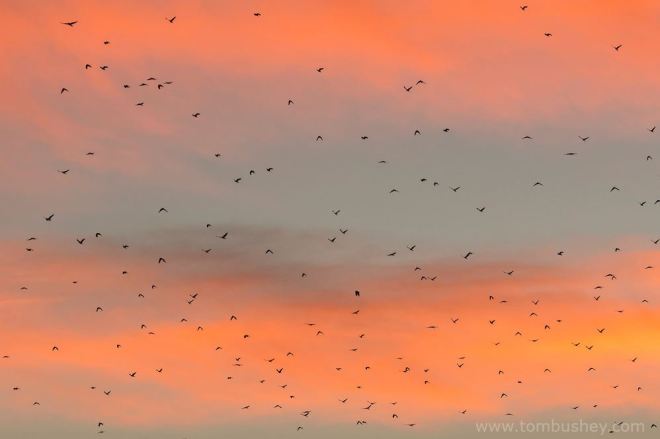
Middletown, NY – Crows fly in front of clouds at sunset Nov. 18, 2016.  Tom Bushey Photography


tb-crows-2
Crows gather in tree branches at sunset, Middletown, NY, November 12, 2016.  Tom Bushey Photography


tb-crows-3
Crows gather in tree branches with the crescent moon in the background, Middletown, NY, November 3, 2016.  Tom Bushey Photography

Note:  during fall and winter months, crows roost together in the thousands, and even in some rare instances, in the millions.  They begin gathering together in late afternoon in  a location separate from the roost, then as darkness falls, they move to the location where they’ll spend the night.  Experts think this is a behavior that helps them defend against their primary predator, the Great Horned Owl, and possibly, too, a strategy for sharing information about food sources.

Visit Tom’s gallery of American Crow images


Crows