A few years back I was working on a project – a peak-bagging exercise in New York’s Catskill Mountains that comprised almost 2,000 miles of hiking and running and more than 500,000 feet of climbing. I’d started this task with a conventional runner’s obsession over speed, but gradually came to think of it as a pilgrimage. Although it took place mostly on weekends, spread out over several years, rather than as an extended absence from work and family and the other day-to-day activities that we associate with a productive life and progress.
A few weeks ago I was reminiscing about the project, when a story came to mind about a young Winston Churchill (then 25 years old) and how he woke up suddenly to the fact that he was riding on a train — and needed to get off. It was night. He crawled onto one of the couplings between the cars and sprang off.
I’d read the story many years ago, but now it surfaced in my thoughts as if to illustrate the rationale for my peak-bagging quest –the simple idea that sometimes you’ve got to make a sudden change. Go in a different direction. Recognize what Walt Witman wrote — that perhaps you have been on a path since you were born and did not know – but sometimes the path contains a fork. Better not to miss that. Because the direction of our lives represents not merely our personal quest and agency, but the weight of so many opinions on what we should do and who we should be – the weight of church and state – the pressure of the priestly class which discourages independent thinking, and that of the police and the military who may be called upon to suppress it – the press of media and fashionable opinions and the arguments of family, friends, neighbors, and strangers on the street, who these days are probably raging and venting on social media.
Look, everyone has ideas about the right way forward. But sometimes they’re wrong.
We all want to believe we are on the train to a better place. Call it the train of progress. Which is a great metaphor when you think of how the expansion of the railroads during the 19th century linked far-flung places for the first time, facilitated trade of goods, movement of people, the spread of ideas. Railroads represented the start of the network economy, which previously was limited to wagon trails, natural waterways, and a few canals. We want to ride the train — to the glorious future we believe in so desperately — to the better lifestyle we hope our kids will enjoy.
But here’s the problem. It’s not like there is one single train. There’s a myriad of them. Going all different ways. Departing throughout the day and night. When was the last time you visited Grand Central?
Trains can take you to bad places. During the Second World War, trains transported troops to the front lines and the horrors of modern combat. Trains took people to the death camps.
You don’t want to be on the wrong train.
In his memoirs Churchill wrote about the Boer War, which he covered as a war correspondent for the Morning Post. He recalled the armored train that would take him to his first battlefield adventure. “Nothing looks more formidable and impressive than an armoured train; but nothing is in fact more vulnerable and helpless.” It takes only the destruction of a culvert, he observed, to leave the “monster” stranded and at the mercy of the enemy.
In 2016, I was starting to feel vulnerable. I was a conventional office worker, getting a little bored and frustrated with the endless calculations that comprised my work and the sterile indoors environment where I passed the time. I’d gotten into running for the intensity and thrill. Took on more and more races as I became passionate about the sport. Attempted a 135-mile course through the Catskill Mountains, determined to set a record. But I couldn’t finish it. Then I got injured. No doubt this resulted from the combination of fatigue and the aging process, as I was no longer young. Then I got injured again. Suddenly my running career was in doubt. I realized with a sinking heart that I was at risk of becoming that which Thoreau feared the most – a member of the class of men who worked their lives away feeling “quietly desperate.”
It was about this time when I discovered the Grid, a project which consists of climbing each of the high peaks in a given mountain range in each calendar month. For the Catskills, the Grid comprises a total of 420 ascents. That’s a lot of work. Nonetheless, the project appealed to me because I would be able to eke out progress at a slow pace over time, accommodating my injured status. The Grid was a chance for me to adjust course while staying in motion. A chance to learn not only about the mountains, but about myself. The experience would lead to major changes in my practice of running. My lifestyle. Career path. Attitude. Values. And once the project was complete, I would go back to work and became productive again.
On November 15, 1899, Churchill rode out on that formidable armored train with a company of British soldiers. Deep behind enemy lines, they were ambushed. Under heavy rifle and cannon fire, Churchill worked frantically to free the engine from the damaged cars – when looking up, he saw two Boer Commandos behind him. They were “tall figures, full of energy, clad in dark, flapping clothes, with slouch, storm-driven hats.” He ran as the “soft kisses” of bullets sucked at the air, passing him by inches. He scrambled up a bank – spied a cabin 50 yards away and then a river which offered safety. Decided to make a dash for it — when a horseman appeared to his front, galloping furiously. Churchill reached for his pistol, only to find it wasn’t there – he’d left it on the train. The Boer horseman brought his horse to a dead stop, covered Churchill with his rifle, eyed him through the sights from 40 yards away. Churchill raised his hands.
He was marched to a tent, where he stood in line, waiting to be interrogated. Anxiety gnawed at him, since he was wearing civilian clothes and might be executed as a spy. But his captors recognized him as a correspondent and a celebrity (“We don’t catch the son of a lord every day, Old Chappie.”). They marched him and the other soldiers to the capital city Pretoria (now known as Tshwane) and locked them up.
A month passed. Churchill recalled the “sense of constant humiliation from being confined to a narrow space.” Yet the prisoners did not give up hope. Indeed, they searched assiduously for a way out and soon found a potential route. Churchill picked a day in December. Waited until dusk. Feeling increasingly desperate, he watched the sentries through a slit in the wall. Saw them turn their backs. Scrambled out a window and pulled himself onto a ledge as the two sentries took a break from pacing back and forth, and one of them cupped his hand to light a cigarette. A moment later, Churchill was across a narrow wall. He dropped into a garden. Strode past a house. Made it out into the streets of Pretoria. It was dark now. No-one paid attention to him in his brown flannel suit. He glanced at the stars to orient himself, headed south, hunting for a railroad line that led to Portuguese territory and freedom, some 280 miles away. Found some tracks. Walked along them until he spotted a signal station. Crouched in a ditch. Waited an hour for a train to appear – let the engine pass and ran after the cars and grabbed twice and came up empty-handed and on the third try secured a grip and hoisted himself aboard. Found a car carrying piles of empty coal sacks, which he burrowed underneath as the train thundered through the night. Feeling secure in this hiding spot, he slept.
Suddenly he awoke. The exhilaration of escape was gone, for now he was conscious of the risk, as he wrestled with this question — what would happen when the train reached the frontier? When the word had gotten out that a high-profile prisoner, the son of a lord no less, was on the loose?
Empty burlap bags were not a good enough place to hide.
He needed to get off the train.
During my peak-bagging exercise, no-one was coming after me with guns, but I did face a risk that if not as dramatic was no less severe – that if you live your life the wrong way, once the years are up you do not get another try.
I often explain my project to other runners with this idea – let’s not think of our sport as merely a recreational activity. Let’s think of running as a practice. In other words, a form of training intended not only to cover miles, but make us physically and spiritually stronger – more purposeful and determined – more reliable – more capable of helping others. A practice can be structured to include big projects. Projects which, like a pilgrimage, can become the gateway to personal change. To finding the direction that works best for you, even if it is subtly different from what other people think is the right way forward.
I drew this simple diagram to make my point a little clearer. The productive life is represented with a horizontal arrow leading straight ahead toward the hoped-for goal of progress. Think of this arrow as representing the train of progress. In contrast, a practice, big project, or pilgrimage is shown as an arrow heading off “orthogonally,” meaning in a different direction — a direction which may have nothing to do with productivity — which may depart from conventional wisdom. Add these two vectors together and you get a new direction. Maybe it is the special path that’s exactly right for you.
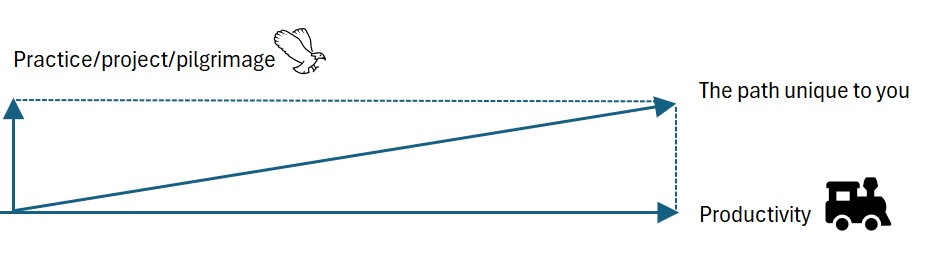
Just to state the obvious — changing course is very difficult while on a train since it cannot go anywhere but where the rails take it.
As for Churchill, he leapt from the train – “My feet struck the ground in two gigantic strides, and the next instant I was sprawling in the ditch considerably shaken.” He followed the tracks on foot, being careful to avoid sentries. Ran low on food and energy. Took a chance, knocked on a door, found someone who would help. They hid him in a coal mine, where he spent three days with pink-eyed rats for company, then got him back on another train heading east to freedom, but this time with a bundle of food, a revolver, and a better hiding place (a stack of wool bales with a tunnel carved between them). When the train finally crossed the frontier, Churchill was so carried away with thankfulness and delight that he emerged from his compartment and fired the pistol in the air in wild jubilation. Then disembarked at the station, found the British embassy, where he was greeted as a hero, and resumed his remarkable path through history.
But you, my friend – you might still need to make your move. Are you on the same path as the majority of Americans today, rumbling down the tracks toward obesity, metabolic sickness, and chronic ailments like diabetes, cancer, and dementia? Are you drowning in debt because you spend your hard-earned money on trifles? Are you experiencing anxiety that you cannot control without risky medications? Are you letting the media channel your frustration and vent your hatred at people who threaten their advertisers’ financial ambitions? Are you letting religious-technologists gaslight you into believing you can live forever by merging your spirit with the Internet?
GET OFF THE TRAIN!
Chasing the Grid is available for pre-order on Amazon!


 The Long Brown Path