What if Chris McDougall was Right?

When Born to Run was published in 2009, it caused a stir.  To many people, McDougall’s thesis rang true – that running is a natural part of being human and so is going barefoot.  More controversial was his claim that modern running shoes predispose us to chronic injury.  The big heels, abundant cushion, and structural features designed to control the motion of the foot create a risk, McDougall argued – that they alter our natural gait.  Why else would 70% or more of runners get injured every year, for participating in such a natural activity?

You could ask similar questions about other aspects of modern life.  If eating is such a natural activity, then why are 74% of Americans overweight or obese?

Clearly, with technology we can solve for things like comfort and taste, since these attributes drive real-time feedback through sales.  But that doesn’t mean we understand what drives health.  Or the hidden costs and unintended consequences of having too much technology.

When Born to Run first came out, people saw barefoot running as primal.  They understood intuitively that going barefoot offered connection and intensity, qualities which modern life sometimes lacks.  The book was the catalyst for a boom in so-called minimalist footwear – lightweight running shoes with thin soles that let you feel the ground –  sandals, like those worn by the Tarahumara Indians whom McDougall profiled in his book — or the funny-looking Vibram Five-Fingers with pockets for each toe.  Some people unlaced their shoes and tried running on the unprotected soles of completely naked feet.

The enthusiasm faded quickly.  People found the transition was too hard.  Going from conventional to minimalist to barefoot exacted a toll on body parts that were used to having cushion.  Many suffered injuries.  For podiatrists, this was a windfall. Shoe companies profited by creating minimalist styles, and then they made even more money with by introducing new shoe types with even more technology.

I, too, experimented with minimalist and barefoot running, thanks to Born to Run.  I, too, suffered aches and pains and injuries and other setbacks.  But my path must have been subtly different from those of other people, because I made the transition successfully and have not looked back. 

My new book, Chasing the Grid, chronicles my pursuit of a peak-bagging challenge in New York’s Catskill Mountains, which I undertook both barefoot and in shoes.  The book’s themes include the power of big goals to drive personal development, and how I adopted the philosophical principles of minimalism and transcendentalism as a consequence of spending time in nature.  The story includes my first experiments with going barefoot, starting with the ascent of Peekamoose Mountain in September 2015, after which  I was immediately hooked.

Benefits of Barefoot

What first impressed me about going barefoot was the intensity.   The wild contrast between aggravating surfaces, like gravel and sharp rocks, and pleasurable ones, such as dirt, smooth slabs, and moss. In shoes, the difference is lost.  Moving barefoot, I felt such a powerful connection to the land – as if I had become part of the forest, instead of merely passing through.

I soon recognized that there were physical benefits, too.  Barefoot teaches you to step carefully, since you can’t afford to slip and stumble without shoes.  As such the practice promotes agility and balance.  As we age, slips and falls become an increasingly serious risk, indeed by the time we’re in our 50s, they are the number one cause of emergency room visits – which might well be another costly side-effect of wearing shoes.

When people see me barefoot, they often ask if I am “grounding.”  There’s no question, in my experience, that going barefoot creates a sense of calm.  Some people think this has to do with electrical forces passing through the soles.  Maybe.  I have a simpler theory – that there’s a lot of circuitry in the brain that’s evolved to guide us in motion, which includes directing soft feet on rough terrain.  When these circuits are engaged, you experience the joy of moving naturally — call it “the original human mindfulness.”  When the feet are covered and protected, this circuitry sits idle, making it easier for the brain to get distracted.

The biggest benefit of going barefoot is that it’s so much fun.  Running without shoes is such a blast!  I think McDougall is right – the practice has improved my form.  I can run hard, go fast, cover long distances, and I feel comfortable and loose.  You know how everyone talks about “pounding the pavement”?  That’s not how you feel in bare feet.  Instead, there’s an incredible feeling of light-footedness.

Suggested Approaches

Since that first climb up Peekamoose Mountain ten years ago, I have completed nearly 14,000 miles barefoot, according to my training log.  These miles include 112 races completed barefoot, of which 23 were marathons and ultra’s (longest distance 50 miles).  Plus a lot of barefoot hiking.  I’ve thru-hiked the 211-mile John Muir Trial in California’s High Sierra and climbed 485 mountains barefoot, including many of the Catskill peaks as chronicled in Chasing the Grid, as well as Mt. Whitney (14,500 feet) and Mt. Elbert (14,440 feet), the two highest peaks in the Continental US.  My training log includes hundreds of miles of barefoot walking, which is such a simple, easy way to take a break from hunching behind the laptop, get some air, enjoy a dose of natural motion, sustain the body – even if it’s a 1-mile stroll on the quiet country roads around my house, the sidewalk outside a hotel, or a treadmill.

So what did I do differently from other people who tried and gave up?  And what would I suggest for those interested in exploring?

Start with barefoot walking

Most of the barefoot action in Chasing the Grid consists of walking along the trails in the Catskill Mountains or moving off-trail in the forest.  In my experience, this is a much easier way to start, because walking doesn’t introduce the same kinds of stress as running, yet you immediately benefit from the sense of intensity, connection, and calmness, while improving your agility and balance.  Let your feet guide you as to speed and distance, and carry shoes as back-up for when they’ve had enough.

By the way, you don’t have to start by climbing a mountain.  Go walk barefoot in a local park.  Take a stroll around town.  If someone asks what you’re doing, tell them you’re experimenting with “grounding.”

Understand that barefoot is a slower journey

Whether walking or running, you’ll find that when the terrain gets rough, barefoot gets slow.  When faced with sharp-edged rocks, gravel, and gnarly roots, you’ll have to look around before stepping and then place each foot with care.  On rough trails, you shouldn’t expect to keep up with friends in shoes.  On rocky trails, I’ve been overtaken by grand-parents.

Going barefoot requires patience, and I suspect this is the primary barrier to more widespread adoption.  But don’t we have enough mindless rushing in our modern lives already?  The American Transcendentalist Ralph Waldo Emerson advised people to “adopt the pace of nature – her secret is patience.”  In my experience, barefoot is a great antidote to the state of constant distraction.

Start barefoot running on rough terrain

If you’re a runner and would like to give barefoot a try, make sure to start out slow and short.  Your legs are strong, and you have plenty of cardio, but the barefoot gait is subtly different.  You’ll need strong core engagement.  Your joints, tendons, and ligaments will need to adapt to a slightly different geometry.

Instead of starting on a smooth surface like a track or a grassy field, the better approach is to find a trail with dirt and rocks.  This will teach you the right form.  You’ll learn to watch where you step. To place your feet with care and pick them up.  You may find that you shift to landing on the forefoot instead of landing on the heel — although contrary to popular belief, you can run barefoot either way.  You may find that you run in a bit of a crouch.  A few years back, I picked out a 1-mile circuit on the bridal trail in New York’s Central Park.  The first time out, the best I could do was walk — with a few trotting steps where the coast looked clear.  After a year of practice, I could move across the rocks at an “easy” running pace.  When rain left the soil soft and damp, I could hammer it at threshold pace.

Barefoot is More Fun

When people see me hiking on the trails or running in a race, they give me lots of positive feedback.  They shout “respect” and “next level” and give me fist-bumps.  They call me “warrior” and “badass.”  The kids cry out, “look Mom, a barefoot runner!”  Afterwards, people ask how long I’ve been running like this.  They want to know, did I read Born to Run?

Barefooting is relatively uncommon, but there are a handful of us out there.  Thea Gavin is a self-proclaimed barefoot running grandma and poet who’s completed numerous trail races without shoes.  She’s also crossed the Grand Canyon barefoot.  In one of her posts, she shared her favorite answer when people ask, why barefoot?

“Because it’s more fun.”

Which is what I now say.  Sometimes I elaborate, explaining that “barefoot is for the experience, while shoes are for speed.”

In my opinion, Chris McDougall is right.  We were born to run.

(Thank you, Chris.)


Chasing the Grid is available for pre-order on Amazon!

What if Chris McDougall was Right?

Some Thoughts on Mental Toughness

In recent years I’ve noticed that mental toughness has become a popular meme on social media.  The topic reflects people’s aspirations for meaningful achievement.  It draws energy, too, from concerns about our increasingly sedentary lifestyle.  These concerns are not new.  In his 1963 Sports Illustrated article, “The Soft American,” President John F. Kennedy reminded us of the link between physical fitness and moral courage.  Warned of the deterioration in strength and health already apparent at that time (this was twenty years before the obesity epidemic took off, leaving us today with 74% of Americans overweight or obese).  In 2016 Angela Duckworth argued in her bestseller, Grit, that our society needs more passion and perseverance.  In 2018 ultra-athlete and former SEAL David Goggins published his memoirs, Can’t Hurt Me, rallying followers with his trademark exhortation — “stay hard.”  Three years later, in the aptly-titled The Comfort Crisis, Michael Easter advocated for embracing pain as the key to happiness.  Steve Magness’s new book, Win the Inside Game, which follows on the heels of his 2022 bestseller, Do Hard Things, offers specific mental strategies for toughness, drawn from his experience as an Olympic coach and performance scientist, which contrast with the traditional narrative of machismo.

My new book, Chasing the Grid, should serve as a useful case study for many of these themes.  The story follows my adventures in the Catskill Mountains while working on a big peak-bagging project (it comprised over 400 separate ascents).  In addition to the mileage and elevation gain, I had to overcome the challenges of terrain, weather, fatigue, injury, and age.  The narrative showcases mental techniques that helped me execute against my goals.  It also shares my mistakes and frustrations. Continue reading “Some Thoughts on Mental Toughness”

Some Thoughts on Mental Toughness

GET OFF THE TRAIN!

A few years back I was working on a project – a peak-bagging exercise in New York’s Catskill Mountains that comprised almost 2,000 miles of hiking and running and more than 500,000 feet of climbing.  I’d started this task with a conventional runner’s obsession over speed, but gradually came to think of it as a pilgrimage.  Although it took place mostly on weekends, spread out over several years, rather than as an extended absence from work and family and the other day-to-day activities that we associate with a productive life and progress.

A few weeks ago I was reminiscing about the project, when a story came to mind about a young Winston Churchill (then 25 years old) and how he woke up suddenly to the fact that he was riding on a train — and needed to get off.  It was night.  He crawled onto one of the couplings between the cars and sprang off.

I’d read the story many years ago, but now it surfaced in my thoughts as if to illustrate the rationale for my peak-bagging quest –the simple idea that sometimes you’ve got to make a sudden change.  Go in a different direction.  Recognize what Walt Witman wrote — that perhaps you have been on a path since you were born and did not know – but sometimes the path contains a fork.  Better not to miss that.  Because the direction of our lives represents not merely our personal quest and agency, but the weight of so many opinions on what we should do and who we should be – the weight of church and state – the pressure of the priestly class which discourages independent thinking, and that of the police and the military who may be called upon to suppress it – the press of media and fashionable opinions and the arguments of family, friends, neighbors, and strangers on the street, who these days are probably raging and venting on social media.

Look, everyone has ideas about the right way forward.  But sometimes they’re wrong.

We all want to believe we are on the train to a better place.  Call it the train of progress.  Which is a great metaphor when you think of how the expansion of the railroads during the 19th century linked far-flung places for the first time, facilitated trade of goods, movement of people, the spread of ideas.  Railroads represented the start of the network economy, which previously was limited to wagon trails, natural waterways, and a few canals.  We want to ride the train — to the glorious future we believe in so desperately — to the better lifestyle we hope our kids will enjoy.

But here’s the problem.  It’s not like there is one single train.  There’s a myriad of them.  Going all different ways.  Departing throughout the day and night.  When was the last time you visited Grand Central?

Trains can take you to bad places.  During the Second World War, trains transported troops to the front lines and the horrors of modern combat.  Trains took people to the death camps.

You don’t want to be on the wrong train.

In his memoirs Churchill wrote about the Boer War, which he covered as a war correspondent for the Morning Post.  He recalled the armored train that would take him to his first battlefield adventure.  “Nothing looks more formidable and impressive than an armoured train; but nothing is in fact more vulnerable and helpless.”  It takes only the destruction of a culvert, he observed, to leave the “monster” stranded and at the mercy of the enemy.

In 2016, I was starting to feel vulnerable.  I was a conventional office worker, getting a little bored and frustrated with the endless calculations that comprised my work and the sterile indoors environment where I passed the time.  I’d gotten into running for the intensity and thrill.  Took on more and more races as I became passionate about the sport.  Attempted a 135-mile course through the Catskill Mountains, determined to set a record.  But I couldn’t finish it.  Then I got injured.  No doubt this resulted from the combination of fatigue and the aging process, as I was no longer young.  Then I got injured again.  Suddenly my running career was in doubt.  I realized with a sinking heart that I was at risk of becoming that which Thoreau feared the most – a member of the class of men who worked their lives away feeling “quietly desperate.”

It was about this time when I discovered the Grid, a project which consists of climbing each of the high peaks in a given mountain range in each calendar month.  For the Catskills, the Grid comprises a total of 420 ascents.  That’s a lot of work.  Nonetheless, the project appealed to me because I would be able to eke out progress at a slow pace over time, accommodating my injured status.  The Grid was a chance for me to adjust course while staying in motion.  A chance to learn not only about the mountains, but about myself.  The experience would lead to major changes in my practice of running.  My lifestyle.  Career path.  Attitude.  Values.  And once the project was complete, I would go back to work and became productive again.

On November 15, 1899, Churchill rode out on that formidable armored train with a company of British soldiers.  Deep behind enemy lines, they were ambushed.  Under heavy rifle and cannon fire, Churchill worked frantically to free the engine from the damaged cars – when looking up, he saw two Boer Commandos behind him.  They were “tall figures, full of energy, clad in dark, flapping clothes, with slouch, storm-driven hats.”   He ran as the “soft kisses” of bullets sucked at the air, passing him by inches.   He scrambled up a bank – spied a cabin 50 yards away and then a river which offered safety.  Decided to make a dash for it — when a horseman appeared to his front, galloping furiously.  Churchill reached for his pistol, only to find it wasn’t there – he’d left it on the train.  The Boer horseman brought his horse to a dead stop, covered Churchill with his rifle, eyed him through the sights from 40 yards away.  Churchill raised his hands.

He was marched to a tent, where he stood in line, waiting to be interrogated.  Anxiety gnawed at him, since he was wearing civilian clothes and might be executed as a spy.  But his captors recognized him as a correspondent and a celebrity (“We don’t catch the son of a lord every day, Old Chappie.”).  They marched him and the other soldiers to the capital city Pretoria (now known as Tshwane) and locked them up. 

A month passed.  Churchill recalled the “sense of constant humiliation from being confined to a narrow space.”  Yet the prisoners did not give up hope.  Indeed, they searched assiduously for a way out and soon found a potential route.  Churchill picked a day in December.  Waited until dusk.  Feeling increasingly desperate, he watched the sentries through a slit in the wall.  Saw them turn their backs.  Scrambled out a window and pulled himself onto a ledge as the two sentries took a break from pacing back and forth, and one of them cupped his hand to light a cigarette.  A moment later, Churchill was across a narrow wall.  He dropped into a garden.  Strode past a house.  Made it out into the streets of Pretoria.  It was dark now.  No-one paid attention to him in his brown flannel suit.  He glanced at the stars to orient himself, headed south, hunting for a railroad line that led to Portuguese territory and freedom, some 280 miles away.  Found some tracks.  Walked along them until he spotted a signal station.  Crouched in a ditch.  Waited an hour for a train to appear – let the engine pass and ran after the cars and grabbed twice and came up empty-handed and on the third try secured a grip and hoisted himself aboard.  Found a car carrying piles of empty coal sacks, which he burrowed underneath as the train thundered through the night.  Feeling secure in this hiding spot, he slept.

Suddenly he awoke.  The exhilaration of escape was gone, for now he was conscious of the risk, as he wrestled with this question — what would happen when the train reached the frontier?  When the word had gotten out that a high-profile prisoner, the son of a lord no less, was on the loose? 

Empty burlap bags were not a good enough place to hide.

He needed to get off the train.

During my peak-bagging exercise, no-one was coming after me with guns, but I did face a risk that if not as dramatic was no less severe – that if you live your life the wrong way, once the years are up you do not get another try.

I often explain my project to other runners with this idea – let’s not think of our sport as merely a recreational activity.  Let’s think of running as a practice.  In other words, a form of training intended not only to cover miles, but make us physically and spiritually stronger – more purposeful and determined – more reliable – more capable of helping others.  A practice can be structured to include big projects.  Projects which, like a pilgrimage, can become the gateway to personal change.  To finding the direction that works best for you, even if it is subtly different from what other people think is the right way forward.

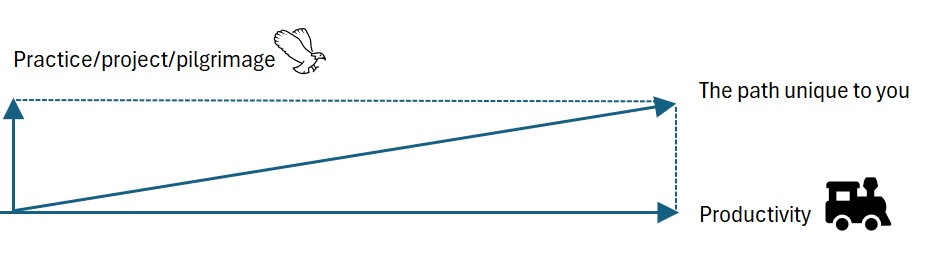
I drew this simple diagram to make my point a little clearer.  The productive life is represented with a horizontal arrow leading straight ahead toward the hoped-for goal of progress.  Think of this arrow as representing the train of progress.  In contrast, a practice, big project, or pilgrimage is shown as an arrow heading off “orthogonally,” meaning in a different direction — a direction which may have nothing to do with productivity — which may depart from conventional wisdom.  Add these two vectors together and you get a new direction.  Maybe it is the special path that’s exactly right for you.

Just to state the obvious — changing course is very difficult while on a train since it cannot go anywhere but where the rails take it.

As for Churchill, he leapt from the train – “My feet struck the ground in two gigantic strides, and the next instant I was sprawling in the ditch considerably shaken.”  He followed the tracks on foot, being careful to avoid sentries.  Ran low on food and energy.  Took a chance, knocked on a door, found someone who would help.  They hid him in a coal mine, where he spent three days with pink-eyed rats for company, then got him back on another train heading east to freedom, but this time with a bundle of food, a revolver, and a better hiding place (a stack of wool bales with a tunnel carved between them).  When the train finally crossed the frontier, Churchill was so carried away with thankfulness and delight that he emerged from his compartment and fired the pistol in the air in wild jubilation.  Then disembarked at the station, found the British embassy, where he was greeted as a hero, and resumed his remarkable path through history.

But you, my friend – you might still need to make your move.  Are you on the same path as the majority of Americans today, rumbling down the tracks toward obesity, metabolic sickness, and chronic ailments like diabetes, cancer, and dementia?  Are you drowning in debt because you spend your hard-earned money on trifles?  Are you experiencing anxiety that you cannot control without risky medications?  Are you letting the media channel your frustration and vent your hatred at people who threaten their advertisers’ financial ambitions?  Are you letting religious-technologists gaslight you into believing you can live forever by merging your spirit with the Internet?

GET OFF THE TRAIN!


Chasing the Grid is available for pre-order on Amazon!
GET OFF THE TRAIN!