We are pleased to announce the winners of the 2016Long Path Race Series! We call these winners Disciples in a nod to Raymond Torrey, Trail Conference founder and promoter of both the Appalachian Trail and the Long Path, whose memorial plaque on Long Mountain remembers him as a “Great Disciple of the Long Brown Path.” The idea is that people who are humble enough to learn from nature can do great things.
The acclaimed Japanese animated filmmaker Hayao Miyazaki’s 1988 classic My Neighbor Totoro tells the story of two young sisters who encounter friendly forest spirits in postwar rural Japan. The film has won numerous awards, and the Totoro has been ranked among the most popular animated characters.
There are many reasons for the film’s success, including the carefully crafted animation, the endearing portrayal of the two sisters, the lush watercolor backgrounds, and the pastoral simplicity of the setting. After watching the movie recently, I asked myself, what is a Totoro? And what was Miyazaki’s purpose in creating this movie?
As race director for the SRT Run/Hike, I’m interested in encouraging participation in the event and seeing more people experience the Shawangunk Ridge Trail (SRT), which is one of my favorite trails in New York. To be fair, the full 70-mile division isn’t for everyone: not only does it require significant endurance to cover such a long distance, but also you’ve got to be mindful about navigation, nutrition, and hydration, since we don’t provide aid stations or course markings. This isn’t everyone’s cup of tea.
But the half-marathon division should be accessible to a lot of people, and with a start-time of 10:30 AM and the final cut-off at midnight, you have 13.5 hours to complete the course, which requires moving at barely a 1 MPH average pace. To demonstrate just how generous this time limit is, I chose a beautiful fall day recently to see if I could complete the 1/2 marathon course within the time limit, without food, water,* or even shoes.
As a novice barefooter, I knew the going would be slow, but I couldn’t think of a better way to spend the day than experiencing the sights, sounds, and textures of New York’s most magical trail.
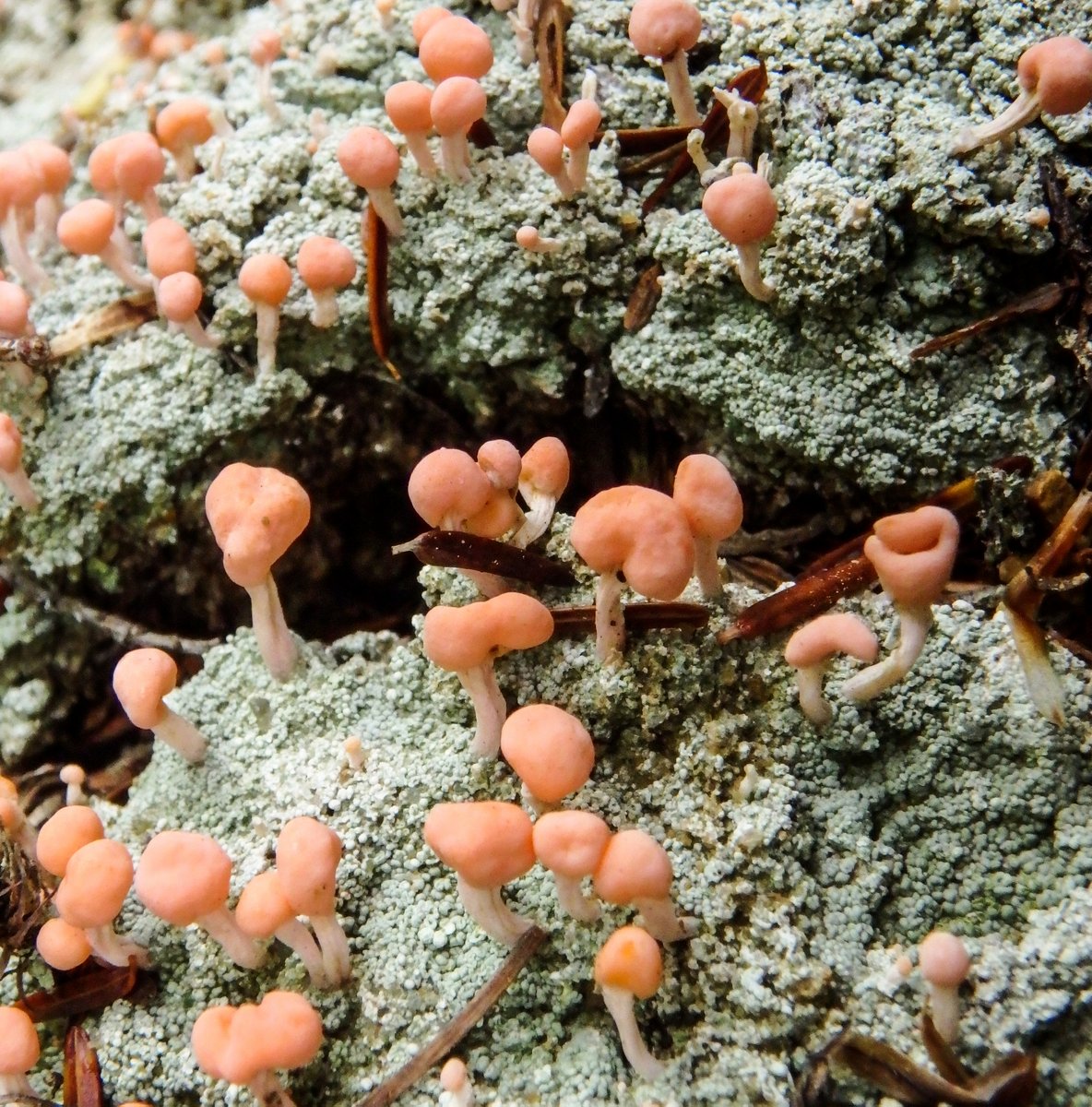
As flowers start to fade and leaves begin to fall my thoughts often turn to lichens, mosses and all of the other beautiful things you can still find in nature in the winter. We’ve had two or three days of drizzle; nothing drought busting but enough to perk up the lichens. Lichens like plenty of moisture, and when it doesn’t rain they will simply dry up and wait. Many change color and shape when they dry out and this can cause problems with identification, so serious lichen hunters wait until after a soaking rain to find them. This is when they show their true color and form. The pink fruiting bodies of the pink earth lichen in the above photo for example, might have been shriveled and pale before the rain.
Pink earth lichen (Dibaeis baeomyces) closely resembles bubblegum lichen (Icmadophila ericetorum.) One of the differences…
Henry David Thoreau’s 1862 essay, “Autumnal Tints,” contains colorful descriptions of New England’s fall foliage, including sugar maple and northern red oak, as well as more humble plants like bearded grass and pokeweed. Of special interest to me was Thoreau’s commentary on the red maple (Acer rubrum): he’d noticed that as early as the 25th of September a small red maple on the edge of a meadow had already turned a “far brighter red than the blossoms of any tree in summer” and that the tree was all the “more conspicuous” in contrast with the rest of the forest, which was still green:
Some single trees, wholly bright scarlet, seen against others of their kind still freshly green, or against evergreens, are more memorable than whole groves will be by-and-by. How beautiful, when a whole tree is like one great scarlet fruit full of ripe juices, every leaf, from lowest limb to topmost spire, all aglow, especially if you look toward the sun!
— Henry David Thoreau, Autumnal Tints
In recent weeks I’d spotted solitary maple leaves dotting the trail, splashes of scarlet among the prevailing greens and browns of the forest floor. This Sunday would be the 25th of September — and based on Thoreau’s essay it seemed precisely the right time to go scouting for the season’s first red maples to have fully changed their color. My friend Steve Aaron was looking for a mountain to climb, so I invited him to join me and Odie the Labradoodle for an attempt on Fir Mountain, one of several pathless peaks that rise above the headwaters of the Esopus Creek.
It was around 6pm on Friday, September 16th when a bunch of SRT 70-Mile participants hopped off a yellow school bus to meet the remaining SRT 70-Mile participants at High Point State Park in New Jersey. Like a school bus of children on their first day of school, we were excited and nervous (and most of us had to pee). After a quick race briefing from the Race Directors, we were off to the starting line at the SRT’s southern terminus. We snapped a starting line photo and the RDs let us loose on our journey to Rosendale, a 72 mile trek along the Shawangunk Ridge Trail.
The shuttle bus from Rosendale (where the race finishes) bumped across a narrow bridge to a small parking lot, illuminated by a single light. The 8 of us (that was it!) trotted out into the misty darkness. The race director gave us waterproof maps and our race numbers and a few navigational tips before the 6 AM start.
So, it’s the summer of 2015 and my running buddy, Malin Barton, says to me “Check out this race Joey, I think it would be fun”. I now know when Marlin Barton say’s “This will be fun”, what she really means is “This will probably kill us”.
The third edition of the SRT Run/Hike took place September 16-17, 2016 with 102 starters across all divisions, up from 82 the year before. A remarkable 92% of starters successfully completed the course this year — a surprising statistic for a minimalist format event which provides little or no aid or course markings. Excluding the dauntingly difficult 70-mile division, the success rate for the other divisions was almost 97%. Besides the inevitable scrapes and bruises, there were no injuries during the event, and no-one got lost. The runners deserve credit for showing up prepared to navigate on their own and manage their hydration and nutritional needs — exactly the spirit of mindfulness and self-reliance we sought to promote in creating this event. And perhaps it’s the case that the magical beauty of the Shawangunk Mountains imparts extra energy to those who move through the wilderness…
Sitting on the porch one summer weekend afternoon, I became conscious of a great cacophony emanating from high in the trees and deep in the bushes, but of the many creatures buzzing, chirping, trilling, squawking, screaming, and clattering away, none was visible. Could I learn to distinguish any of these sounds and associate them with their respective species? And would I ever catch a glimpse of these secretive singers?