The day was overcast when Odie and I set out for High Point, not the best conditions for appreciating the 100+ mile views, but you never know when the winds might shift, or what you might see if you opened your eyes.
Nature
Sights of Spring
Thoreau wrote about the brilliant colors of New England’s fall foliage, but I wondered, what about winter? And I found such a wild mix of impressions during my winter runs: sun dazzling against fresh rime ice, clouds rolling in and smothering the world in dim light — one hike was a slog through sand-like snow that spilled out from underfoot and dribbled down the rocks, another a desperate scramble over sheets of ice, and then a storm rolled in with pelting sleet and lightning. Even at night there was a huge variety of sights: solitary farm lights sprinkled across the darkened plains, snowflakes sparkling in the headlamp’s beam, moonlight shining on snow-packed trails so bright you could run without lights, or the crescent moon rising above a distant mountain ridge and glowing in such a strange mix of orange and purple it seemed like a hue that’d never been seen before.
But now it was spring — and everything was changing so quickly, it seemed if you blinked you might miss it all.
So I kept my eyes open as best I could, and here’s a collection of spring impressions, things I noticed while hiking the Long Path along the Hudson River and in the Catskills.
Lichens of Slide Mountain
“I lean and loafe at my ease observing a spear of summer grass,” wrote Walt Whitman (1818-1892) in his poem, The Song of Myself, an eerie echo of a theme in 13th century Japanese Zen literature:
There is a world of sentient beings in clouds. There is a world of sentient beings in the air. There is a world of sentient beings in fire…. There is a world of sentient beings in a blade of grass.
— Mountains and Wates Sutra, Eihei Dogen (1200-1253)
Could there be a world of sentient beings in a piece of lichen?
Last weekend my friend Steve Aaron and I had the privilege of accompanying nature photographer John Franklin on an expedition to Slide Mountain. John is working on a book about New York lichens, and he kindly shared many observations with us as well as some spectacular photographs which are showcased below together with some apropos quotations from Henry David Thoreau.

Thank you, John!
Spring Tints
Inspired by Henry David Thoreau’s essay “Autumnal Tints”, last fall I’d headed out in early September, while the mountains were still green, in search of the first red maples turning scarlet. That experience got me thinking: while we all love the fall foliage, what about winter colors? And spring?
The Mountains are Calling, and We Must Run
One day I stood in the Shawangunks and stared at the Catskills. It was a cold winter day, and the distant mountains seemed carved out of blue crystal and white diamond. I remember feeling a surge of adrenaline, as if I could at that moment head off and run the thirty miles from here to there, although the icy wind dissuaded me.
This experience made me think of John Muir’s famous line in an 1873 letter to his sister, “The mountains are calling, and I must go.” He used similar expressions in his account of his first summer in the Sierras, when during 1869 he accompanied a sheep herd into the mountains. For example, when he first got high enough up in the foothills to look deep into the Merced Valley, he perceived “a glorious wilderness that seemed to be calling with a thousand songful voices.” Similarly, his diary entry from July 8 of that year notes: “Many still, small voices, as well as the noon thunder, are calling, ‘Come higher.'” In fact, every aspect of the natural wilderness called to him:
How interesting everything is! Every rock, mountain, stream, plant, lake, lawn, forest, garden, bird, beast, insect seems to call and invite us to come and learn something of its history and relationship.
Continue reading “The Mountains are Calling, and We Must Run”
Crows
(I was reading one of John Burroughs’ essays, and his description of the American Crow caught my eye, and made me think of my friend Tom Bushey, who loves to photograph them. Thank you, Tom, for letting me post some of those images here.)
Hardy, happy outlaws, the crows, how I love them! Alert, social, republican, always able to look out for himself, not afraid of the cold and the snow, fishing when flesh is scarce, and stealing when other resources fail, the crow is a character I would not willingly miss from the landscape. I love to see his track in the snow or the mud, and his graceful pedestrianism about the brown fields. He is no interloper, but has the air and manner of being thoroughly at home, and in rightful possession of the land. He is no sentimentalist like some of the plaining, disconsolate song-birds, but apparently is always in good health and good spirits. No matter who is sick, or dejected, or unsatisfied, or what the weather is, or what the price of corn, the crow is well and finds life sweet. He is the dusky embodiment of worldly wisdom and prudence. Then he is one of Nature’s self-appointed constables and greatly magnifies his office. He would fain arrest every hawk or owl or grimalkin that ventures abroad. I have known a posse of them to beset the fox and cry “Thief!” till Reynard hid himself for shame.
— John Burroughs “Winter Sunshine,” 1875
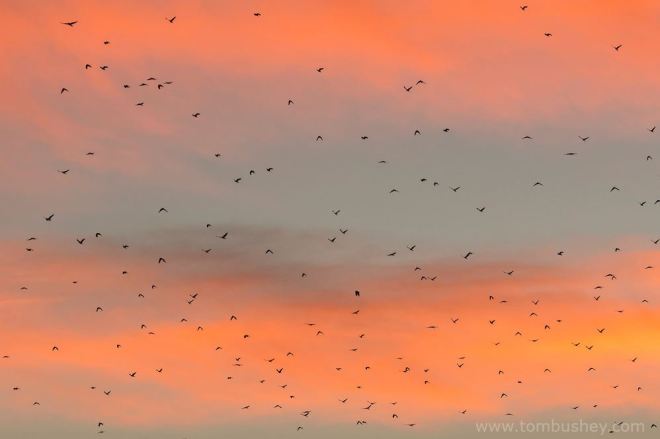


Note: during fall and winter months, crows roost together in the thousands, and even in some rare instances, in the millions. They begin gathering together in late afternoon in a location separate from the roost, then as darkness falls, they move to the location where they’ll spend the night. Experts think this is a behavior that helps them defend against their primary predator, the Great Horned Owl, and possibly, too, a strategy for sharing information about food sources.
Visit Tom’s gallery of American Crow images
My Autumnal Tints
I picked up a beech leaf and examined it: the leaf was pale yellow in the center and dark brown around the edges. I knew that soon these leaves would carpet the forest floor in layers of beige, but for now, the forest was sparkling in the late October sunlight, and the beech trees glowed like gold.
The scene brought to mind Henry David Thoreau’s 1860 essay “Autumnal Tints,” in which he wrote, “There is just as much beauty visible to us in the landscape as we are prepared to appreciate.” He meant that by diligent study of nature we learn to appreciate its beauty. He summed up the essay by encouraging readers to pay attention to nature:
When you come to observe faithfully the changes of each humblest plant, you find that each has, sooner or later, its peculiar autumnal tint; and if you undertake to make a complete list of the bright tints, it will be nearly as long as a catalogue of the plants in your vicinity.
— Henry David Thoreau, “Autumnal Tints”
And so, this fall, I tried to do as Thoreau suggested, that is, as I hiked, ran, and drove through the eye-shocking autumnal displays in upstate New York’s Shawangunk and Catskill mountains, I tried to “observe faithfully.” Here is my list of the brightest tints….
What’s a Totoro?
The acclaimed Japanese animated filmmaker Hayao Miyazaki’s 1988 classic My Neighbor Totoro tells the story of two young sisters who encounter friendly forest spirits in postwar rural Japan. The film has won numerous awards, and the Totoro has been ranked among the most popular animated characters.
There are many reasons for the film’s success, including the carefully crafted animation, the endearing portrayal of the two sisters, the lush watercolor backgrounds, and the pastoral simplicity of the setting. After watching the movie recently, I asked myself, what is a Totoro? And what was Miyazaki’s purpose in creating this movie?
In Search of Autumnal Tints
Henry David Thoreau’s 1862 essay, “Autumnal Tints,” contains colorful descriptions of New England’s fall foliage, including sugar maple and northern red oak, as well as more humble plants like bearded grass and pokeweed. Of special interest to me was Thoreau’s commentary on the red maple (Acer rubrum): he’d noticed that as early as the 25th of September a small red maple on the edge of a meadow had already turned a “far brighter red than the blossoms of any tree in summer” and that the tree was all the “more conspicuous” in contrast with the rest of the forest, which was still green:
Some single trees, wholly bright scarlet, seen against others of their kind still freshly green, or against evergreens, are more memorable than whole groves will be by-and-by. How beautiful, when a whole tree is like one great scarlet fruit full of ripe juices, every leaf, from lowest limb to topmost spire, all aglow, especially if you look toward the sun!
— Henry David Thoreau, Autumnal Tints
In recent weeks I’d spotted solitary maple leaves dotting the trail, splashes of scarlet among the prevailing greens and browns of the forest floor. This Sunday would be the 25th of September — and based on Thoreau’s essay it seemed precisely the right time to go scouting for the season’s first red maples to have fully changed their color. My friend Steve Aaron was looking for a mountain to climb, so I invited him to join me and Odie the Labradoodle for an attempt on Fir Mountain, one of several pathless peaks that rise above the headwaters of the Esopus Creek.

Songs of Summer
Sitting on the porch one summer weekend afternoon, I became conscious of a great cacophony emanating from high in the trees and deep in the bushes, but of the many creatures buzzing, chirping, trilling, squawking, screaming, and clattering away, none was visible. Could I learn to distinguish any of these sounds and associate them with their respective species? And would I ever catch a glimpse of these secretive singers?
 The Long Brown Path