The 19th-century English art critic John Ruskin saw in mountains a story of endurance and destruction. All we can know about a mountain is that “it was once greater than it is now, and it only gathers vastness, and still gathers, as it fades into the abyss of the unknown.”
And so it is with people – we endure as long as we can, hoping to leave something behind.
This is my report on reaching 13,000 miles of barefoot walking, hiking, and running, after starting on this unexpected journey some ten years ago.
1,000 Miles on an “Irritated” Meniscus
In early January I injured my knee. I was descending from Superstition Peak 5057 outside Phoenix, Arizona, when I slipped on gravel. My sports doctor explained the meniscus in my left knee was “irritated.” He handed me a prescription for a week’s worth of Voltaren, a potent anti-inflammatory.
“Do I really need to take these?” Since the pandemic, I’ve become hesitant about modern medical interventions.
“I would,” he replied, pointing to the X-ray, “there’s some edema on the bone.”
He told me to come back and see him in a month, but I didn’t — because the knee was starting to feel better. After spending January doing nothing more than 1-mile walks, in early February I participated in a 5k as a walker – something I’d never done before. So here I was, marching along in bare feet on a paved road in the rain, in the back of the pack with the old, the overweight, and the out of shape. I saw a very large man reading a story to a tiny girl as they walked together, and I lagged for a moment to listen, before hastening on. My finishing time ended up 1 hour 2 minutes – it was my slowest 5k ever. “Knee still aches, but not badly,” I noted in my training log.
By March, I was ready to return to running, albeit at a tentative cautious pace, attentive to the slightest sensations, in case they were warning signals. I participated in a 5k and a 4-miler without pain, so next I signed up for a 10k. A friend asked how long it would take. I thought for a moment – considered my prior racing times and the state of my recovery — hazarded a wild guess – “maybe 50 minutes?”
The clock read 49:59.3 when I crossed the finish. I’d run it hard, never once looked at my watch. There’s something to be said for experience.
Later that spring, I ran the Woodstock 15k hard, too, winning 3rd in my age group. Won first place in my age group in three more races that summer. Ran so hard at a 5k on July 4th I was practically in tears, but I couldn’t catch the fellow in front of me, so I came in 2nd, with a new Personal Best (the fastest barefoot 5k time of my life, albeit a couple of minutes behind my fastest 5k in shoes).
How I love running fast!
The Ellenville Run Like the Wind 5k is an old favorite and with knee back in shape I was excited to show up again – but unbeknownst to me, they’d changed the course. They moved it off the smooth paved roads in the heart of town to a rail trail which had been recently resurfaced with a coat of fresh gravel. The pointy stones were so painful underfoot I couldn’t run – I could hardly walk. I struggled along, managing to stay just ahead of the sweeps who were cleaning up the course markings. My finishing time was 1 hour 7 minutes – a new Personal Worst.
I flew out to Sioux Falls to run a marathon, only to have it canceled due to hot weather. They let us run the ½ marathon, however, which was a mix of smooth paved trails where I flew and rough pavement with sharp pebbles embedded where I trotted slowly or veered onto the sidewalks and lawns by the side of the road. To my astonishment, there was another barefoot runner – a personal trainer and Air Force veteran named Jay. Like me, he seeks in the barefoot practice a more direct connection to the environment and a more natural experience.

My last race during this 1,000-mile block was a popular ½ marathon in New Rochelle called Pain-to-Paine. The course passes along a series of trails through local parks, and in some places the path is full of rocks. Here I jogged along slowly, placing each foot with care, while a stream of shod runners passed me by. But in other places, the trail was smooth packed dirt, and since my legs were fresh after jogging slowly on the rocks, I was able to hammer it – and now I was passing all those runners wearing shoes! What a strange accordion-like experience, going slow then fast for 13 miles – and what fun!

All told, during the last 1,000 barefoot miles, I ran 17 barefoot races, bringing me to a total of 106. I ran on the rough rural roads around my house and on the grassy paths in a wildlife preserve. I did speedwork at the track to get faster and long runs of 20 miles or more to whip myself back into marathon trim. Running barefoot provides a special feeling of light-footedness, and even pavement has come to feel friendly underfoot – even roughly-rolled chip-and-seal provides that elemental connection to the environment, whereas footwear, like any other technology, shields us from sensations and in so doing starts to separate us from nature.
A Second Meniscus Incident
On October 1, 2024, two days after Paine-to-Paine, I was pulling on a pair of boots, which I wear for safety when splitting firewood with a maul (wouldn’t want to drop a piece of wood on a naked toe), when I felt a sharp tearing sensation on the inner side of the knee. It was the meniscus again. But this time the pain was searing. If previously the cartilage was “irritated,” this time it was enraged.
It hurt so bad I couldn’t sleep.
The next day I tried walking one mile at a slow pace and could barely finish it.
Two days later, I was searching around for a different form of exercise, when I remembered the cord of rounds which still needed to be split. I grabbed the maul and started tapping gingerly on a wedge, being extremely careful not to jar the knee. After a minute or two, something didn’t feel right with my lower back. I lay down the maul and staggered back inside. Lowered myself onto the carpet and stretched my back for a minute or two. Rose shakily to my feet. Sunk into my favorite recliner. Struggled to get back up. Forget 1-mile walks, now I could barely make it to the kitchen.
Mercifully, the back recovered in a couple of days. Reasoning that everything heals faster when in motion, I resumed the 1-mile walks. Typically, the knee would feel OK for the first ¼ mile, but by the half-way point it was stinging, and after ¾’s of a mile, I was limping along with fists clenched and teeth gritted. During the night, the angry meniscus continued to disturb my rest, unhappy with whichever position I was lying in. Even swimming was a problem – mind you, with a buoy between my legs and no kicking – yet the knee complained when I turned around slowly in the water upon reaching the far end of the pool.
October was a grim month – no running, no races, no hiking, no mountains. Just slow painful 1-mile walks. I called my doctor, but the office told me he was booked until mid-November. I’ve been through injury cycles before, and that experience helped guide me as to what to expect. So now I steeled myself against the twin perils of optimism and despair. At night I lay in bed and focused my breathing on the meniscus as a stimulus to accelerate the healing process (as I’d been taught to do in Karate, nearly 50 years ago). Visualized the piece of cartilage sandwiched between two bones. The pain radiated across the edge of the knee, but the injury itself was inside the joint — a scratch on the cartilage’s outer surface? A tear in the center?
On October 24, I was down in Dallas for business. Went for a slow barefoot walk on the smooth paved trails of Andrew Brown Park. It was a lovely afternoon and such a delight to feel the sun-warmed pavement underfoot. I reached 1 mile, without the knee feeling like it was on fire, and kept going for another 1/4.
Flew to Denver for a business conference and did some short walks in the downtown area, this time in shoes, not wanting to startle colleagues and their clients. At one point I was working feverishly on my laptop, hunched over in an unfamiliar chair, and when I stood up I found I’d strained my lower back again. Went limping off to a meeting. Told my colleagues I was ready for the scrapheap, to which a friend replied that I could have a tablet of Naproxene from the jar he carries with him everywhere, explaining that his calf goes out like clockwork every 3 months, which is a shame since he loves to run. Another colleague told the story of her Achilles tendon injury – it was 8 weeks in the boot – she’d strained it while hiking then ruptured it jumping into a lake. Then our CEO skipped a meeting – rumor was he’d strained something on his morning run, flown back to Texas, and was now himself in the boot.
Once again, my back recovered over the next few days. I gradually extended the distance of my walks. On November 1, I was back in Dallas padding along on the smooth sun-warmed trails of Andrew Brown Park. I walked 3 miles in the morning and 3 miles in the evening.
What a joy to be moving again!
I began to plan, as I packed for the return flight to New York. During the flight I sketched out a route. Wheels down — 10 pm, and I was home by midnight.
The next morning, screwing up my courage, I drove to Ringwood NJ. For extra support, I brought trekking poles, which I rarely use, but these helped as the trail was steep in places and shrouded in fallen oak leaves, which are slippery in bare feet and also make it hard to see the rocks.
This hike was very important to me, even if it was by necessity short and cautious. You see, last winter, I decided to set a lifetime goal – to climb 1,000 mountains barefoot. I feel this huge pressure to get out there and make progress. And wild enthusiasm when I do.
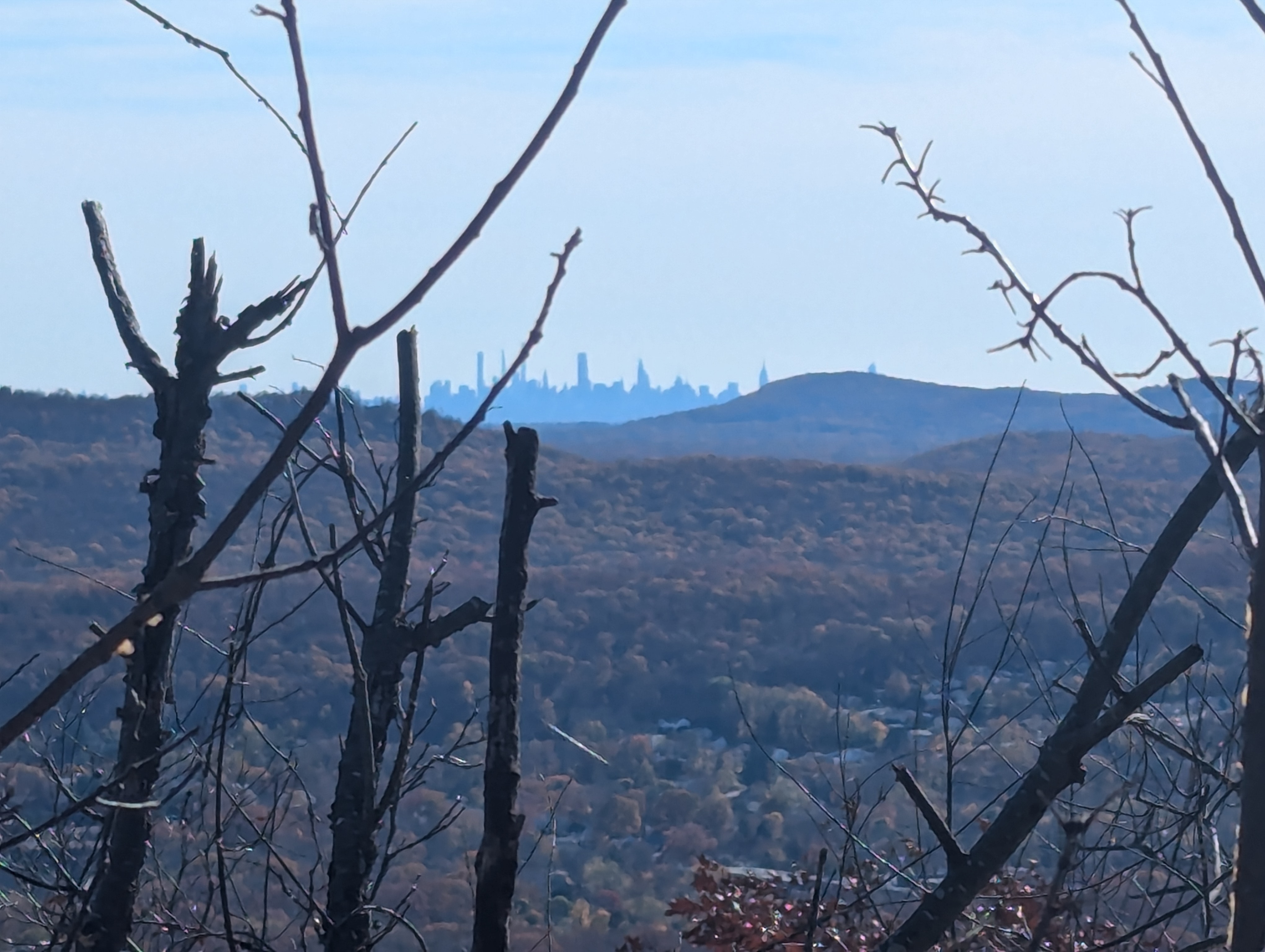
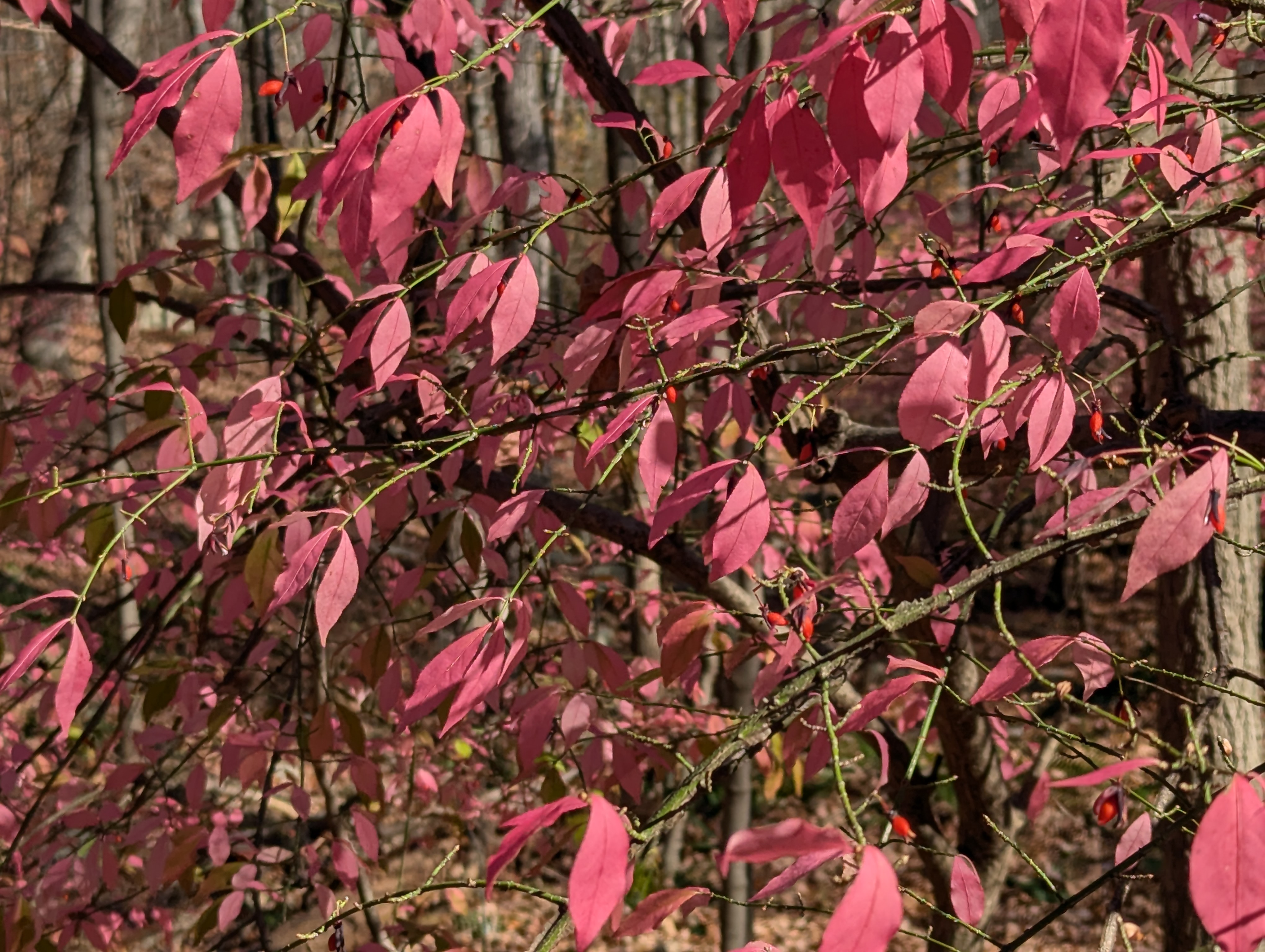
The Ringwood hike was so much fun – to feel the sun on my cheek on an unseasonably warm fall day – to find a weird pink forest full of burning bush, an exotic invasive – to stand on Board Mountain and survey the sparkling blue waters of the Wanaque Reservoir and through a gap in the hills glimpse NYC’s pencil-thin towers, such an alien sight in this natural landscape – to pass across the top of Bear Mountain through a grove of white pine and tread upon their long needles – to stand at the summit of Windbeam Mountain beneath a US flag on a pole and later to see that flag flapping cheerfully from the road below – to pad along the last mile back to the car on smooth black asphalt, such a joyful feeling underfoot after contending for hours with slippery leaves and hidden rocks.

During the last 1,000 barefoot miles, I bagged a total of 66 peaks. I climbed baby mountains, like in Ringwood (barely 1,000 feet tall) and the Southern Taconics (+/- 2,000 feet). I climbed the high peaks in Vermont, at just over 4,000 feet, the last for me of the 115 4,000-footers in the Northeast, and perhaps (who knows?) I have become the first person to complete this list without shoes. During a summer trip to Arizona and Colorado, I climbed mountains ranging from 6,000 to 14,000 feet, including Mount Elbert (14,444 feet), which is the second tallest mountain in the Continental U.S. behind Mount Whitney (14,500 feet), which I’ve climbed twice barefoot and once in shoes.
As of today, the count stands at 452, meaning I have 548 left to go before my body falls apart for good.
John Ruskin believed that true art contains a vein of sympathy, and you find a certain sensitivity even in his descriptions of the landscape. For example, he wrote of one mountain – possibly a favorite in the Alps – that it was “shedding its flakes of granite, on all sides of it, as a fading rose lets fall its leaves.” Clearly, the peak once stood much taller — indeed, its distinctive shape reflects the gaps left by rock-fall, the cutting power of streams, “the subtle wedges of frost.” Like people, mountains are “destructible and frail.” They “wither.” They show “the untraceable decay in their own substance.”
In two days time I’ve planned a hike in Harriman State Park – a 10-mile loop that will bag me 7 more peaks. Now I’m hunched over in my favorite recliner — studying route on laptop and checking the weather forecast – a pillow bracing lower back — attentive to a residual ache in the meniscus (when I slipped and caught a foot on a stick and twisted the knee ever so slightly). I wonder about the condition of the Harriman trails. Surely there are still some slippery oak leaves in my future.
Running the Long Path is my account of a 350-mile run in pursuit of a fastest known time record and what I discovered along the way. (Click on the image for more info)
 The Long Brown Path
Sorry you have been coping with injury. But you have done so much! The Stoics would be proud! I too am coping with age and injury. Great that your karate teacher taught you rudiments of healing through what the Chinese call Qigong (Chi -kung)! Keep it up! I have to get into a more serious qigong practice. And I keep going with learning more mild forms of sport, such as Tai Chi and Oriental sword forms, along with artistic/physical outlets such as voice lessons. And I can still work on my swimming stroke and flexibility. Our physical strength may wane, but we may exploit what we have better, because the years of our experience can increase the level of our skill at wielding it.
LikeLiked by 1 person
Ira, thanks for sharing, that sounds like a beautiful collection of activities. Onwards, let’s do more! And swimming when all else fails LOL
LikeLike