As a teenager I was fascinated by Nietzsche (I was desperate, of course), but now, forty years later, here I am on an airplane flight, Beyond Good and Evil on my lap — and no, I don’t remember what prompted me to dust it off after all these years.
The page falls open to an aphorism so widely quoted it has become cliché —
“Take care that if you fight monsters, you do not become a monster. For if you gaze into the abyss, the abyss also gazes into you.”
I wonder what was he suggesting — did he mean that introspection is dangerous? That would be a strange thought, since every schoolchild knows the unexamined life is not worth living. But maybe there is a question of degree. In Joseph Conrad’s Heart of Darkness, Marlow describes Kurtz as lost — “I looked at him as you peer down at a man who is lying at the bottom of a precipice where the sun never shines.” Alone in the jungle, Kurtz’s soul “looked within itself.” And whatever it saw drove him mad.
Perhaps Nietzsche gazed into the abyss and saw the heart of nothingness. For elsewhere he wrote that the self contains an “abysmal sickness, weariness, discouragement” — symptoms of the impoverishment of life that results when the “will to power” turns against itself – symptoms of the spirit of nihilism that grasped 19th century European culture, once it became apparent that their god was dead.
Abyss means “a deep or seemingly bottomless chasm.” You lean over, drop a stone, listen.
I picture a cave hidden deep within a canyon. A cave which lies in the bottom of my mind. It reaches back to my earliest memories. Reaches back farther — to the source of that collective, ancestral knowledge handed down over generations. I wonder, if you followed this tunnel far enough, would it lead you all the way back to the inception. If you ventured deep enough within the darkness, would you bump into the primordial forces that animate us?
I put down the book. Glance out the window. Staring straight at me is — a cloud.
This was a year or two ago. Ever since then this strange idea has stuck with me, namely, that deep within the abyss you might find a cloud….
I’m on another trip to Texas. The airplane rises from La Guardia, banks southwest, clings to the Jersey coast. Out the window looms a dreary gray skyscape formed of multiple stratus layers. Featureless. Shadowy. Forlorn.
This gray scene is the archetypal New York skyscape, of this I am convinced. Our skies are often overcast. Perhaps the stratus layers condense as moist airflows trundle across the Catskill Mountains. Perhaps New York is just an old place, where people remained even as opportunity shifted elsewhere.
From a gap in the layers, the sun peeks through — and suddenly a fan of crepuscular rays flashes across the horizon. As if a cosmic eye were batting its lashes. The eye of a dragon that inhabits a parallel universe and sometimes, vaguely curious, looks into ours.

The jet hurtles onward. The sun sinks. The sky turns bronze. We’ve crossed into open country. We’ve arrived in the cumulonimbus zone. The moisture bubbles up in enormous columns, then flattens off into the distinctive anvil-shaped layers known as incus, which occur where water vapor phase-shifts into crystal.
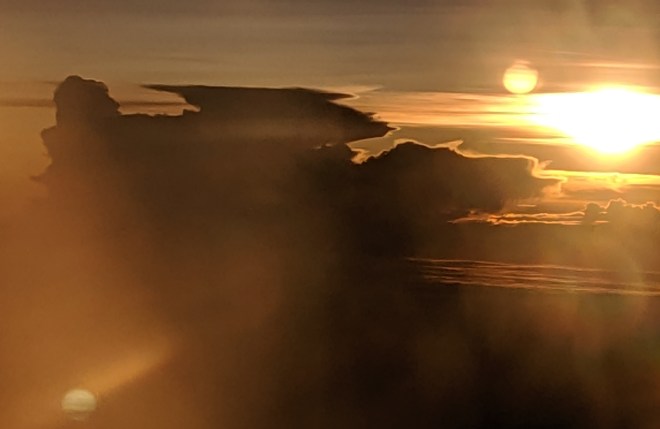
One month later (it’s August now), I’m on another flight, and once again we’re crossing the cumulonimbus zone, but this time the mid-afternoon sky is mellow. The potential for violence is there, but veiled. For now, the clouds are well-formed. Graceful. Peaceable. Within a massive cloudbank, there lies a circular gap, reminiscent of an arch you might see in a fin of orange sandstone (slickrock member of the Entrada formation) in Arches National Park.
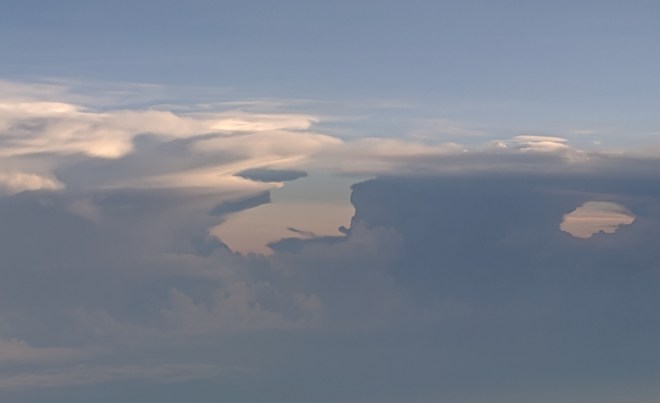
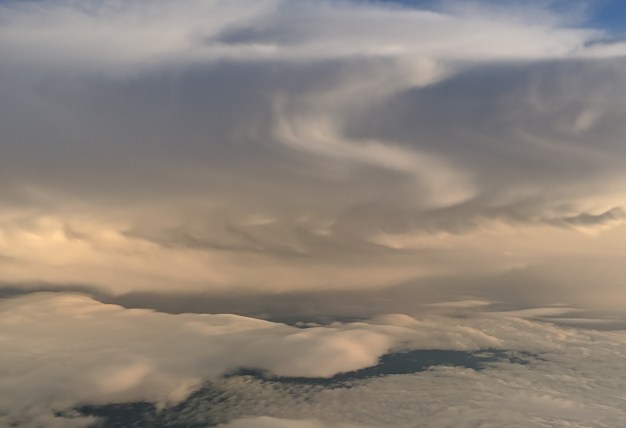
From a distance the incus looks two-dimensional, like a piece of a paper, but as the jet passes underneath, swirling features are revealed on the underside, including the wavy pouches called mammatus, while far below a sheet of cumulus cloaks the ground like a cotton blanket spread out for a picnic.
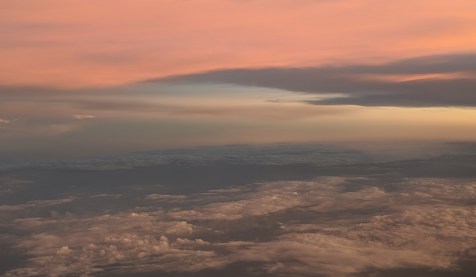
The sun slides beneath the horizon. The clouds turn a dusky coral color.
The reason for these flights is a new job, which takes me to Dallas on a frequent basis. My next trip is in late September. I’ve timed the arrival to allow for an evening run before checking in at my hotel. On the descent we pass through a band of cumulus. Upon reaching the ground, I see in the north a cumulonimbus so large it appears monstrous. Soon I’m in my rental car, heading towards this brooding presence, which hulks above a complex urban sprawl of dusty freeway interchanges and sand-colored distribution centers innumerable.
When you’re operating outdoors, clouds matter. Their presence gives warning of potential disturbance. Imagine our distant ancestors – they were always on the move, constantly searching for food and shelter. In a time before weather forecasts or Goretex (or umbrellas for that matter), they would have been mindful of the sky and what the patterns presaged.
I continue north. The thunderhead hovers in the distance, portentous. There it is again, hulking in the northeast when I arrive at the trailhead. The white cumulus erupts into the atmosphere, while murky bands flank the lower edges.
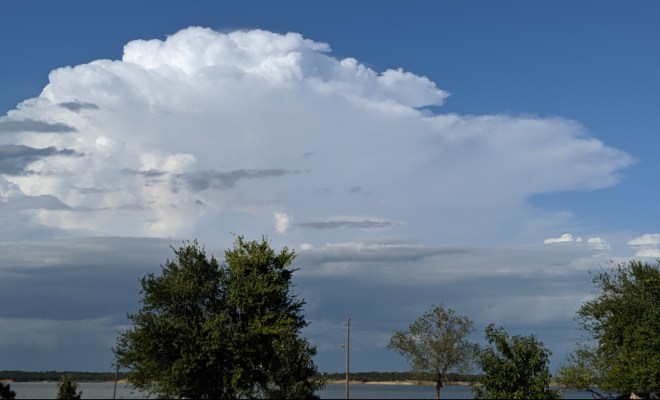
I start my run, relieved to be on the move after hours in cars and planes sitting rigid and nearly motionless, but also feeling the prick of anxiety. The route is unfamiliar. And there’s that presence. The dirty gray stratus layers spread overhead. The light’s fading, although the sun breaks through in places and gilts the edges. Farther off, there are great swirls, hinting at the vortex.

The gray stratus thickens. The thunderhead disappears in the murk. I spot precipitation to the northwest.
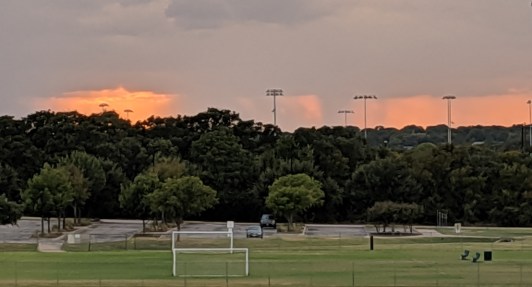
Run finished, I drive to my hotel, wondering where that storm is headed. Will I wake up to the sound of heavy rainfall hammering against glass panes?
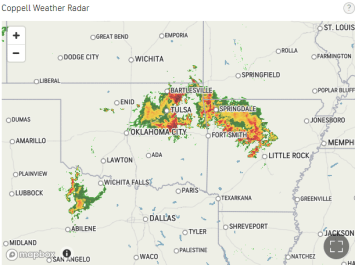
The next morning is strangely quiet. Eerie. I question what is real and what I imagined. That something happened seems incontrovertible for the weather radar shows a disturbance to the north, a sizeable zone of heavy precipitation spanning Oklahoma and Arkansas, while a map of surface conditions indicates a cold front closed in on Dallas during the night, before somehow reversing course and pulling back.

On the drive to work, I spot tendrils of precipitation to the northeast. Rearguard elements?

That evening, twisting cirrus plumes catch the rays of twilight. The vapors flicker orange and yellow with hints of coral pink. Just out of sight dances a flight of cosmic dragons.

I am convinced that the clouds of Texas are different from those of New York. No doubt this is due to differences in ambient temperature and humidity. Although I can find no data to support this thesis.
In his writings Nietzsche used the words “abyss” and “abysmal” in connection with “sickness” and “the will to decline” (a reference to Christianity, which he loathed). The abyss was also a source of “arrogance” and “antagonism” and a realm where lurked the spirit of German nationalism (which he also loathed). He used the abyss as a metaphor for crimes against nature. The pleasures associated with destruction and negation. “Gloomy, black, unnerving sadness” and “invincible horror.” Indecencies and abuses. Suspicion. Decadence. Universal decay.
Nietzsche suffered throughout his life from various physical afflictions including migraine headaches and nausea. For relief he turned to opium. His books were too radical for contemporary tastes; they sold poorly and left him unemployable and isolated. He retired from teaching in his 30s. At 45 he suffered a mental breakdown and then multiple strokes. He died at 56.
As a young man I was sympathetic to the tension in his writing. At the time I believed I had something to offer, but lacked confidence, for I felt weak and hollow inside, as if there were a void at my core. I found Nietzsche’s philosophy uplifting, because his “will to power” seemed to be an affirmation of health, energy, purpose, and agency, rather than a quest for dominion over other people. The “ubermensch,” as he conceived of the concept, was not a member of a special class or race but rather a person who figured out how to transcended his or her limitations.
Over the years, those feelings of emptiness faded as I accumulated experience and some modest success. And then, one day, as I gazed out an airplane window it occurred to me that the abyss might contain not only fear, but also equanimity.
In recent years I seem to have developed an affinity for clouds. And why not? – are not people, too, composed largely of water and animated by the sun?
I find myself studying them closely. In New York City I’ve glimpsed distant banks of cumulus hustling between the office towers, while in the Catskill Mountains I’ve born witness to tendrils of fog erupting from the cloves — cloud-puffs racing past summits — the formation known as cirrus vertebratus arrayed above autumnal forests the color of pumpkin pie.
In New Zealand, I sipped a cup of tea while admiring an almond-shaped lenticular cloud forming above a ridge.
In Utah I saw a massive mushroom cloud bubbling above Mt. Peale. It dwarfed the 13,000-foot mountain.
I am constantly staring at the skies, convinced that the swirling vapors carry hidden meaning. If only I could divine the implications.
Let us walk on clouds, let us harangue the infinite, let us surround ourselves with symbols!
— Friedrich Nietzsche, “The Case of Wagner”
Running the Long Path is my account of a 350-mile run in pursuit of a fastest known time record and what I discovered along the way. (Click on the image for more info)
 The Long Brown Path
I think Nietzsche would want you to take yourself less seriously. And I don’t think your psychoanalysis of his sickness is something he himself would approve of. Nietzsche had some loathing for Christianity, but even more as the secularized “morality” as taught in the Protestant churches of his day. Nietsche also thought Buddhism was too quietistic, so I can’t imagine his finding “acceptance and equanimity” in the abyss. I certainly don’t think he would approve of our American self-improvement quest and the pop-psych uses of the term “overcoming limitations.” Today most people don’t believe in traditional theism, so much of our current idolatry is “self-Improvement.” I’m sure Nietzsche would’ve knocked an American superman like you a notch or two, just like he knocked Stoics, Platonists, and everybody else! You trumpet your health over Nietzsche’s sickness? What did The Kinks say?
“And he’s oh, so good,
And he’s oh, so fine,
And he’s oh, so healthy,
In his body and his mind.
Hes a well respected man about town,
Doing the best things…”
You’re still a hero to me, anyway, Ken, but get back to my favorites, the Stoics and Platonists. Or else Joni Mitchell, who looked at clouds from both sides. Don’t try to read her into Nietzsche -Your proud Jewish friend, Ira
LikeLike
Ira, thanks for your response
LikeLike
[…] My next connection departed Dallas and winged its way west-northwest. Once we’d settled in at altitude, I pulled out some work I’d brought along and attended to it. But finished quickly. I’d brought along some books, but didn’t feel like reading them. I thought about a race I might one day like to run (or more likely walk, given the long distance) and spent 10 minutes typing up some thoughts on training. Then I sat back, idle. I would have liked to be more productive. But then it occurred to me that idleness is a natural state. If I had to be productive, what did that say about my independence, my sense of agency, that I could not relax unless harnessed to a set of tasks? So instead I looked out the window. […]
LikeLike
[…] When hiking barefoot, I feel connected to nature, instead of merely passing through it. I pause frequently to observe flowers. Trees. Mushrooms. Birds. Butterflies and other insects. Ponds and streams and waterfalls. The views from vantage points, the skyscapes, and especially the clouds. […]
LikeLike
[…] toward my coffee shop, the southern sky turns the color of a tangerine. I’m convinced that Texas skies are different from New York, although I have not found data to test the […]
LikeLike
[…] possible I first saw the dragon even earlier — in August 2018. From the window of an airliner lifting off from New York’s LaGuardia, banking southwest, […]
LikeLike