Three Hikes to Windham

In a recent post on lichens, I quoted from Walt Whitman’s Song of Myself:  “I lean and loafe at my ease observing a spear of summer grass.”  I also mentioned that Whitman’s poetry echoes 13th-century Japanese Zen Master Dogen, who wrote: “There is a world of sentient beings in a blade of grass.”  These sages question the modern propositions that big is more impressive than small, that sentience is only a human quality, that loafing around is a waste of time.

My last climb for August would be Windham High Peak, and as I began to plan the hike, I suddenly recalled that unlike many Catskill mountains, the path to Windham is lined with grass.  There would be, it seemed, the opportunity to achieve three goals with one hike:  to reach the summit, to observe the grasses along the way (and perhaps identify a species or two), and to reflect on Whitman’s message.
Continue reading “Three Hikes to Windham”

Three Hikes to Windham

Discovering John Burroughs and Walt Whitman on the Long Brown Path

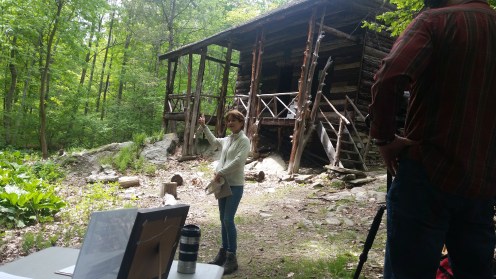
This post is based on talk I gave at the John Burroughs Association May 20, 2017 Slabsides Open House, assisted by my friends Lisa Zucker Glick, who read the John Burroughs’ quotations, and Jim Porter, who read the words of Walt Whitman.  For additional citations and references, please see “Running the Long Path.”

An edited video of the talk is available here:  https://vimeo.com/218372727

For more information on the John Burroughs Association, please visit johnburroughsassociation.org

20170520_122517.jpg
Joan Burroughs welcoming visitors to the Slabsides Open House


Continue reading “Discovering John Burroughs and Walt Whitman on the Long Brown Path”

Discovering John Burroughs and Walt Whitman on the Long Brown Path

Finding Black Birch on the Long Brown Path

Sunday was beautiful: sunny, calm, warm (in the 50s!) — a respite from the snow, ice, gusting winds, and heavy cloud cover more typical of February in  New York.  A great day to be alive and outdoors.

Driving back to the city with Odie the Labradoodle, I pulled over at a trailhead on the Long Path, figuring we’d sneak in a two- or three-mile hike.  The snow had largely melted, leaving only scattered patches, so I took off sandals and stepped gingerly onto the path and found it to be a manageable mix of dirt and mud that had warmed up nicely in the morning sun.  Odie scampered ahead, while I sauntered along, and soon we were clambering up the lichen-crusted granite rock face that marks the summit of Long Mountain, a 1,155-foot peak in Harriman State Park.  Carved into the rock is a memorial to Raymond Torrey:

20170220_110829

Continue reading “Finding Black Birch on the Long Brown Path”

Finding Black Birch on the Long Brown Path

Burroughs: Don’t Lose Your Connectivity with Nature

In Whitman:  A Study, the Catskills nature-writer, essayist, and philosopher John Burroughs  (1837-1921) defended Walt Whitman (1819-1892) against the hostile reactions of contemporary scholars, for whom Whitman’s poetry was too coarse, racy, and controversial.  In the book, Burroughs presented Walt Whitman as the “poet of democracy” and described him as a primal man, visionary of the open air, barbarian in the parlor, force of nature, and prophet.  But Whitman:  A Study isn’t just about Whitman, it’s also an exposition of Burroughs’ philosophy.  Inspired by both science and nature, Burroughs saw natural processes at work within society, and he explained how both physical strength and the vitality of culture can fade if we lose our connection with the natural world.  This message seems just as relevant for our information age as it was 120 years ago when  Whitman: A Study was first published.

Continue reading “Burroughs: Don’t Lose Your Connectivity with Nature”

Burroughs: Don’t Lose Your Connectivity with Nature

Tree Pose

The Stoic philosopher and Roman emperor Marcus Aurelius once wrote,

It is in your power, whenever you choose, to retire into yourself. For nowhere either with more quiet or more freedom from trouble does a man retire than into his own soul

— Marcus Aurelius, Meditations

This advice reminds me of one of the messages in the Bhagavad Gita, a two-thousand year-old Hindu text:

Wherever the mind wanders, restless and diffuse in its search for satisfaction without, lead it within, train it to rest in the Self.  Abiding joy comes to those who still the mind.

— Vishnu, Bhagavad Gita

I’ve been trying to put this advice into practice.  Walking down the street in the face of an icy winter wind, I make an effort to relax.  Instead of fretting at subway delays, I imagine shifting my brain into neutral gear.

The other day, arriving at a restaurant a few minutes before my wife, I took a deep breath and put away my phone…

Continue reading “Tree Pose”

Tree Pose