In a post last fall, I shared a photograph taken from the summit of Twin Mountain and made the point that after years of admiring the Catskills from the vantage of the Shawangunks, I had for the first time made the reverse connection.
Last weekend I returned to Twin Mountain, but this time with my friend Steve Aaron, who is a talented landscape photographer. And this time I saw something new….
Northern Shawangunks, seen from Twin Mountain in the Catskills. Photo: Steve Aaron Photography
Reproduced with permission from the author, Lorraine Anderson, here is a recent social media post that caught my eye:
So I’m hiking in the woods, loving the serenity and alone time with nature, and all of a sudden comes running a super fast runner up the mountain I was going down. It was a man wearing only a black pair of shorts. He was really super fast and quiet, if it wasn’t for the leaves underfoot , I wouldn’t have heard anything, no heavy breathing, light on his feet, I cheer him on as he approaches I say ‘way to go, you’re doing great! He smiles and says yesterday I ran up here carrying a rock. I said, Omgoogness! That’s awesome! What are you training for I ask. He says ‘life’ with a big smile. I said I love it ❤ that’s the best ❤
Credit: Lorraine Anderson, feelfitforever
Note: Carrying rocks uphill was a training method popular among Yurok Indians of northwest California.
You can follow Lorraine’s blog feelfitforever on wordpress.com — I particularly enjoyed a recent post in which she recalled her childhood love for nature.
In the Bhagavad Gita, Krishna advises Arjuna to “strive to still the mind,” which reminds me of a point made by 2nd century Roman emperor and Stoic philosopher Marcus Aurelius:
It is in your power, whenever you choose, to retire into yourself. For nowhere either with more quiet or more freedom from trouble does a man retire than into his own soul.
— Marcus Aurelius, Meditations
One day, while waiting for the subway, I decided to give it a try. Instead of fretting at the wait, I put away my phone and stood still. Anxiety faded, and the surroundings came into focus, as I slowly let out my breath.
A visual image had helped me make the transition: I imagined moving a gear shift into neutral. Then I wondered, could I shift into neutral while running?
(An updated version of this blog post was published in The New Rambler)
In her recent book, Grit: The Power of Passion and Perseverance, psychologist Angela Duckworth argues that the secret to success — whether for parents, students, educators, athletes, or business people — is not talent, but a combination of passion and perseverance she calls “grit.”
The dictionary definition of “grit” is “mental toughness or courage.” The term calls to mind gritting or clenching the teeth when facing up to an unpleasant task, or it makes us think of small particles of sand or stone that irritate skin, get in the eyes, clog machinery — the idea being that an individual with grit perseveres in the face of these frictions.
The gritty individual approaches achievement as a marathon; his or her advantage is stamina. Whereas disappointment or boredom signals to others that it is time to change trajectory and cut losses, the gritty individual stays the course.
Packaged for a self-help audience, the book is filled with stories about how grit contributed to the achievements of celebrities and other successful individuals, and it makes for fun and informative reading. However, many of us understand the point already, if for no other reason than we’ve seen the movie, True Grit (either the 1969 version starring John Wayne or the 2010 version with Jeff Bridges) or read the 1968 novel by Charles Portis on which the films were based.
While Duckworth does a nice job, her thesis falls short in that it fails to consider grit in the context of alternative mental strategies or consider the drawbacks and risks of grit. Interestingly, a more balanced assessment comes through in a close reading of True Grit.
Henry David Thoreau, the 19th century Transcendentalist and author of Walden, came under attack in the New Yorkerlast fall for his individualistic philosophy and seemingly anti-social attitude. This isn’t a new issue. His contemporaries regarded him as crusty and contrary and called him a hard man to like. The naturalist John Burroughs wrote that he lacked sympathy and compassion.
Is it OK to admire Thoreau’s writing, if he was really such an unfriendly person?
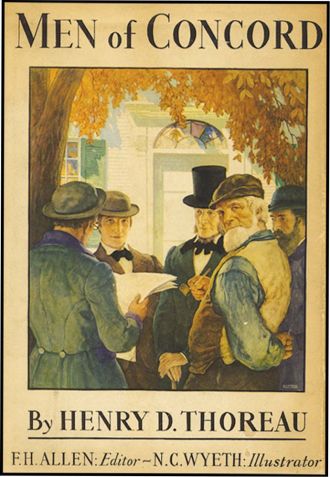
It was with this question in mind that I recently read Men of Concord, a book published in 1936 that contained selected entries from Thoreau’s journal over the period 1838-1860, with a special focus on interactions with his neighbors in the Massachusetts town of Concord. The idea came from N. C. Wyeth (1881-1945), a popular illustrator during the early 20th century and a great admirer of Thoreau’s work, who conceived of the book as a way to help the public appreciate Thoreau as a great American philosopher. He contributed twelve original oil panels, which were reproduced as color plates in the book and which are on display today at a museum exhibition in Concord.
A few weeks ago, my wife and a couple friends participated in The Great Saunter, a 30+ mile circumnavigation of Manhattan along the city’s Waterfront Greenway, and reported that they had had a great time. This seemed like a promising exercise for me, too, and not just for the training miles, but also for the experience of circling the island, which I had never done before. Accordingly, last Saturday morning after a cappuccino and a handful of mixed nuts, I headed out to Riverside Park on Manhattan’s west side. It was a beautiful, clear spring morning, with the forecast calling for sunny skies and moderate temperatures, although as I would learn later the temperature would peak at 91 F.
In a New Yorker article last fall, Kathryn Schultz attacked the legacy of Henry David Thoreau, calling Walden’s author “pond scum” and dismissing as unrealistic any political vision built upon his “rugged individualism.” Based on her reaction to Thoreau, she’d likely recoil in horror from Diogenes of Sinope (412-323 BCE), founder of the Cynic school of philosophy in ancient Greece. Known as “The Dog,” Diogenes lived in a tub, begged for food, and went barefoot, haranguing rich and poor alike for their pointless conformity, irrational behavior, and moral bankruptcy. Compared to Diogenes, Thoreau was pampered and tame.
You might be familiar with the image of a white-haired man carrying a lamp in daylight, searching for an honest man. That was Diogenes.
Statue of Diogenes in Sinop, Turkey. Source: Wikipedia
Brilliant philosopher, shameless exhibitionist, ragamuffin — take your pick, but before we concede to people like Schultz and dismiss the man, we have to ask the question, why is Diogenes still remembered some twenty-four hundred years after his death?
I recently came across a book by Professor Luis Navia of New York Institute of Technology, Diogenes the Critic: The War Against the World, which sheds some interesting light on this question.
Last Saturday, I climbed Sherrill Mountain, the final peak in my quest to complete all 35 of the Catskills’ highest mountains barefoot. It was also one of the most difficult, with briars, nettles, and steep slopes cloaked in dense thickets. But discovering new spring flowers made up for some of the strain.
After parking on Spruceton Road, the first challenge was crossing an open field with lumpy grass hummocks interspersed with briars. Then it was into the forest, where the briars gave way to the spring’s first growth of stinging nettles. I was wearing sensible long pants, but as for the feet, there was nothing to do but step thoughtfully.
I steered to the right of a little stream and began to climb straight uphill until eventually the nettles were left behind and I emerged into a grove of hemlocks. The last time I’d climbed Sherrill, I’d learned an important lesson, that it’s much better to turn and head up along top of a ridge, even if it means a little longer distance than following a straight line to the summit. On the prior visit, I’d stuck to the azimuth until I found myself cutting laterally across the face of a steep slope, where the slanted footing was slow and treacherous. I vowed not to make that mistake again.
Now I glanced at the map on my phone and realized that in my haste to head uphill, I had turned too early and was climbing the wrong ridge. To get back on course, I’d have to cut laterally across the face of a steep slope until I rejoined and then crossed that little stream. In my effort to avoid the mistake I made last time, I’d ended up making the same mistake.
After patiently picking my way along the slope, I hopped across the stream and headed up slope, now back on track. This was a difficult climb, as the slope was not only steep, but also carpeted with an extremely dense thicket of young beech and birch saplings, with plenty of hobble-bush thrown in for extra vexation. The only explanation for such thick young growth was that the hillside had burned in recent years, and it did seem that here and there a charred stump or log was visible poking up through leaves.
Hobble-bush (Viburnum lantanoides)
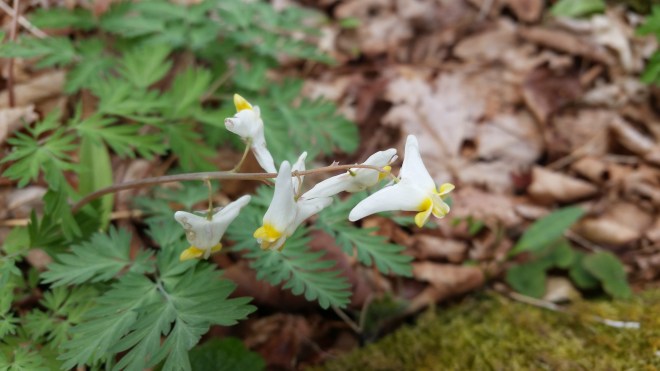
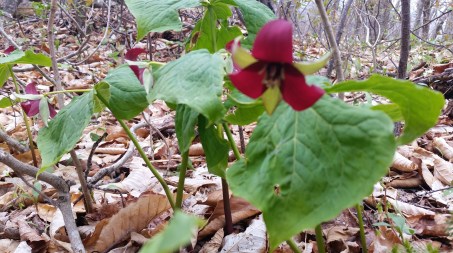
After a long time, I made it onto the ridge and turned left to head towards the summit. I reached a clearing and saw the summit up ahead after a short rise. But after climbing the rise, I saw higher ground further on. Along the way, I noticed familiar wild flowers, including Purple and Painted Trilliums, as well as unfamiliar species. Looking down, I saw a strange-looking plant with tiny white flowers shaped like pantaloons — but I didn’t have time to stop and examine it. Instead, I kept moving until I reached another clearing on a shoulder of the mountain, but upon checking the map, there was still one last rise in front of me.
I did eventually reach the summit and signed in at the canister. The trip had taken 2.5 miles, which was about double what I’d estimated from a quick glance at the map before heading out. That plus almost 2,000 feet in elevation gain made Sherrill one of the more difficult bushwhacks I’ve completed, with or without shoes.
Dutchmen’s Breeches (Dicentra cucullaria)
The return trip took almost as long, even with sandals, but with the mission complete, I took the time to photograph some of the spring flowers. Crossing the open field, with the car finally in sight, I snagged a toe on a briar, necessitating a band-aid. No major harm done, although sensible people will likely continue to prefer shoes when bushwhacking in the Catskills. Upon returning home, I submitted a inquiry to the Catskill 3500 club, asking if they would award a certificate for completing all 35 of the highest peaks barefoot, but have yet to hear a response.
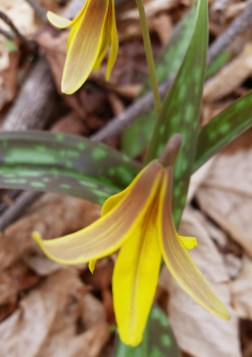
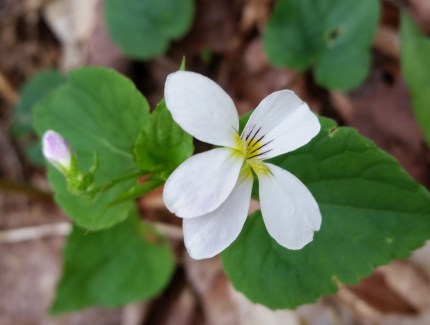
Purple Trillium or Wake-Robin (Trillium erectum)Trout Lilly (Erythronium americanum), so-called because the mottled patterns of its leaves are supposed to resemble the skin of a troutPainted Trillium (Trillium undulatum)Dog Violet (Viola riviniana)Sweet White Violet (Viola alba)Spring Beauty (Claytonia caroliniana)
In Whitman: A Study, the Catskills nature-writer, essayist, and philosopher John Burroughs (1837-1921) defended Walt Whitman (1819-1892) against the hostile reactions of contemporary scholars, for whom Whitman’s poetry was too coarse, racy, and controversial. In the book, Burroughs presented Walt Whitman as the “poet of democracy” and described him as a primal man, visionary of the open air, barbarian in the parlor, force of nature, and prophet. But Whitman: A Study isn’t just about Whitman, it’s also an exposition of Burroughs’ philosophy. Inspired by both science and nature, Burroughs saw natural processes at work within society, and he explained how both physical strength and the vitality of culture can fade if we lose our connection with the natural world. This message seems just as relevant for our information age as it was 120 years ago when Whitman: A Study was first published.
Following an unsuccessful attempt on the Catskills 9, I returned two weeks later to bag the three peaks I had missed, namely Slide, Cornell, and Wittenberg. It was six miles barefoot over steep and rocky trails, and then six miles return in Luna sandals, but a relatively uneventful journey without physical or mental drama. It was also a chance to appreciate the mountains, make new discoveries, and enjoy the signs of spring.









 The Long Brown Path