Working in a bank a few years back, I saw that everything important was documented, allowing auditors to review decisions for compliance with policies and procedures. Which begged the question — why wasn’t I documenting the important things in my life?
So, I opened a spreadsheet in Excel and created a training log. The first entry dates back to February 15, 2013. Evidently I ran 9 miles, although there is no indication of where or why or how it went.
Back then business travel took me to Florida from time to time, and I’d sometimes take advantage of a nearby beach to run barefoot – just for the novelty. On July 10, 2013, I ran 5 miles barefoot on Vero Beach. The following February, I ran 6 miles in Boca Raton. The hard-packed sand felt frigid underfoot.
I don’t remember when I read Born to Run, but Chris MacDougall’s warning that shoes predispose us to injury struck a nerve. Since I was struggling with running-related injuries at the time, I decided to conduct an experiment, although instead of running, I decided to try a barefoot hike. On August 25, 2015, while on vacation in the Italian Alps, I walked up a nearby ski slope, and what I remember most was how the cows stared at me in wonder, as if they’d never seen a human without shoes before. Two weeks later, back home in New York, I repeated the experiment on Peekamoose Mountain in the Catskills.
And then I went off the deep end.
Roughly one year later, I reached my 1,000th mile of barefoot training, comprised of running, hiking, and walking. Speaking of documentation, this quirky accomplishment inspired me to write up a blog post in which I explained that barefoot running had been an “interesting experiment” based on the “calculated bet” that more natural form would prolong my useful running life. I admitted to some surprise at the feeling of light-footedness, the exhilaration, the sense of a more direct connection with nature. Even so, I had no idea where this odd journey was going to take me.
When I reached my 2,000th barefoot mile, I published a second blog post, and thereafter it became a habit upon reaching the next thousand-mile-marker to write about what I’d done and learned. On June 22, 2025, I reached my 14,000th mile but skipped the report as I was busy — so here is my latest update, with the barefoot odometer now at 15,000 miles.
Let’s start with a summary of the last 2,000 miles, which took place between November 3, 2024 and January 12, 2026, a period spanning 434 days or roughly 1.2 years. These miles represented 89% of my total training volume during this period, as I sometimes wore shoes during the winter, and I also wore them during a ½ marathon trail race in Colorado because I didn’t want to make my son, who’s very fast, wait around all day for me to finish.
These 2,000 miles of barefoot training were comprised of 1,312 miles running, for 65% of the total, with 414 miles hiked or 21%, and the rest was walking on treadmills, sidewalks, and quiet country roads. These totals include only designated training exercises, where I was moving with a specific purpose in mind, whether to drive improvement in strength, endurance, mental focus, or technique, or merely to aid in recovery. These totals do not include going about town on errands without shoes, or visiting museums barefoot, or walking through airports and the like, although there are significant benefits to this activity, too, including the fact that going barefoot is fun, and fun is a form of psychic-spiritual energy which can be stored and put to use later.
Barefoot Hiking
414 miles of barefoot hiking might not sound like much, but it included bagging 144 mountain peaks, bringing me to a total of 603 peaks climbed barefoot towards my lifetime goal of 1,000. I am very pleased with this productivity, in part because injuries had interfered with progress the year before. Specifically, an irritated meniscus in my left knee had sidelined me in February 2024 and then again in October. Why, it stung so bad I could barely walk a mile – it ached even in the swimming pool with a buoy between my legs and no kicking – and the pain kept me up at night. But after limping around for the better part of a month, the tense angry knee started to relax. With some trepidation I ventured out to Ringwood, New Jersey, to tackle some of the small mountains there, and having surviving this test, I spent much of the fall hiking in nearby Harriman State Park, which is full of small mountains – some 59 of them, according to my count, all plus or minus 1,000 feet tall.
Previously Harriman hadn’t been on my radar, but now I found it a lovely place, with a mix of smooth and rocky trails, slabs of ancient gneiss surrounded by blueberry, shadowy U-shaped glacial valleys cloaked in laurel and rhododendron, while the summits are quiet grassy knolls in open forest, where you can sit and listen to the wind, admire views across the next valley, and from many vantage points on the eastern rampart observe the New York City skyline. The geometric silhouette with pencil-thin towers seems so alien, as if it were a scene from some sci-fi fantasy.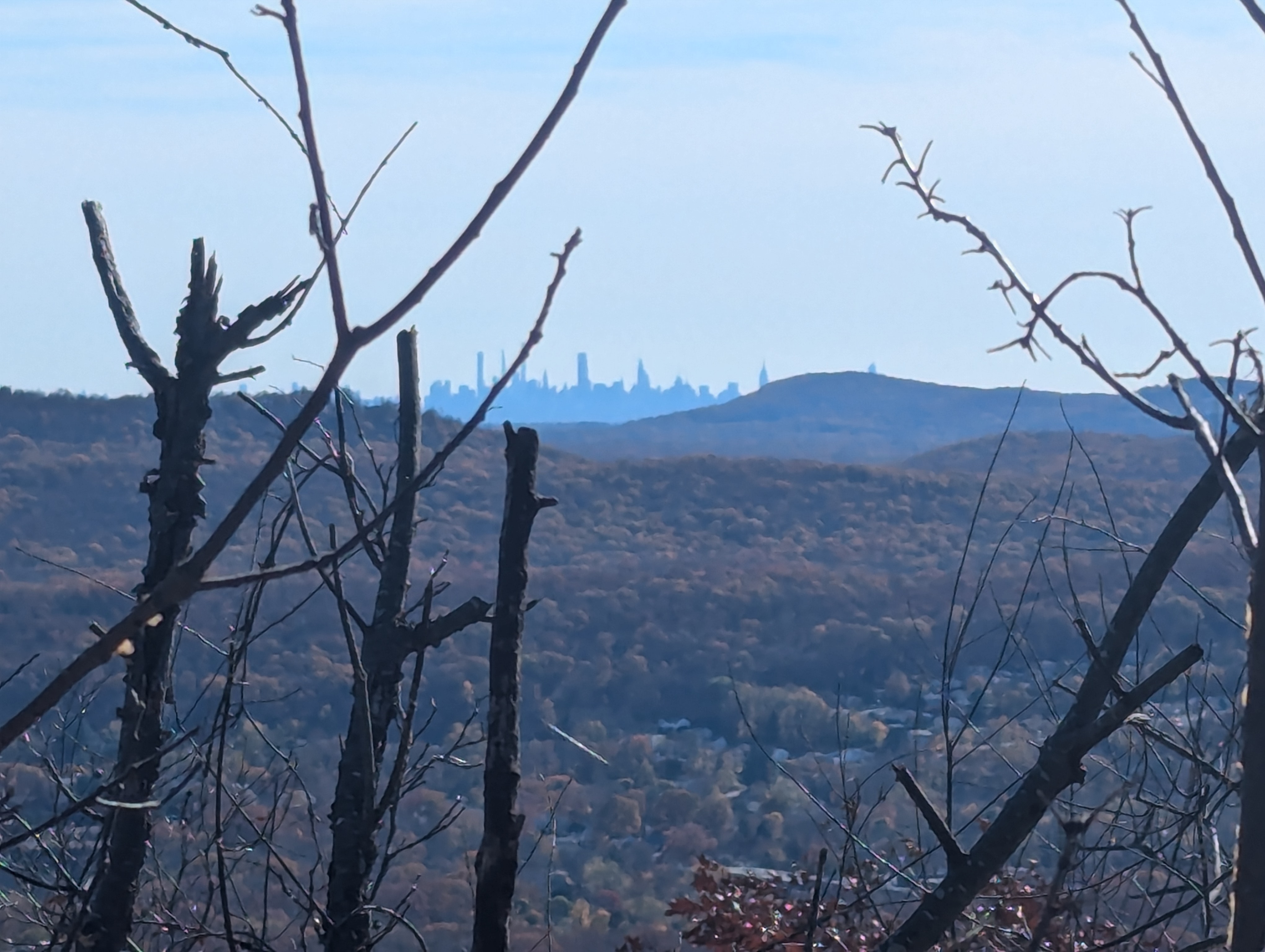
As a subgoal of my 1,000 barefoot mountain quest, I’ve decided to bag all the Harriman peaks. With the park being only an hour’s drive away, I’ve been able to get to 38 out of the 59 peaks so far, even venturing out in mid-December when snow and ice were dappling the north-facing slopes, but before temperatures dropped too far and the snow got too deep for shoeless travel.
Needless to say, as someone who’s completed the Catskills Grid, I wasn’t going to keep away from these old friends, and indeed made several visits to favorite trails, including a 15-mile out-and-back in the Blackhead Range. I also explored the Northern Catskills, which I’d last seen in 2013 when I thru-ran the Long Path. On the way to Evergreen and Packsaddle Mountains, I struggled through waist-high ferns tangled with bindweed and then, once I’d decided to cut short the hike and escape from this impenetrable mess, I got caught in a thicket of multiflora rose which was so stiff and thorny I had to pull on my shoes. Just to be clear – I’m not anti-shoe. It’s just that, as with any technology, we should use shoes mindfully, i.e., when speed is more important than the experience. When barefoot, I’m seeking an intimate connection with the land, not trying to rush.
In June I flew out to LA to visit to my cousin Brandon, and this trip gave me the chance to bag some mountains in the San Gabriels, including Baldy, Cucamonga and Strawberry Peak. My last hike on this trip took me to Mount Pinos, a high point in Kern County, whose name in the Chumash language is Liyikshup, meaning “center of the universe.” As I made my way toward the summit, a dust devil formed right on the trail and then blew past me, as if it were the manifestation of an angry spirit that resented my presence on this sacred ground, and I reflected on how much anger infects our world – why, I see it on social media all the time, even among my friends. The next moment, however, the sensation of anger vanished as I looked up and saw a splash of brilliant red – a field festooned with Indian paintbrush. According to the Chumash, Liyikshup is located in a place of mystery and resonates with harmony, balance, and tranquility. Appreciation for the mountains is widespread among California Indians, according to the anthropologist Jay Miller. They believe that a supernatural energy called “puha,” which is associated with rationality and memory, collects on mountain summits and radiates outwards in concentric recursive patterns.
In August, I traveled to New Mexico, where I summited Mt. Taylor (11,305 feet), which is the southern sacred peak of the Navajo and known to them as Tsoodził. As I followed a sandy path through groves of pine and aspen, I recalled the story of Gus Bighorse, who’d headed to this spot, after discovering his parents had been killed, to link up with Navajo warriors who were leading the people in resistance against the US Army.
I climbed nine mountains in New Mexico, in the process completing a local peak-bagging challenge organized by the Social Hikers Network. Afterwards, I drove off to Colorado to run in that ½ marathon (in shoes) with my son. Then I summited Quandary Peak (14,271 feet), which was my fifth barefoot ascent of a 14er. The trail was a tumble of granite blocks, and the winds at the top were ferocious.
Phoenix, Arizona was my destination after the holidays for a brief respite from New York winter, and there I was able to complete a second Social Hikers peak-bagging challenge. As part of this project, I hiked up to Fremont Saddle from which vantage point I looked out at Weaver’s Needle, a tower of welded tuft (fused volcanic ash) rising 1,000 feet above a rock-strewn desert valley. Fog was curling around the Needle’s feet and brushing against its back, while a ray of sun broke through the clouds and splashed on the valley floor and lit up a small hill several miles away. I told a Phoenix friend about this vision, and she insisted that I move to Arizona! Her proposal made me smile, although I remained strictly noncommittal – but that night I woke up and realized this had been a special vision.

I love barefoot hiking for the mindfulness and connectivity, but like many people, I struggle with balance in life. Even as I get older, I still feel that need — the need for speed. Meaning that running is as important to me as hiking, which leaves me feeling conflicted sometimes about which activity to prioritize.
Barefoot Running
Now, with respect to running, we must accept the reality of the aging process. Yet at the same time, we’ve got to stay in the fight. Once you stop fighting and surrender to your fate, the process of deterioration accelerates. Which is why we never say the words “I can’t” out loud – it can become a self-fulfilling prophecy. The question is how to balance the spirit of acceptance and that of fighting. The secret may well be to dial up or down the energy level as is appropriate for the return and risk. This takes self-control.
All meaningful tasks require self-control.
This was the message of Diogenes, founder of the Ancient Greek philosophy of cynicism, who practiced radical minimalism and called his peers to task for their lavish lifestyles and hypocrisy. “Nothing in life has any chance of success without self-discipline,” he is thought to have said, while with it “anything is possible.”
Over the last year, I made a point to work on speed, although mindfully and with care. During calendar year 2025, I completed 24 speed workouts, typically at the track. I also ran in 25 races. These races consisted of eight 5ks, one 4-mile races, two 5-milers, three 10-ks, five half marathons, and five marathons/ultra’s. In total, these 49 workouts and races average to one high intensity exercise per week, which is probably as much as I can do.
I race hard. The year before at a fourth of July 5k in Highland Falls, NY, I saw someone in front of me who looked my age. I ran so hard to catch him that I was practically in tears, but couldn’t — he finished 10 seconds ahead of me. But I set a barefoot personal best for the 5k distance. Which is not bad for being 61 years old.
This year, now 62, I tried that race again. That competitor did not return, but still I wanted to improve my personal best and ran as hard as I could. Afterwards, I felt quite good, but when I checked my training log, I found that this year’s time was a minute slower than the year before.
Oh, well. Nothing to do but keep trying – and I did, running hard at races throughout the year. But each time, the same thing happened – when I checked, I found my time had slipped.
To be fair, there were some injuries early in the year that took a toll. In January, doing squats and deadlifts in the gym triggered lower back spasms. Later that spring a physical therapist helped me improve my posture and alignment, borrowing from the techniques outlined by Stuart McGill in his classic book, Back Mechanic. But this was too late for the Cowtown Marathon in Fort Worth, which took place in February. For the second time I ran the Cowtown barefoot and in a cow costume, a little slower than I would’ve liked due to my grumpy back. But the friendly spectators were very encouraging as they shouted, “Go, barefoot cow!”

In late April, with my back finally feeling better, I toed the starting line for a 5-miler and decided to take a calculated risk. I thought back over my running career – now 45 years in duration — and besides an occasional calf or hamstring strain, injuries when running at full speed had been pretty rare. So I pushed the throttle forward and punched the afterburners and raced as hard as I could – until mile 3, at which point I felt a sharp burning sensation in my left proximal hamstring. I came limping into the finish at a slow jog. On a positive note, I’d won my age group. But with the Cincinnati Flying Pigs Marathon only a week away, my calculated risk had gone awry.
For what it’s worth, that strained hamstring was only the second injury I’ve experienced in the last ten years while running barefoot. The list of injuries I’ve experienced in shoes now fills a full page and then some. In any case, the goal at Flying Pigs was merely to finish without destroying myself. With a pocketful of ibuprofen and a strategy of jogging slowly on the flats and walking every single uphill step, I got it done. Along the way I passed a 90-year old “streaker” who was completing his 27th consecutive Flying Pigs run. Suddenly I realized that if I returned to this event each year for the next 26 years, I’d be his age. Maybe he is my future self – and maybe I am his ghost.
In June, after visiting Liyikshup, I drove to Morgan Valley, Utah for a marathon. The race was a disaster. It took place on rough country roads, paved in “chip and seal,” the kind of surface you recognize while driving from the tires’ noisy rumble. At mile 16 I gave up and put on shoes and even then I could hardly move.
Later that year, I decided it was time to return to ultra-running. At the 24-hour Hainesport Endurance Run, I allowed myself to run 70 miles, which was the longest distance I’d ever gone barefoot, and the longest race I’d completed in nearly 10 years. Since the race went well, I signed up for the Fat Ox 24-hour run with the goal this time of going for 100 miles, a distance I used to run routinely. I set out with great confidence and 24 hours later reached 74 miles. Well, it was a small improvement. I guess with age, everything gets harder.
At the Houston Marathon in January 2026, the last six miles got progressively slower and more difficult, and this despite it being a beautiful smooth course underfoot. Later I saw a Facebook post by a 74-year old who commented on how injuries earlier in the year had left him feeling fearful, yet he finished 45 minutes ahead of me.
Well, there’s nothing to do but keep working.
Right now, I’m in Detroit, where it’s cold and continuously snowing. I don’t know what my journey to 16,000 barefoot miles will look like, but I’ve already reached 15,052 thanks in part to the hotel treadmill. Not the most exhilarating modality, although the machine offers me connectivity to a black rubber mat. Call it a variation on “grounding.”
In any case, I’m thrilled to be moving.
Chasing the Grid is available on Amazon!

 The Long Brown Path