A reader asked me to “share what a few days’ worth of eating has been for you.”
Glad to. I’ve been pondering diet for years. And I’ve concluded that our approach to food must be deliberate. Thoughtful. Mindful. The way you would move on patrol behind enemy lines – because the environment is clearly risky — or how you would step through a minefield.
I first started thinking about the topic as a teenager, on a summer vacation trip to a middle eastern country. The surprise – how their food was so tasty, compared to what we ate back home. I put my young finger on a possible cause – their economy was not as advanced as ours, meaning they didn’t have as much refrigeration equipment, so the food had to be prepared and sold while it was still fresh. This was back in the 1970s, and a lot of what we ate came in cans or was frozen, like seafood, which tasted awful.
Fast forward to the 1990s. I’m in my late 30s now. Drinking Cokes to stay alert while driving — nibbling on candy during those late-afternoon lulls — partaking of the giant cupcakes passed around for co-workers’ birthdays and feeling queasy afterwards — dutifully eating oatmeal for breakfast and feeling famished by 10:30 am — often “hangry,” i.e., suffering from blood sugar crashes, and becoming insufferable and cranky. I looked around me. Obesity was noticeable, and people were talking about it. I saw colleagues getting sick and dropping from the work force. I did a “tactical risk assessment” as I’d been taught in my Army days and decided to pay attention.
That was a good call.
Today obesity is a major problem. Over 40% of the US population is considered obese, on top of another 30% deemed overweight, which means only 30% of us are thin.
And it’s not just about looks, because obesity is a health risk. And for this and other reasons, life expectancy is now falling. It peaked in 2014, slid over the next few years, plummeted during the COVID pandemic, in part because the virus preyed on those who were metabolically sick. Also, the gap between lifespan and healthspan is widening, which means that healthy years lived are falling even faster.
Strangely, life expectancy in the US is lower than for other advanced economies, which doesn’t make a lot of sense since we have the single most advanced economy in the world.

Unless economic progress is now a root cause of chronic illness.
Could it be that the modern world is beginning to kill us?
Back to diet. That reader asked me to share what I ate over the span of a few days. For breakfast on Friday, January 10, 2025, I had three hard-boiled eggs, an apple, and a handful of grapes.
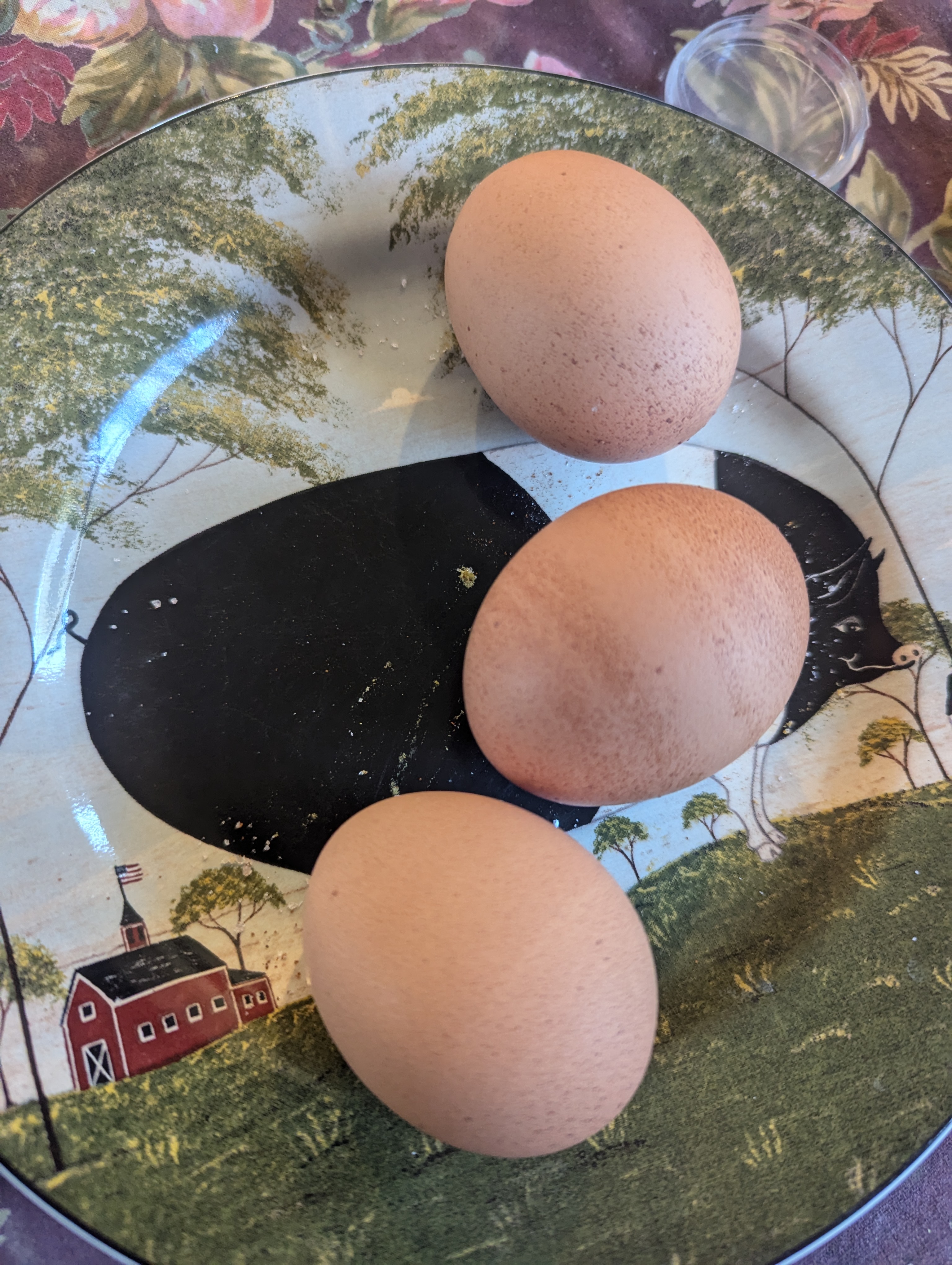
Let’s talk eggs. When shopping, I look for the words “pasture-raised,” hoping that the chickens enjoy a natural diet – plants, seeds, small fruits, insects – rather than chicken feed, which consists mainly of corn. I like the yolks dark orange, which suggests they contain healthful nutrients. You can buy boiled eggs in the supermarket, and sometimes I’m tempted to because this saves me the bother of boiling them myself and then having to peel the shells — but I’ve noticed the yolks are quite pale. That may be a sign that these eggs come from factory chickens fed corn-based feed, and that the egg contains fewer nutrients. One of the challenges we face with industrial farming is that everything is bred for maximum yield. That’s true for crops, and for animals, and in most cases the animals consume feed made from those crops. Of course, any business has to maximize yield. But when corn, wheat, and soy are grown in massive mono-species plantations, it’s hard not to believe the soil was depleted of nutrients years ago. In which case, what we consume is a function mainly of water, fertilizer, pesticide, sunlight – plus artificial flavors to mask the lack of nutrients and to stimulate craving and overconsumption. These flavors are also put in animal feed (they’re called “palatants”) to get the animals gorging on stuff (which maximizes yield) that otherwise they would find tasteless and unappealing.[1]
Just for fun, I sprinkle salt and paprika on the eggs. I like deviled eggs, which you can buy at the supermarket, but I noticed the ingredients include seed oils. I haven’t studied the risks associated with seed oils in great depth, but I hear smart, independent people (for example, Tucker Goodrich) commenting on how these oils become rancid and inflammatory when heated and how they contain a much higher quantity of omega-6 fatty acids than what was present in our ancestral diet, which may contribute to health problems.[2] In any case, seed oils are ubiquitous. Walk down the aisle of a grocery store and read the labels – they’re in all the processed foods. Try to find a restaurant that doesn’t cook with them (once I asked to see the butter my eggs were cooked in, and the diner staff showed me a tub of butter-flavored soybean oil). Nor is the meat supply safe, since animal feed often contains the stuff. This ubiquity makes seed oils a “concentration risk,” to borrow a term from the field of risk management. So why not stay away.
Let’s talk fruit. I like fruit, but I’m mindful of the sugar content. “Glycemic load” refers to the quantity of digested sugar that shows up in the bloodstream per unit of time. Whole fruits contain water and fiber, which slows the digestion of the sugar, reducing the glycemic load. Dried fruits and fruit products like jams and jellies typically have much higher loads – for me they are rare treats because I know if I eat more than a small amount of raisins, figs, or dried mango, I will quickly feel queasy. Among whole fruits, grapes have a lot of sugar. I used to avoid them completely; now I enjoy them in limited quantities – typically a handful or two.
Foodstuff
Glycemic load/serving
Apple
6
Dried apple
10
Apple juice
11
Dried figs
16
Grapes
8
Orange
5
Orange juice
12
Raisins
28
Strawberry fruit bar
23
Oatmeal
24
Bread
8-12
Source: Fiona S Atkinson, Jennie C Brand-Miller, Kaye Foster-Powell, Anette E Buyken, Janina Goletzke, International tables of glycemic index and glycemic load values 2021: a systematic review, The American Journal of Clinical Nutrition, Volume 114, Issue 5, 2021, Pages 1625-1632, ISSN 0002-9165, https://doi.org/10.1093/ajcn/nqab233.
The problem with eating lots of sugar is that it spikes your insulin, which causes blood sugar to be stored as fat. While you’re storing fat, you can’t burn it, which means you lose fat metabolization as an energy source and may become quickly hungry again. The cycle of blood sugar spikes followed by cravings can lead to constant snacking and continual weight gain. Plus too much insulin production can exhaust the pancreas and leave the body insulin-resistant, leading to chronic excessive blood sugar, which is the gateway to type 2 diabetes — and these metabolic ailments are thought to be contributors to or potentially root causes for chronic ailments ranging from cancer to Alzheimer’s.[3]
As a caveat, these are theories, and not everyone is in agreement. Some researchers blame sugar, others point to seed oils as the real problem, while factors like sedentary lifestyles, lack of exercise, and mental health must be considered as inputs to the obesity equation. Mainstream scientists have been slow to weigh in, but here’s the problem – much of mainstream science is funded by industry. Several years ago I was startled to learn that the primary funding sources for the American Heart Association are Big Food and Big Pharma. It’s a convenient arrangement. The industry can point to sponsorship of not-for-profit organizations as evidence for their commitment to public health. But the not-for-profits understand all-too-well, without anyone having to speak a word aloud, that they best serve their funding sources by conducting “scientific” research that supports current practices, rather than challenging them. You might remember from back in the day, how four out of five doctors recommended unfiltered Camel cigarettes. The same playbook is likely in use today. How else can you interpret a $3 million NIH-funded study by Tufts that describes sugary breakfast cereals as healthier than meat and dairy products?
Which is why you and I, as individuals, need to be deliberate, thoughtful, and mindful about food. And skeptical, too.
For lunch on Friday, I had a plate of mozzarella cheese, grape tomatoes, and basil leaves, with a sprinkling of olive oil. And an avocado.

Regarding olive oil, one challenge in the US is that food manufacturers can cut the olive oil with seed oils (which are less expensive) without having to disclose this on the label. Think of this as a version of seigniorage, the ancient practice of diluting the precious metal contained in currency, which was an important source of profit for monarchies, so long as no-one noticed. In an economy with scare resources, suppliers of every good and service will tend to cut corners to save costs, if they can get away with it. In a competitive economy, they have no choice. Which means that consumers must always be vigilant regarding quality.
To mitigate this risk, I now buy olive oil from Villa Capelli, an Italian producer recommended by Vinnie Tortorich. I’ve followed Vinnie’s work for years. Seen him advocating for diets low in carbohydrates. Warning people away from grains and sugars. Promoting the importance of healthy fat. I trust his judgment.
Let me comment on grape tomatoes, because in the spirit of full disclosure, I eat a lot of them – especially the orange ones, which I prefer, although they come in red, yellow, and purple, which are tasty, too. When I was a kid, the tomatoes available in the grocery store were hard as rocks, as they’d been bred to survive transport via jet and truck from distant farms. It was nice to have them in the winter, when midwestern fields lay fallow under snow, but of taste they had little. Today’s supermarket tomatoes are fresh and tasty year-round. They come in a myriad of shapes, sizes, and colors, including exotic heirloom varieties. No, they’re not quite as delightful as what you can pluck straight from the vine at a local farm during the month of August. But they’re pretty close.
My point here is that the modern industrial food supply system in our advanced economy produces both good and bad. Which means that our principal strategy as consumers must be to choose with care. In other words, to discriminate. This requires a deliberate, thoughtful, mindful approach.
The problem is more complex than it might seem. Our paleolithic ancestors lived in the same locale for generations. They became highly adapted to food sources among the local flora and fauna. You and I, however, are likely descended from a mix of people who lived in different places. As a result, we face a perplexing challenge — to match the ever-changing mix of modern foodstuffs with the mix of needs we’ve inherited. And we probably don’t know much about our ancestors’ diet, even if we can trace the family tree back more than a generation or two. The way to approach this challenge is to adopt an N=1 attitude and follow test-and-learn procedures. And we need to pay attention to what our stomachs have to say.
Friday dinner was Sicilian-style sweet Italian sausages, from Full Moon Farm, a farm located a short drive from my home. I know the farmer, Paul. I know the cows, lambs, and pigs graze in pastures. Still, I read the ingredient label — “ground pork, water, sea salt, black pepper, whole, fennel seeds.” This is acceptable.

On the side, some pickles. I introduced pickles into my diet recently, after seeing an influencer on the social media platform X recommending them. Chris Cornell (@BiggestComeback) lost 80 pounds of excess body weight by shifting to a low-carbohydrate diet, typically limiting carbs to 50 grams per day or less. One of his key themes is satiety — he chooses foods that leave him feeling satisfied, not bloated or distended, while avoiding the processed stuff that leads to endless cravings. A favorite meal for him is ground beef with cheese and some pickles. On this diet, he’s sustained his 80-pound weight-loss for several years. I read the label – “cucumbers, water, distilled white vinegar, salt, garlic, dill, grape leaves.” This is acceptable. Once I bought a jar of pickles which I noticed, after I’d eaten them, contained an artificial sweetener. I felt deceived.
For dinner I also had an orange bell pepper. This is another example of how the food supply has improved. When I was young, we had green peppers. Which were fine when sliced up and thrown into a stew or casserole, but on their own, they were, like the tomatoes of that time, unappealing. Imagine my surprise when a young woman in a foreign movie (I think it was Russian) took a green pepper in her hand and bit into it like an apple. Back in the 1970s, we wouldn’t do something like that.
Fast forward to today and we have peppers in all sorts of colors – dark green, pale green, and my favorites – red, orange, and yellow. The best come from local farms in late summer – they have more taste and texture than the supermarket varieties, which are thinner and a little watery-tasting. But the supermarket varieties aren’t bad – plus they’re available year-round and they come in convenient packaging: bags of snack-sized peppers, individual fist-sized bells, packages with one each of red, orange, and yellow.
I ate my orange pepper like an apple, tossing away the stem and seeds.
For breakfast the next morning – nothing. Nada. Except for coffee.
I’ve been practicing intermittent fasting for ten years. My protocol, which I track in my training log, is specific: 150-200 hours of fasting per month, in minimum blocks of 16 hours, plus a single fast each month of at least 30 hours. In practice, 16-hour fasts typically mean skipping breakfast. For example, if I finish dinner at 8:00 PM, then I need to hold out until noon the next day. Ten of those blocks sum to 160 hours, consistent with the monthly target. During the monthly 30-hour fast I’ll go a whole day without food.
Why go through this bother? For metabolic health. My theory is that without refrigerators, our distant ancestors didn’t eat every day. They were constantly out on the move, hunting and gathering, and sometimes came up empty-handed. Too much regularity, i.e., three square meals every single day, may lead to metabolic weakness – if the body doesn’t need to burn fat to sustain itself during periods of absence, it won’t – and its fat-burning capabilities may attrit. This seems to be happening. For example, I’m amazed that the typical hiker can’t make it through a day-hike without stopping for a snack. Ditto for the typical runner, who can’t complete a long run without sucking down sugary gels. This is part of a bigger problem – comfort leads to weakness. For example, people who sit indoors all day may struggle with outdoors heat and cold and they may not be able to walk long distances or run.
Typically, I do the 16-hour blocks on weekends, as going without food while I’m hiking or running isn’t difficult (I’ve run plenty of marathons without food, and once ran 50 miles with zero calories). It’s much harder for me to skip food while I’m sitting motionless, for example, while working on my laptop for long periods. During extended sedentary periods I feel like my body shuts down. Stops burning fat. I feel hunger pangs. The food in the kitchen starts calling. I find myself checking the clock. What helps in these situations – breathing deeply, drinking a glass of water, taking a break and going for a walk.
Typically, I do the 30-hour fast while traveling. It’s nice that airport shops now offer snacks with more protein, like cheese, processed meats, and boiled eggs. But without detailed labeling, you have to assume this stuff is fashioned from the lowest-cost ingredients available, which means factory-raised chickens and corn-fed cows. And airport food can be quite expensive. I was so upset the other day when I reached for a cup of fruit, only to find the price was $7 (feeling outraged, I returned the item to the shelf).
The longest I’ve fasted is 48 hours. I was traveling to a business conference, and chose not to buy anything at the airport either coming or going. During the conference itself, I abstained from the breakfast buffet, which looked pretty good, and the box lunch, which was disgusting. We’re talking a sandwich which is mostly bread — a bag of chips — a large cookie – a tub of pasta salad — a measly apple. All carbs. Predictably, these lunches spike my blood sugar, then the insulin response shuts off fat burning. My energy drops. I start nodding off during the afternoon meetings, which is not a good look. The greatest benefit of fasting is that it gives me the confidence and thus the self-control to stay away from bad choices.
Having skipped breakfast, I went for an 8-mile run, then headed to a favorite coffee shop for a late lunch (17-hour fast complete, and noted in my training log, bringing me to 185 hours fasted over the last 30 days and therefore in compliance with my protocol). Lunch consisted of avocado toast with two eggs, a scone, and a cappuccino.

I eat very little in the way of grains, but as this meal indicates, I don’t totally abstain. With respect to bread, there is not only the issue of glycemic load (a slice of bread may have as much sugar as a small candy bar). But there is now the disturbing development that wheat is often harvested with glyphosate, aka RoundUp, the popular weedkiller. What they do is spray glyphosate on the crop to desiccate or dry out the wheat prior to harvesting it, which prevents mold. Stephanie Seneff, a researcher at MIT, has warned that glyphosate is a significant threat to human health and the environment and possibly a contributing factor to the surge in autism, Alzheimer’s, chronic fatigue, cancer, and autoimmune conditions. I haven’t read her book,[4] and I understand that some people view the conclusions as controversial, but you’ve got to imagine that Monsanto (now owned by Bayer AG) would fight to preserve a product with $8 billion in annual sales. I’ve listened to Ms. Seneff being interviewed and whether she is right or wrong about glyphosate, she is very intelligent. Incidentally, you and I as laypeople don’t need to figure out debates like this — all we need to do is recognize that when smart people are arguing, that means there’s controversy. So why not stay away.
I also ate a scone, which is pure carbs. Having just run 8 miles, and coming off a 17-hour fast, I felt like a few more calories were in order. And maybe that was the right call, or maybe it wasn’t, because on the drive home, I didn’t feel 100% — my energy level dropped to, like, 90%. Once I was home, it dipped to maybe 85%. I find that too many carbs can produce a fluttery kind of energy, which is not as consistent or reliable as the power provided by good protein and fat. Many years ago, my wife would cook a big pot of spaghetti. Who doesn’t love spaghetti? I’d shovel down a plateful, and often a second plate as well, stagger to the living room, collapse unconscious on the sofa – only to be awakened 30 minutes later by complaints that I hadn’t washed the dishes.
As an aside, fasting puts me into a totally different energy-state. Mental clarity is excellent. Energy is plentiful, albeit my mindset becomes conservative. Time slows. I feel no inclination to rush. Rather I take on one task at a time and move along step-by-step. I become like a cheetah scanning the veldt, tracking a herd of antelopes. Yes, I have the energy to kick off the chase, but I don’t want to waste effort going after an animal that’s too fast or far away. Better to be patient. Better to wait for the right target to appear. Better to be deliberate. Thoughtful about the options. Mindful.
After this high-carb lunch, my energy-level eventually recovered (back to 100%). I spent a productive afternoon working on the computer for several hours, only to look up at the clock and remember I had an evening appointment. Dinner would have to be fast. I reached into the refrigerator and grabbed a wheel of brie and some left-over chuck steak I’d cooked a couple of nights back.
I ate the entire cheese, which consisted of 72 grams of fat and 32 grams of protein, spreading it on some tasty crackers (containing bits of apricot and pistachios but no offending ingredients — no seed oils) and comprising just under 50 grams of carbs. The chuck steak came from farmer Paul’s Full Moon Farms, which means the cows were 100% grass fed.
It may strike some as strange to eat such large quantities of fat and red meat, since they have long been vilified by the mainstream press. Years ago, I too avoided fat and red meat, thinking they weren’t safe. Until I started to look into the so-called science behind these claims. The fundamental problem with nutritional science is that it’s nearly impossible to measure the long-term effect of different foodstuffs on people’s health. Imagine taking 100 people and locking them in a laboratory. You feed one group salads and the other steaks. Measure what happens over, say, ten or twenty years. And no, you can’t let them leave the laboratory, without a scientist or a policeman to escort them, lest they sneak off and go eating all the things they weren’t supposed to and ruin the experiment. What happens in practice is that researchers ask people to keep food journals, and then they assess health outcomes over time. But this method suffers not only from the unreliability of people’s notes, but also from the fact that the subjects aren’t separated into random groups. These are not Randomized Controlled Trials – they are exercises in “data-mining,” meaning that the correlations that show up between variables may not reflect much about the underlying causes.
I have a simple thesis to explain why plant-based diets get praised in mainstream publications while fat and meat get shamed — the companies that produce plant-based stuff are much bigger and more profitable and thus have much larger budgets to fund so-called scientific research and then publicize the results. Check out the table below, comprised of the top ten food companies in the US and globally. Revenues for the meat-focused companies, namely, Tyson, JBS, and Hormel, total $111 billion, only 19% of the industry total of $575 billion. The two dairy-focused firms, Danone and Land O’Lake, represent another 8%. Put simply, three-quarters of revenues are associated with firms that are largely focused on plant-based products. Therefore, it would be logical to assume that there are 3x as many scientists working on research to promote plant-based diets, and that the marketing and advertising budgets for plant-based foodstuffs are 3x as large. I suspect that some of the research blaming climate change on the flatulence of cows is subsidized by these giant companies, although that’s just a guess.

Source: https://xtalks.com/top-food-companies-in-2023-by-revenue-according-to-fortune-500-3817/ and https://vinut.com.vn/product-knowledge/top-10-largest-food-and-beverage-companies-in-the-world/
Breakfast, Sunday, January 11, 2025 — Nada. Another intermittent fast (22 hours, bringing me to 207 hours over the last month), and then a long day at the track, where I ran 20 miles.
On the way home, I stopped at the grocery store to stock up. As I walked down the aisles, I asked my stomach for its opinion. We passed lettuce and spinach, asparagus, broccoli, cucumbers, and mushrooms, and my stomach was silent. Although I happily grabbed some tomatoes for lunch and some extra peppers (orange and red).
A smattering of foraging with my friend Heather Houskeeper, who is an expert botanist and herbalist, has taught me to pay attention to what my stomach has to say. When out on fall hikes in the mountains, I snack on mountain ash berries and Japanese barberries, which have a super sour punch – but there’s something there my stomach wants, so I grab another handful. During late summer, I nibble on chicory leaves for that bitter taste like arugula, and my stomach urges me to have a little more, whereas supermarket produce evokes no interest. The best mushrooms I’ve ever had were chantarelles growing naturally in the soil, which I’ve harvested in New York and Maine – but now I walk past the mushrooms on the shelves without pausing – I can’t imagine but they’re grown in sterile soil whose only purpose is to provide stability. I can’t imagine buying lettuce or spinach in a supermarket – I don’t think there’s anything in the leaves besides cellulose and water.

Once I ran a 50k ultramarathon (30.1 miles) in a fasted state, having not eaten anything since the night before. By the end of the event, I estimate my calorie deficit was around 4,000 kcals – equivalent, perhaps, to a full pound of fat. Once I crossed the finish line, I helped myself to the goodies available at the aid station: bacon bits, grapes, pop-tarts, potato chips, cookies, gummi bears. I remember being startled by the dramatic flavors. Then I realized with sudden force that what my body craved was energy and nutrition – not taste. In the modern world, taste is there to distract us from poor quality.
For dinner on January 11, I sauteed a grassfed ribeye steak, this time from the grocery, not farmer Paul. I visited the website for the brand (“Nature’s Promise”) and found extensive disclosure about the organic nature of the beef, but whether “grassfed” meant the cows ate “some” grass or “only” grass was unclear. No matter, the meat had the clean look and fresh taste I associate with grassfed – as opposed to the greasy quality and excessive marbling I find in corn/wheat-fed beef — and my stomach gave it a thumbs-up. Grassfed beef is a staple for me, and it’s honestly another example of how the modern food supply system delivers high-quality fare, when consumers demand it. I remember years ago, strolling through the supermarket, thinking to myself how it would be nice to buy grassfed beef – I opened my eyes, and there it was, as if the store had been listening to my thoughts.
For dessert that evening I had a couple of squares of dark chocolate. 100% cocoa, meaning zero sugar added. The ingredients label on the box reads “chocolate.” I used to buy the 80% and 90% varieties, but found the bars unappealing, since I craved the sweetness I associated with the Snickers Bars, Milky Ways, Raisinets, and M&Ms which I’d eaten as a child. One day I read that Italians used to take their hot chocolate “bitter.” Meaning they did not add sugar, just as they didn’t use sweeteners in their coffee. A light bulb went off in my mind with a brilliant flash. Like the Italians, I don’t take sugar in my coffee – and thus it followed logically that I shouldn’t need it in my chocolate, either. From that point on I’ve embraced the 100% variety, and it’s become another staple. The flavor is quite intense – and I rarely eat more than a square or two. Whereas with respect to conventional chocolate bars and candy, I have never once in my life failed to eat every single bite within the wrapper, regardless of the package size.
In Summary
To be honest, I’m not as completely disciplined as these three days might suggest. I have a weakness for sweets, and sometimes a bag of M&M’s or a chocolate cookie or an extra scone slips through my defenses – especially when I’m out on business travel and bearing some extra stress. And I do eat out from time to time, and then I have little control over the ingredients, although I’ll often order hamburgers without the bun (limits glycemic load) and once a waitress stared at me and said, “why, you’re keto, too!”
Also, notwithstanding the risks I am highly attuned to, I consider myself an optimistic person. I expect the decline in life (and health) expectancy cited earlier will slow and eventually reverse, especially as more attention is brought to these issues. Whatever you think of our recent elections, “Make America Healthy Again” has become a rallying cry. It’s hard to imagine that where we focus our attention, we won’t make things better.
The biggest risk would be that the average person doesn’t care. Views health as a luxury. Inclined to deploy all their mental resources against work and family goals. Lets the body take care of itself. Relies on the medical-pharma complex for assistance. After all, there are these new shots which cause people to lose weight rapidly, although the side effects are said to be difficult to tolerate. Well, I can’t criticize people for choosing this path, so long as they make their decisions thoughtfully.
As for me, health is just another word for life. I want to run more races hard and maybe improve my times. I’ve got 515 mountains left to climb to reach my lifetime goal. And I want to take the joy and energy from these activities and infuse them into everything else I do – even working on a laptop. And in this way set a good example of how to live a productive life — for my colleagues, friends, and family members. For my grandson. Additionally, I’m no fan of hospitals, procedures, and pharmaceuticals – I’d like to stay as far away as possible.
Count on me to stay mindful, cautious, disciplined – for as long as I am able.
[1] This point is the underlying thesis in The Dorito Effect: The Surprising Truth About Food and Flavor, by Mark Schatzker
[2] See Tucker’s recent article with economist Tyler Ransom
[3] Re Alzheimers, which is sometimes referred to as “Type 3 Diabetes,” see the work of Dr. Dale E. Bredesen. Re cancer, see the work of Thomas Seyfried
[4] Toxic legacy : how the weedkiller glyphosate is destroying our health and the environment Seneff, Stephanie, author. 2021
 The Long Brown Path
Thanks so much Ken!
RH
LikeLiked by 1 person