I’ve set myself a daunting objective – bag 1,000 mountains barefoot — a task so large it will take many years to complete. It’s a crazy project — partly an effort to retreat from the digital environment, refresh, refuel, and rearm so I can reenter the fray — partly a chance to live more naturally, as a participator in nature instead of as a passive observer — partly a chance to explore and learn, and the funny thing is, the project keeps dragging in themes and thoughts about the rest of life, and snatches of history. Regardless, I’m not even at the half-way point, so better keep moving.
This summer I summited some big ones, including the Navajo’s sacred mountain of the west, Dooks’o’osliid AKA Humphrey Peak (12,633 feet) outside Flagstaff, Arizona, and Colorado’s Mt. Elbert (14,440 feet), the second-tallest peak in the continental US. It was slow work, though, with six summits eating up two weeks of precious vacation time, a rate of progress so slow I might well be 100 years old before I finish.
Once back home, I turned my attention to the nearby Taconic Mountains, a range of low-lying peaks situated in eastern New York and western Connecticut and Massachusetts. Soon I was pouring through online maps, fascinated by these ancient mountains, typically only 2,000 feet tall. To get four, five, or six of them in a single day seemed eminently feasible, which was an exciting prospect for somebody with so much to do. I was thrilled, too, for the chance to explore new places, which I hadn’t expressly included in the mission statement for this quest, although presumably it was part of the subconscious calculus. When I found a Saturday in my calendar with nothing scheduled, I was delighted.
So here I am in my black Jeep, bumping down a gravel road in Mt. Washington state forest, kicking up a cloud of dust. No, not the presidential range in New Hampshire, where Mt. Washington looms 6,000 feet overhead, boasting the worst weather in the western hemisphere. This is a township in western Massachusetts so small (population 165) I didn’t notice it when driving through.
I nose into a parking area big enough for maybe three cars. Glance at the trailhead sign. Shoulder pack. Hit the start button on my watch to track distance and elevation. Head out on the trail, hoping, as always, for smooth surfaces but ready for rocks.
It’s such a quiet day. The air is still, the forest shadowy and silent. Here the rocks are metamorphic schist or phyllite, thin layers of sediment laid down in ancient lakebeds, compressed over eons, now flat and smooth to step upon, which is nice when hiking barefoot. Except where the strata is tilted, exposing the layers’ broken edges. Now I’m placing soft feet on sharp wavy edges containing interbedded veins of harder rocks like quartz and chert. I am walking upon the Taconic Allochthon – a 25 mile wide layer of rocks that got shoved up and to the west, coming to rest on top of the underlying bedrock, some 440-470 million years ago when an island arc pushed against the side of ancestral America and the Appalachians were first birthed.
A slow, steep, painful scramble takes me to the top of my first peak – Round Mountain, elevation 2,280 feet. Views of rolling hills. Mostly green, with some sallow hints of autumn. The late September sun hangs in an empty sky, beaming down mildly – warm but not hot.
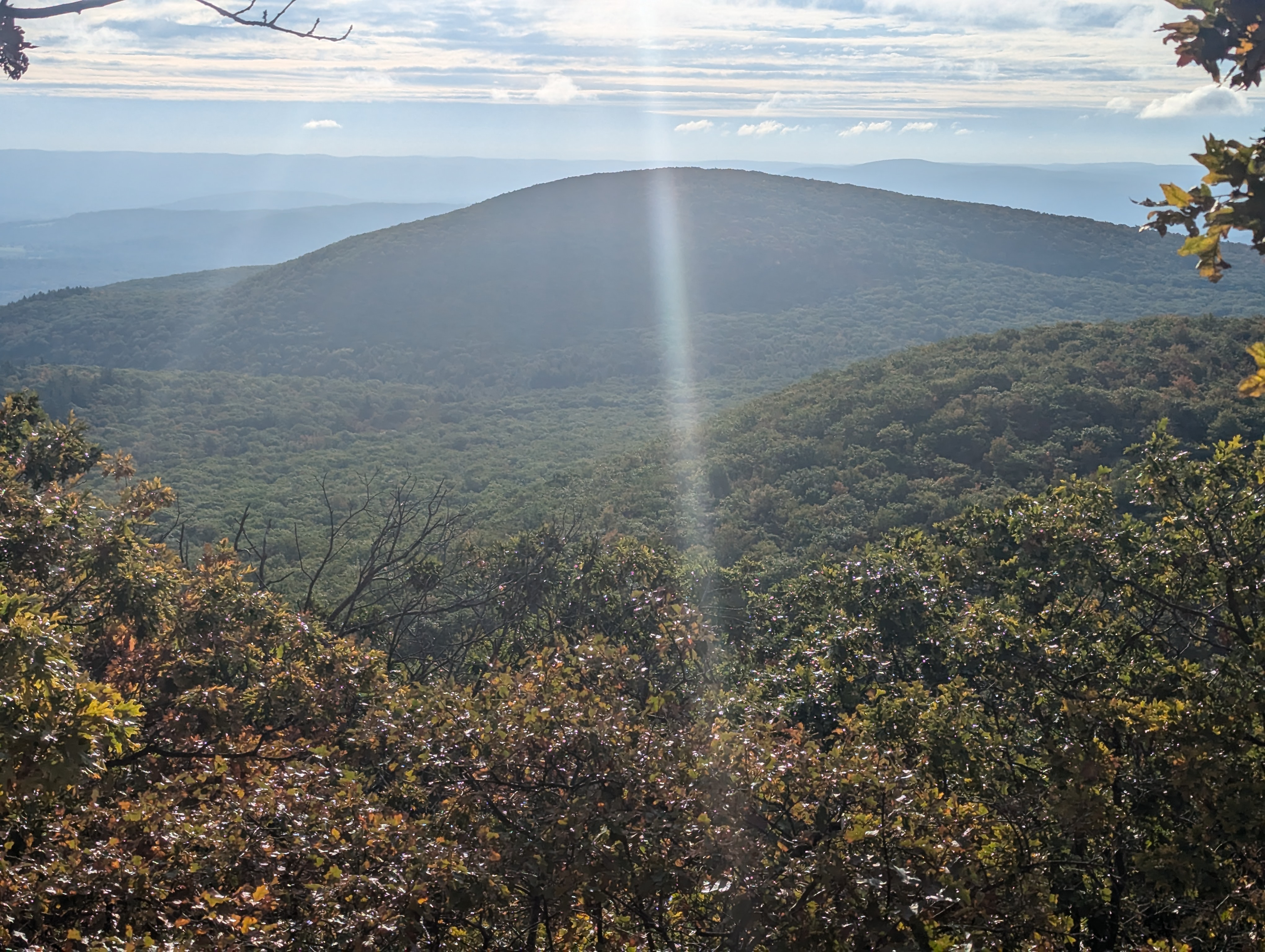
It’s not far to Frissell and Brace Mountains, but the trail is unremittingly rocky, which makes for a tedious slow pace in bare feet. Checking the map, I spot an alternate route back which would spare me the sharp rocks I’ve just traversed, and when I reach the junction, a forest road beckons wide and grassy. I’m so happy to be moving quicker and more easily! But a few steps later, the road deteriorates. Now it’s washed out, and I’m stepping through piles of rocks, like in the bottom of a dry streambed. There’s nothing to do but be patient and persevere. Later I’m rewarded with a stretch of smooth dirt dusted with pine needles, and grim determination shifts to exhilaration. Until I hit a gravel road.
The next junction takes me toward Bear Mountain, and now I’m tooling along on soft dirt again, and after seeing no-one all morning, now there are people on the trail, as Bear Mountain lies on the heavily-traveled Appalachian Trail. I clamber up a series of exposed ledges to the summit, where a blocky structure built of rocks squats in a small clearing. Thru-hikers and day-hikers are hanging out on the top, admiring eastern views across the Housatonic River Valley and the rolling green hills that lie beyond. It’s a quiet, mild day, without any wind, with hardly any sounds at all, and no-one says a word.
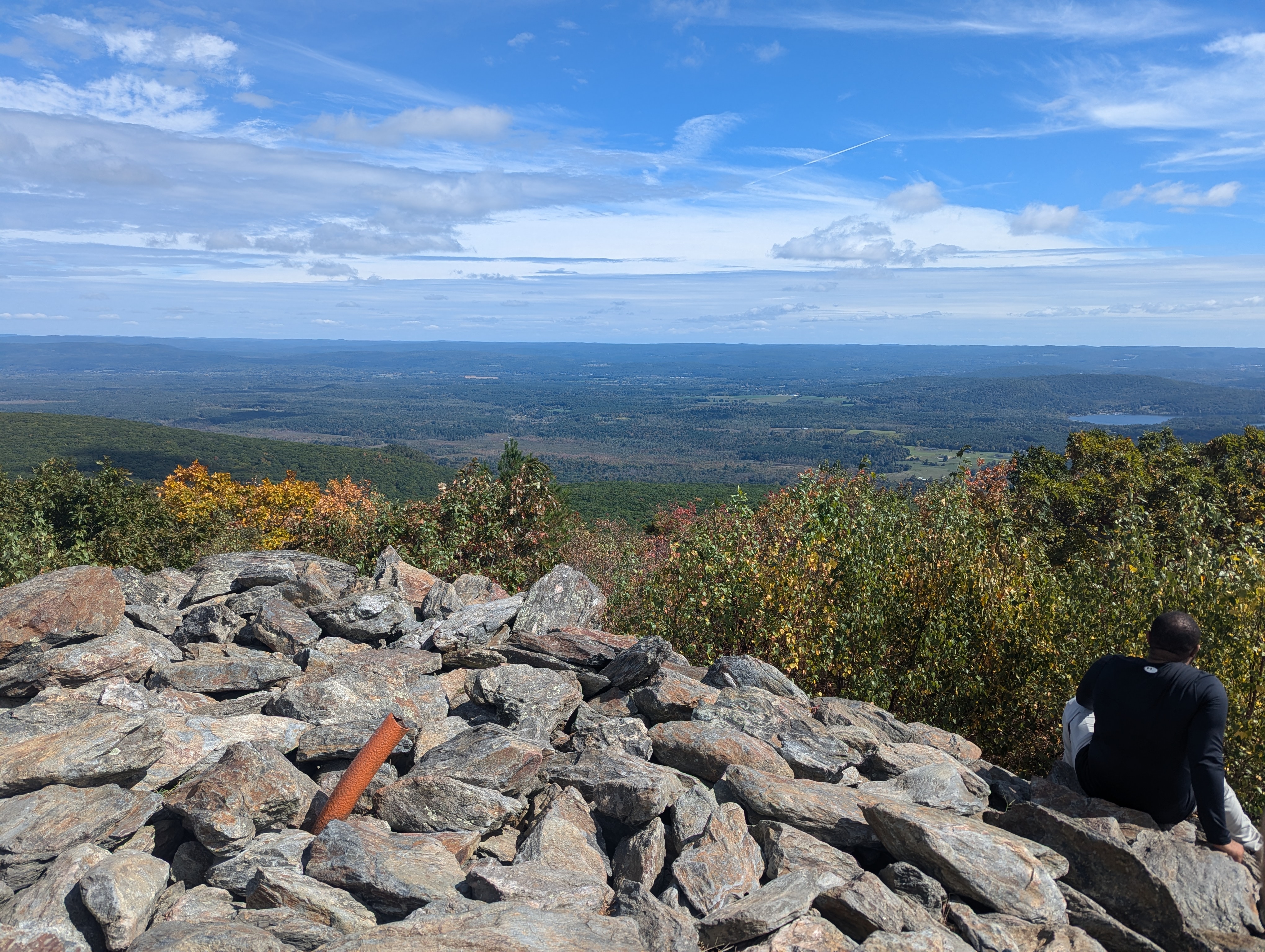
I’ve got time and energy for one more peak, which would be Mount Everett (2,602 feet), the highest point in the Southern Taconics. Returning to the car, I drive fifteen minutes north to a parking spot at Everett’s base. Climb the .75 miles to the summit on a path that is pile upon pile of metamorphic fragments. At the top, I perch upon a block of concrete — the footing for a fire tower long since gone. Take in once again eastern views across the Housatonic and quiet green distant hills. Recognize dwarf pitch pine and scrub oak trees reminiscent of the Shawangunk Mountains, two hours to the southwest, whose bands of dark gray shale and white conglomerate are thought to be formed of sediments that eroded from the Taconics and washed out to the west over a period of many millions of years.
On the way home, I stop at the boyhood homesite of W. E. B. DuBois (1868-1963) on the southern outskirts of Great Barrington. I’d heard him called one of the most influential black intellectuals of the 20th century. Now I read a plaque that describes him as an “architect of the modern civil rights movement,” as well a great advocate for democracy, which he learned about as a young man from participating in town meetings in nearby Great Barrington. Later he cautioned that democracy was “strictly limited” by many factors, including religion, property, and race, as well as the “power of corporate wealth.”

I’d read in his memoirs, Dusk of Dawn, that he was critical of many aspects of the modern world. “Science was becoming religion,” he warned, and “Wealth was God.” And while modern society was massively productive, he found that “efficiency and happiness do not go together in modern culture,” for he saw that the human spirit was crushed by material over-abundance, that people were overwhelmed by peers in such great throngs that they could not know or understand them and thus saw them as inhuman and hateful. During travels in Africa, he found that people living in more primitive conditions were happier, in part because they were spared from incessant news.
DuBois was not a fan of white industrial culture. The “vast Frankenstein monster” doesn’t really serve its makers. The machines give us “the drab uniformity of uninteresting drudgery,” not rest and leisure. Even the creators of the modern economy do not understand it, cannot curb or guide “the raging devastating machinery which kills men to make cloth, prostitutes women to rear buildings and eats little children.”
The long drive home took me across the Hudson River. Blinking into the rays of the setting sun, I saw the silhouette of the Catskill Mountains’ eastern rampart looming along the horizon, with a field of sunflowers glowing in the foreground. Acres upon acres of sunflowers – there must have been a million yellow face–like discs – more than I’d ever seen in one place.

This first trip had bagged me five peaks. With respect to my 1000-mountain goal, this was solid, steady progress if not quick, for five peaks represented merely one-half of one percentage point (0.5%) of the total. In any case, now it was time for a second trip, this one an overnighter with base of operations in the western Massachusetts town of Pittsfield.
I’m driving there on a Thursday evening in late September. Two hours in steady rain. Thinking about the Anxious Generation by Jonathan Haidt, which describes rising rates of anxiety and depression among the younger generation. Indeed, the charts start hockey-sticking in 2015, when smart phones became widespread among school-age kids, beckoning them into a digital world of social media, video gaming, and online porn, a world that conveys unlimited access to information, but can also contribute to alienation. Can inflict mental trauma. Can perchance “eat little children,” as DuBois warned. At the same time, Haidt blames the spread of “safetyism” among parents for curtailing the unstructured, unsupervised forms of outdoors play that children used to enjoy, which he believes are essential for development into confident, mentally healthy adults.
Haidt describes “explore mode,” which engages the Behavioral Activation System (BAS), and causes the brain to scan for opportunities and take the initiative – and contrasts it with “defense mode,” which involves the Behavioral Inhibition System (BIS), which causes the brain to scan for signs of danger. The problem today, Haidt believes, is that many young people have been traumatized by unfortunate online experiences. As a result, too many youths are stuck in defense mode. They are fearful of conflict, desperate to be on a team, inclined to stay indoors, unable to consider different points of view. Hence the rising clamor for censorship, to protect people from what they don’t want to hear. So now we must add censorship to the list of democracy’s potential limiters.
As I contemplate Haidt’s concerns and the dialectic between BAS-BIS (explore-defend), the dark wet back roads sweep by under my Jeep’s thick tires, while the windshield wipers swish back and forth. Now I’m wondering — don’t you need some of each? That scene from the movie Sicario pops into my thoughts – the special operators are moving in stealthy formation towards the entrance of a tunnel complex where cartel gunmen are hiding – while overhead a hovering drone is providing a night-vision video stream. Moving toward the target is explore mode – while overwatch is a defend mode, facilitating quick detection of and reaction to threats.
Suddenly I sense movement in the rearview mirror — a vehicle has lunged into place right on my tail. I react intuitively, flipping the signal, moving into the right lane. As the vehicle passes, I see the emblem on the door – my intuition was correct: State Trooper. Later I spot the red and blue lights flashing, but only for a moment. The officer did not pull anyone over. He just wanted them out of his way.
The next morning, I pull out of my Pittsfield motel and hit a new Taconics trailhead. A long looping trail takes me uphill. It keeps crisscrossing another trail. I’m constantly checking the map on my phone. On not one navigation app, but two – but neither map clarifies this rabbit warren of intersecting paths, although the CalTopo app contains a geology layer, which confirms I’m stepping upon metamorphic phyllite rocks (and maybe there is a bed of marble nearby).
I pad across the summit of Honwee Mountain (2,313 feet) in the shadow of dense hardwood forest. The path intersects a paved road, which I take for a distance, enjoying faster pace and smooth sensation of bare feet on slick black asphalt. Reach Berry Mountain (2,203 feet), which is graced with a microwave tower surrounded by chain-linked fence. A soft grassy trail (The Taconic Crest Trail) takes me to Tower Mountain (2,193 feet), which used to have a fire tower but no longer does. Another peak – and then a glance at the watch, there’s still time, so another mile on a wonderful grassy trail, then all the way back, then a long steep descent bagging Pine (2,221 feet) on the way.


On Pine’s summit, a long drawn-out call above me, shadow flitting in the foliage, sound of beating wings. Underfoot, spiky balls containing the nuts of a chestnut tree – which later that evening I realized was a rare find, since native chestnuts have all but been wiped out by a fungal blight.
Back at the motel, I notice a scratch on one toe, which prompts the question – how to dress for dinner? I’m cautious in these small Massachusetts towns. New Englanders can be surly. They are not always tolerant of unfamiliar behavior. They do not always welcome people who go barefoot. Like that time I was enjoying a cappuccino in nearby Williamstown, when the proprietor came out and lectured me – and when I tried to explain about the physical and mental health benefits of going without shoes, he started shouting. Screaming at me like I was a misbehaving teenager.
So now, wearing shoes, I swing open the door of a pizza restaurant that came highly recommended by the proprietor of my hotel and take a seat by the window. Scan my surroundings. It’s Friday night, but early still, and the place is half full. At the next table sits a tough-looking man wearing a collared shirt with the insignia of a sports team, staring out the window at something on the road. Across from him a blond woman with chiseled hard looks. At the bar, a large man with pasty-white face and red-veined nose presiding over a small group. He looks like a proverbial wrestling coach. Someone who’s used to intimidating boys.
Over the bar, a large TV screen showing a football game. The broadcast cuts to a picnic dinner scene. Camera pans to an elderly white couple, all smiles, then shifts to an elderly black couple, also smiling, but I notice there are no mixed-race couples. The announcer describes the side-effects to a pharmaceutical product, some kind of vaccine. DuBois’s contention comes to mind that “science has become religion.” I recall the link, perhaps tenuous, between vaccines and autism. And how autism is correlated with gender dysmorphia. Glancing down at my phone, I see a story on Twitter about a security guard who shot and killed a shoplifter after a scuffle over a handful of stolen candy. The shoplifter was described as a homeless transgender advocate. Both shooter and victim were black. In another story, a black transgender student stabs a 19-year old white woman in front of their classmates because “she was an easier target.” Is this what the “raging devastating machinery” has done to us? Or are these stories merely social media click-bait? Haidt’s data was compelling – young people are not just being diagnosed with depression more frequently, statistics on self-harm and suicide are rising, too. We are embodied spirits, he warns – we cannot thrive solely on digital ether.
The next morning I’m standing outside Dottie’s, waiting for the coffee shop to open. A young worker marches out with the Stars and Stripes and a rainbow-colored LGBT flag. Now that the colors have been raised, we are welcomed in. I’m sitting beneath a large potted palm, as the waiter brings me cappuccino and croissant. A young wispy male with a shock of wavey brown hair, he peers at me from beneath the fronds with a wide smile, sees that I have what I wanted, gives me a thumbs-up. Such a genuine friendly attitude, in such an unguarded manner. I imagine this shop is a safe space for him to express his emotions just as he feels them. I imagine how the high school gymnasium presided over by a big pasty white-faced man with red nose might not be.
Coffee finished, I’m driving to the trailhead for my last set of Taconic peaks. Notice a Cheshire County patrol car parked on a side road. Now it’s rolling. Swings onto the road about 100 yards behind me. I check my speed, glance in the rear-view mirror. The tension is uncomfortable. I pull off, let the cruiser pass, see it again a few minutes later parked by a fire station.
Explore. Defend. Choose the objective. Plan your route. Scan for threats. Be ready to react. I pull into the trailhead and realize I’ve chosen the wrong one. Ended up on the other side of the mountain from where I meant to start. OK, change the route. If not five peaks, I can still get three.
The trail starts out covered in nasty sharp-edged gravel, the kind that’s trucked in from the quarry – it’s called “rip rap” or “shot rock” – and I’m limping in slow motion, starting to feel desperate, but eventually the gravel fades, and I’m on packed dirt, smooth and moist — but now the trail turns quite steep. Indeed, I’m hustling up a 2,000-foot climb to Greylock (3,489 feet), highest point in Massachusetts. Half-way up, two young men pass me, notice that I’m barefoot – “amazing,” one says. I notice the haircuts, packs, boots. They’re Army engineers with the Connecticut National Guard, skilled in demolitions and rapid bridge emplacements, out here today for some fun. We thank each other for their service, theirs current, mine from nearly four decades back. Half my age and wearing boots, they rapidly pass ahead and vanish around a turn. I reach a junction in the trail and take the steeper turn. It must have been a shortcut, because I surprise them at another junction near the top.
A small tower sits on the summit, surrounded by sloping lawn of neatly mowed grass. The New England asters are glowing brilliant purple in the mild sun, while common blue asters luxuriate in the shade. Crowds of tourists are milling about, as there’s a road and parking lot nearby. A leather-clad motorcyclist strolls past me, talking expressively in Spanish. There’s a light breeze up here. A group of people sitting on the lawn, looking east across the Housatonic valley, drinking in the quiet still scene. Sure, the leaves are beginning to color, just as they do every year, but nature changes but little over human time-scales, and its principals are fixed. In contrast to the mindless flutter of digital media, the silence is refreshing. Nourishing. Encouraging.


The Appalachian Trail crosses this summit, too. I follow it through boreal forest, and here the phyllite rocks are covered in leaves of birch and beech and mountain ash. The trail is comfortable for me, but still slow. I scramble around in the forest to reach the high point, which lies ¼ mile off the trail.
Pulling up in front of the turn-off to Ragged Mountain (2,538 feet), I study watch and phone, trying to estimate the time it’d take to bag one more. A bicyclist is sitting on the side of the trail, looks at me. Encourages me to check out Ragged – the views are gorgeous, and “when are you going to be here again?” I take the nudge, scamper off, make a wrong turn, catch it and correct, scramble to the top, and the bicyclist was right – the view is gorgeous. Above looms Greylock’s Summit, with the short tower on the top, and above it three hang-gliders floating in space. A young woman joins me on the vantage point. It’s one of her favorite places. We talk for a minute about the trails and nearby Pittsfield, until she mentions her boyfriend is waiting for her down below with a dog, which I take as my cue to move on. Maybe she slipped into BIS/defend mode. Or maybe I let through a little too much genuine but unguarded friendliness, like the young server at Dottie’s.

On the two-hour drive home, mist begins to dot the windshield. I see a K-9 cruiser passing in the left lane. A few minutes later, there are flashing red-blue lights ahead – someone got pulled over. Sometimes I feel like we already live in a police state. Still, we must explore.
The rain is heavy now. Another thirty minutes brings me home. I roll into the garage. Mission accomplished, back at base. Over two trips and three days, the Taconic Allochthon gifted me fourteen peaks. Which is a good yield. Still, with 432 barefoot mountains climbed and 568 to go, I’ve got much work still to do.
Running the Long Path is my account of a 350-mile run in pursuit of a fastest known time record and what I discovered along the way. (Click on the image for more info)
 The Long Brown Path
[…] a total of 66 peaks. I climbed baby mountains, like in Ringwood (barely 1,000 feet tall) and the Southern Taconics (+/- 2,000 feet). I climbed the high peaks in Vermont, at just over 4,000 feet, the last for me […]
LikeLike