Reservoir Year by Nina Shengold — A Review

Everyone wants to be in charge, but there are so many distractions

The Ashokan Reservoir is an important component of the New York City water supply.  Lying at the base of the Catskill Mountains, the reservoir is 12 miles long, covers 8,300 acres, and has a maximum capacity of 123 billion gallons of water.  Reservoir Year: A Walk of Days is Nina Shengold’s account of a unique project during which she visited the Ashokan Reservoir for a daily walk along the shore, with a special commitment to complete a full year’s worth of walks without skipping a single day.  In her daily notes, which range from a single sentence to a few pages, she brings the reservoir to life.  She recounts the drama of sky and water.  Shares the antics of crows, deer, squirrels, bears, herons, and bald eagles.  Relates the interactions with strangers she encountered and with friends and family members who sometimes walked with her during this improbable quest.  Improbable, for a 60-year-old single mother with bills to pay and aging parents who need her help and many other obligations.

Nina is a talented writer and in particular a master of metaphor, which makes the book a stimulating read.  On a spring-time visit, the cloud-striped sky evokes a blue-and-white lava lamp.  The atmosphere beneath a brewing thunderhead feels “dead-air, locker room humid.”  A sunset morphs from pastel “to flamingo, persimmon, tandoori salmon, hot lava.”  It’s clear in writing up this account she had fun.

But beneath the engaging prose, a serious question lurks.  Why?  Why, if you didn’t have to walk a dog, would you visit the same place on every single day for a full year?

Looking across the Ashokan Reservoir

Continue reading “Reservoir Year by Nina Shengold — A Review”

Reservoir Year by Nina Shengold — A Review

Transcend This!  A Quantitative Interpretation of American Transcendentalism

How to Allocate Your Time, Avoid Burn-out, Boost Your Spiritual Power, and (Possibly) Make it to the Other Side

The word “transcend” is derived from the Latin “trans” (across) and “scandere” (to climb).  In a sense, the word means to cross a mountain range.  Like the scout William Lewis Manly, who found a route across the Panamint Mountains bordering Death Valley, made it to coastal California, and returned with food to save his comrades who were starving.  This was in 1849.[1]  Go back further in time, and it’s not hard to imagine our hunter-gatherer ancestors staring at a mountain wall, wondering what they would discover on the other side.  If they could find a route across.

Today we use the term, “self-transcendence,” in a more general sense, wondering if we could become tomorrow, in some way, better, stronger, happier, and more productive than we are today.

American Transcendentalism was a 19th century philosophical movement which included authors such as Ralph Waldo Emerson, Henry David Thoreau, Walt Whitman, John Burroughs, and John Muir, among others.

The central premise of Transcendentalist philosophy was that people could achieve self-transcendence by drawing spiritual power from nature.  In this regard, the Transcendentalists were reacting to problems they perceived in 19th century America, where industrialization and urbanization were spreading rapidly, and the frontier was shrinking and would soon close.  Among the clerks, mechanics, priests, professionals, and others who spent their days indoors, Thoreau remarked on what he perceived as “lives of quiet desperation.”  Emerson railed against the conformity, timidity, anxiety, and toxic egotism he associated with conventional society.  Whitman was blunt – writing under the pen name Mose Velsor, he warned that a sedentary indoors lifestyle devoted purely to mental work was “death.”

Fast forward to today.  The Transcendentalists are still remembered, but the popular narrative has shifted.  The new philosophy is Transhumanism – the hope that we will transcend our limitations through technology.  Transhumanism culminates in the “Singularity” – the point at which humans and machines merge.

Exhibit 1:  Search Trends Show Transhumanism Eclipsing Transcendentalism

Exhibit 1

Source:  Google Trends

Continue reading “Transcend This!  A Quantitative Interpretation of American Transcendentalism”

Transcend This!  A Quantitative Interpretation of American Transcendentalism

Hyper-reality and the Desert of the Real

Flying into LaGuardia, the City shimmering outside the airplane window — labyrinth of light beneath squid-ink sky.  Bridges spanning black waters, buildings silhouetted against dark vistas, boulevards radiating in concentric directions. Circuit board of the digital economy.

“City of hurried and sparkling waters!” sang Walt Whitman, “city of spires and masts!  City nested in bays! my city!”

But it’s not my city.  Not anymore.  Never really was… Continue reading “Hyper-reality and the Desert of the Real”

Hyper-reality and the Desert of the Real

More Nature, Less Technology

“You’ll be the troublemaker.” Arif gave me a sly look as he guided me to a far corner of the restaurant, and I nodded, because surely life is too short for small talk.

There were six of us seated at the table.  Four middle-aged women — each one attractive, intelligent, engaging, successful.  A quiet-spoken serious young man with a shock of brown hair.  And me, wearing camouflage-colored Yankees cap and a few days’ worth of stubble.

This was an “intergenerational dinner,” hosted by the Hoot Owl, a cozy restaurant in upstate New York with a loyal local following.  The event was organized around a series of questions designed to elicit discussion.

Anne had been tasked as the table’s guide, and now she opened with the first question – what makes you feel most alive? Continue reading “More Nature, Less Technology”

More Nature, Less Technology

Pushing Back Against Winter

By Barefoot Ken

There are two themes to the December Grid so far.  First is the question whether I can get all 35 done, with the latest challenge being a sore knee and a tight groin, which together led me to abort an attempt on Big Indian and Doubletop earlier this week.  The second, and more interesting theme, is the effort to “push back” against the grim cold conditions of winter, especially on the part of someone who’s pretty comfortable in the heat (even back in the day running in summertime Death Valley) and for whom the cold can be a little intimidating.  As it happened, the other day an email showed up from the Wim Hof organization promoting a new book by investigative journalist Scott Carney, titled “What Doesn’t Kill us,” which profiles the author’s experiences with some of the cold-training methods that have made Wim Hof famous, culminating in a shirtless climb of Mt. Kilimanjaro.

Over the last few years I’ve played around with some of the Wim Hof techniques, and this new book sparked my interest again, and helped me stoke a little bid of attitude with which to confront the cold.  (Also, I signed up for ten 10-week Wim Hof instructional video series, so it will be interesting to see what I learn going forward.)

Continue reading “Pushing Back Against Winter”

Pushing Back Against Winter

Discovering John Burroughs and Walt Whitman on the Long Brown Path

This post is based on talk I gave at the John Burroughs Association May 20, 2017 Slabsides Open House, assisted by my friends Lisa Zucker Glick, who read the John Burroughs’ quotations, and Jim Porter, who read the words of Walt Whitman.  For additional citations and references, please see “Running the Long Path.”

An edited video of the talk is available here:  https://vimeo.com/218372727

For more information on the John Burroughs Association, please visit johnburroughsassociation.org

20170520_122517.jpg
Joan Burroughs welcoming visitors to the Slabsides Open House


Continue reading “Discovering John Burroughs and Walt Whitman on the Long Brown Path”

Discovering John Burroughs and Walt Whitman on the Long Brown Path

Burroughs on “Observing”

The east coast naturalist John Burroughs was a passionate observer of the forests, animals, and especially the birds of his native Catskill Mountains.  He wrote unabashedly, “I find I see, almost without effort, nearly every bird within sight in the field or wood I pass through (a flit of the wing, a flirt of the tail are enough, though the flickering leaves do all conspire to hide them).”

This was no idle boast.  Theodore Roosevelt, himself a great birder, acknowledged Burroughs’ mastery in his 1905 book, Outdoor Pastimes of an American Hunter, where he wrote that “No bird escaped John Burroughs’ eye; no bird note escaped his ear.”

As a Burroughs fan and someone trying to improve his own skills, I was thrilled to discover recently that the master had left behind some advice on the art of observation.  Several of his essays contain how-to tips, including “The Art of Seeing Things,” “Sharp Eyes” and The Gospel of Nature, which I’ve tried to summarize in this blog post.

But first a few words of caution, in the form of a caveat Burroughs offered his readers:  “I have as little hope of being able to tell the reader how to see things as I would have in trying to tell him how to fall in love or to enjoy his dinner. Either he does or he does not, and that is about all there is of it. Some people seem born with eyes in their heads, and others with buttons or painted marbles.”

Continue reading “Burroughs on “Observing””

Burroughs on “Observing”

Crows

(I was reading one of John Burroughs’ essays, and his description of the American Crow caught my eye, and made me think of my friend Tom Bushey, who loves to photograph them.  Thank you, Tom, for letting me post some of those images here.)

Hardy, happy outlaws, the crows, how I love them! Alert, social, republican, always able to look out for himself, not afraid of the cold and the snow, fishing when flesh is scarce, and stealing when other resources fail, the crow is a character I would not willingly miss from the landscape. I love to see his track in the snow or the mud, and his graceful pedestrianism about the brown fields. He is no interloper, but has the air and manner of being thoroughly at home, and in rightful possession of the land. He is no sentimentalist like some of the plaining, disconsolate song-birds, but apparently is always in good health and good spirits. No matter who is sick, or dejected, or unsatisfied, or what the weather is, or what the price of corn, the crow is well and finds life sweet. He is the dusky embodiment of worldly wisdom and prudence. Then he is one of Nature’s self-appointed constables and greatly magnifies his office. He would fain arrest every hawk or owl or grimalkin that ventures abroad. I have known a posse of them to beset the fox and cry “Thief!” till Reynard hid himself for shame.

— John Burroughs “Winter Sunshine,” 1875


tb-crows-1
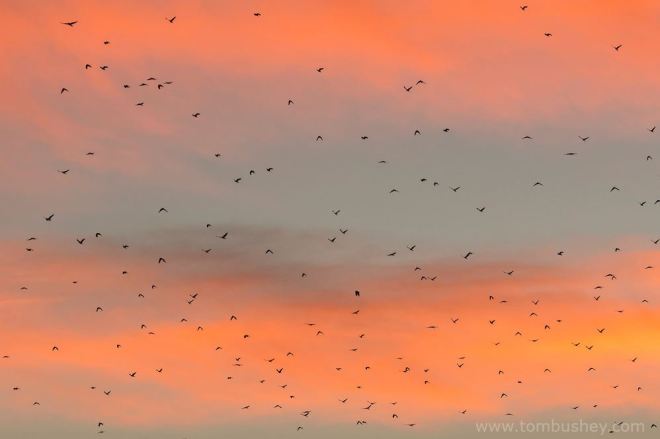
Middletown, NY – Crows fly in front of clouds at sunset Nov. 18, 2016.  Tom Bushey Photography


tb-crows-2
Crows gather in tree branches at sunset, Middletown, NY, November 12, 2016.  Tom Bushey Photography


tb-crows-3
Crows gather in tree branches with the crescent moon in the background, Middletown, NY, November 3, 2016.  Tom Bushey Photography

Note:  during fall and winter months, crows roost together in the thousands, and even in some rare instances, in the millions.  They begin gathering together in late afternoon in  a location separate from the roost, then as darkness falls, they move to the location where they’ll spend the night.  Experts think this is a behavior that helps them defend against their primary predator, the Great Horned Owl, and possibly, too, a strategy for sharing information about food sources.

Visit Tom’s gallery of American Crow images


Crows

Searching for the Heart of the Southern Catskills

Slide Mountain is the Catskills’ highest peak, and one I’ve climbed many times, including both summer and winter, day and night — but always following the trail from Big Indian Valley.  One day I was rereading “In the Heart of the Southern Catskills,” John Burroughs’ account of his first ascent of Slide Mountain in 1885.  Burroughs had long been intrigued by Slide, but he wasn’t going to take a trail.  Rather, he chose the more remote Woodland Valley as his starting point and then made his way to the summit through unmarked forest.  Moving off trail like this is today called “bushwhacking,” and depending on the terrain, it can be exhilarating — or extremely challenging.

I put down the essay and thought for a moment.  As a member of the Catskill 3500 Club, I had climbed the 35 highest peaks in the Catskills, of which a dozen or so require bushwhacking because there is no trail.  But it had never occurred to me to seek a bushwhack route when an established trail was available.  Why would you do that?

Then a light bulb went off:  because it would be a totally new experience.

Pulling out the map, I measured a straight shot from the Woodland Valley Campground to Slide’s summit, about 2.5 miles in distance and 2,000 feet in elevation gain.  Towards the top, the grade got steep, I noticed, exceeding 40% in places.

Two weeks later, a little before 9:00 AM, I was pulling into the parking area at Woodland Valley Campground to meet my friend Alan.  Our goal:  to reenact Burroughs’ bushwhack ascent of 1885 …

slide-map
Orange line indicates proposed bushwhack route

Continue reading “Searching for the Heart of the Southern Catskills”

Searching for the Heart of the Southern Catskills