Sitting on the porch one summer weekend afternoon, I became conscious of a great cacophony emanating from high in the trees and deep in the bushes, but of the many creatures buzzing, chirping, trilling, squawking, screaming, and clattering away, none was visible. Could I learn to distinguish any of these sounds and associate them with their respective species? And would I ever catch a glimpse of these secretive singers?
Henry David Thoreau
Getting to Know Thoreau
Henry David Thoreau, the 19th century Transcendentalist and author of Walden, came under attack in the New Yorker last fall for his individualistic philosophy and seemingly anti-social attitude. This isn’t a new issue. His contemporaries regarded him as crusty and contrary and called him a hard man to like. The naturalist John Burroughs wrote that he lacked sympathy and compassion.
Is it OK to admire Thoreau’s writing, if he was really such an unfriendly person?
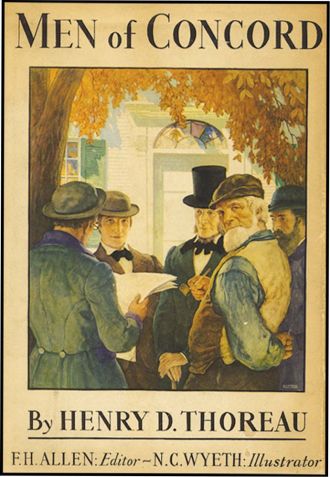
It was with this question in mind that I recently read Men of Concord, a book published in 1936 that contained selected entries from Thoreau’s journal over the period 1838-1860, with a special focus on interactions with his neighbors in the Massachusetts town of Concord. The idea came from N. C. Wyeth (1881-1945), a popular illustrator during the early 20th century and a great admirer of Thoreau’s work, who conceived of the book as a way to help the public appreciate Thoreau as a great American philosopher. He contributed twelve original oil panels, which were reproduced as color plates in the book and which are on display today at a museum exhibition in Concord.
Burroughs: Don’t Lose Your Connectivity with Nature
In Whitman: A Study, the Catskills nature-writer, essayist, and philosopher John Burroughs (1837-1921) defended Walt Whitman (1819-1892) against the hostile reactions of contemporary scholars, for whom Whitman’s poetry was too coarse, racy, and controversial. In the book, Burroughs presented Walt Whitman as the “poet of democracy” and described him as a primal man, visionary of the open air, barbarian in the parlor, force of nature, and prophet. But Whitman: A Study isn’t just about Whitman, it’s also an exposition of Burroughs’ philosophy. Inspired by both science and nature, Burroughs saw natural processes at work within society, and he explained how both physical strength and the vitality of culture can fade if we lose our connection with the natural world. This message seems just as relevant for our information age as it was 120 years ago when Whitman: A Study was first published.
Continue reading “Burroughs: Don’t Lose Your Connectivity with Nature”
Accepting the Universe

In his prime, John Burroughs (1837-1921) was one of the most popular writers in America, with a huge following of readers and relationships with the likes of Theodore Roosevelt, Henry Ford, Thomas Edison, and railroad tycoon E. F. Harriman. His passion was the birds, forests, rivers, and mountains of his native Catskills, and his writings reveal a scientist’s powers of observation and a nature-lover’s emotional connection to the land. In 1919, at age 82 he appeared in a short film, shown leading a trio of young children around his Catskill farm. He points out butterfly, chipmunk, grasshopper, and then the following words appear on the screen:
I am an old man now and have come to the summit of my years. But in my heart is the joy of youth for I have learned that the essentials of life are near at hand and happiness is his who but opens his eyes to the beauty which lies before him.
Today, these words are remembered by a dedicated group of Burroughs enthusiasts. But despite his enormous popularity, his hasn’t become a household name like other American naturalists such as Henry David Thoreau or John Muir. I wondered, why?
The Cry of the Anarcho-Primitivists
In short, all good things are wild and free.
— Henry David Thoreau, Excursions
As someone who enjoys running in the mountains, I find myself drawn to Henry David Thoreau’s vision of nature and wildness. But when you follow in Thoreau’s path, you discover that his admirers include not only outdoors enthusiasts, but also people with more extreme views. Consider the philosopher and writer John Zerzan, a self-proclaimed anarchist and primitivist, who criticizes industrial mass society as inherently oppressive and warns us that technology is leading humanity into an increasingly alienated existence, at the same time that it threatens to destroy the natural environment. To be sure, the anarcho-primitivist movement counts few members, but does that mean it’s safe to ignore Zerzan and his warning?

Let’s Put Thoreau in his Proper Place
In a recent post, I compared a weekend spent hiking in the Catskills to Henry David Thoreau’s two-year sojourn at Walden Pond, as both were experiments in natural living and self-sufficiency.
But then my daughter Emeline brought to my attention a recent article entitled “Pond Scum.” The author, Kathryn Schulz, questions why we still admire the literature of a man who was mean-spirited and a fake. She summarizes her opinion in no uncertain terms:
Walden, in a Weekend
Friday evening, my nephew Nathaniel stopped by to visit during college break. Over dinner he mentioned a course he was taking on Henry David Thoreau, the 19th century transcendentalist who had spent two years living in a cabin by the side of Walden Pond. I had read Walden recently and appreciated Thoreau’s experiment in self-sufficiency and simple living, as well as his clever style. I asked Nathaniel, did he think Thoreau was a nature lover or a social recluse? Then I wondered aloud why Thoreau had left Walden after only two years.
Once dinner was over, and Nathaniel had left, I summoned Odie the Labradoodle, and we piled into the car for a weekend adventure that might, it occurred to me, share some of Thoreau’s values. For us, self-sufficiency and simplicity would mean hiking barefoot, skipping meals, and sleeping in a lean-to. However, instead of two years, our trip would last two days. It would be like Walden, just in miniature.
I went to the woods because I wished to live deliberately, to front only the essential facts of life, and see if I could not learn what it had to teach, and not, when I came to die, discover that I had not lived.
Henry David Thoreau, Walden
 The Long Brown Path