Bringing “Askeisis” to the Catskills 9

(Note:  a revised version of this post has been published in the blog Stocism Today)

Saturday evening after dinner I drove out to the Catskills to make another attempt on the “Nine,” a 19-mile circuit that crosses nine mountain peaks,  with the special distinction that five of the peaks are accessed off trail, that is by bushwhacking through the forest.  I’d run the Nine twice before during the day and once at night and also bagged eight of the nine during the winter.  But this time I’d be going without shoes, part of a quixotic quest to climb all 35 of the Catskills’ highest peaks barefoot.

Madness perhaps, but not without method.  Ancient Greek philosophers advocated the practice of “askeisis,” which means “rigorous training.”  Especially favored were practices that entailed endurance, resistance to the elements, or going without food and water.  Askeisis is the root of the modern word “asceticism,” and while the Greek concept was not associated with a lifestyle of self-denial, it was thought that rigorous training would lead to both athletic and spiritual development.  The ultimate goal was to achieve the states of “ataraxia” (tranquility, serenity, freedom from worry) and “apatheia” (equanimity, composure, freedom from unruly passions).

As a runner, I’m often looking for a chance to add some askeisis into my adventures, recognizing that my spiritual development needs all the help it can get.  On this trip I’d carry no food or water, and with the weather forecast calling for a low of 36 F, sleeping outside in the cold sounded like another fun option (John Muir used to go for days in the Sierras during chilly fall weather, without bringing blanket or coat).  After further thought, I grabbed a light sleeping bag and tossed it in the pack.

Continue reading “Bringing “Askeisis” to the Catskills 9″

Bringing “Askeisis” to the Catskills 9

Boston Marathon 2016 Race Report

Friday April 15, 2016, I was on the train to Boston to attend a conference on Native American Running presented by Harvard’s Peabody Museum in collaboration with the Boston Athletic Association and other sponsors.  This topic has interested me since reading a book by Peter Nabokov which described how Indians ran to communicate, fight, and hunt, as well as interact with spiritual forces.  I thought the Indians’ experiences might contain clues to human potential which have been forgotten in today’s technology-obsessed world.

I’m glad I went:  the speakers talked about the spiritual and community aspects of running — a welcome contrast to the heavy commercialism of the Boston Marathon Expo.  It was a special treat to meet Arnulfo Quimare, the Ruramari runner of Born to Run fame who beat American ultrarunner Scott Jurek in a 50-mile race — and surprising to learn that he doesn’t “train” like American runners, but rather developed his running prowess from dancing and walking.  He’s happy when running, he stated through a translator, and even happier when he wins.

Out of all the speakers, one comment caught my attention in particular.  Chief Oren Lyons is a member of the National Lacrosse Hall of Fame, a distinguished professor of Native American studies at the State University of New York, and a tribal leader in the Onondaga Nation.  When asked what advice he gives young Indian athletes, he mentioned a word in the Onondaga dialect, which sounded to me like “jaga.”  It meant, he explained,

Try hard — try harder!

— Chief Oren Lyons

After the conference, I returned to my hotel and prepared to participate in my fourth Boston Marathon.

Continue reading “Boston Marathon 2016 Race Report”

Boston Marathon 2016 Race Report

Warming up to John Muir

In a previous blog post, I expressed skepticism about John Muir’s message.  Both nature and humanity are expressions of God’s love, he had written, but it was pretty clear he didn’t care for humanity’s towns, cities, factories, and social conventions.  In some of his most famous quotations, he described nature as a place of “refuge” from the worries of everyday life, with the “healing power” to cure the wounds of society.  The wilderness was a source of beauty that “cleans and soothes and warms” and a place for “repose,” “pure rest,” and “sleep.”  As a runner, I had trouble relating to these metaphors and found the message a little preachy.

But then I read a comment by John Burroughs, America’s most popular nature-writer during the late 19th and early 20th centuries.  Burroughs lived in New York’s Catskill Mountains, on the other side of the country from Muir’s beloved Yosemite, but the two men had met during a trip to Alaska, and while their personalities were quite different, they shared many values, respected each other’s work, and became friends.

A unique character — greater talker than as a writer — he loved personal combat and shone in it.  He hated writing and composed with difficulty, though his books have charm of style; but his talk came easily and showed him at his best.

— John Burroughs journal entry 1915

Based on this assessment, I needed to give Muir another chance.  So I picked up a book called The Wild Muir:  Twenty Two of John Muir’s Greatest Adventures, which contained first-person accounts of some his most interesting exploits.  And now that I was hearing him talk (so to speak) instead of preach, I got a much better sense of the man….

Continue reading “Warming up to John Muir”

Warming up to John Muir

Burroughs on Barefoot

If you don’t know the man, John Burroughs was America’s most popular nature writer in the late 19th and early 20th century.  The other day I was flipping through one of his early essays and came across this commentary:

Occasionally on the sidewalk, amid the dapper, swiftly moving, high-heeled boots and gaiters, I catch a glimpse of the naked human foot. Nimbly it scuffs along, the toes spread, the sides flatten, the heel protrudes; it grasps the curbing, or bends to the form of the uneven surfaces,—a thing sensuous and alive, that seems to take cognizance of whatever it touches or passes. How primitive and uncivil it looks in such company,—a real barbarian in the parlor! We are so unused to the human anatomy, to simple, unadorned nature, that it looks a little repulsive; but it is beautiful for all that.

— John Burroughs, Winter Sunshine

Continue reading “Burroughs on Barefoot”

Burroughs on Barefoot

Seven Miles to Doubletop

Spring had arrived early, it was quiet at work, and so I made plans to take Friday off and head to the Catskills, with the goal of bagging two or maybe three more mountains in my quest to hike all thirty-five of the highest peaks barefoot.  The forecast called for temperatures in the 50s, reports indicated that all the ice was gone, and the 90% chance of rain seemed only a minor consideration.  How could a person not want to be in the woods on a day like this?  And what about a dog?  Feeling in good spirits Friday morning, I hopped out of bed, gave a shout for Odie the Labradoodle — and off we went, arriving in due course at the Seager trailhead deep in the western Catskills.

Continue reading “Seven Miles to Doubletop”

Seven Miles to Doubletop

The Problem with Seeking “Flow”

The Problem with Seeking “Flow”

By KENNETH A. POSNER

Review of The Rise of Superman: Decoding the Science of Ultimate Human Performance, by Steven Kotler

Published in the New Rambler

new-rambler-reviews_logo

Click here for another blog post on “Flow” and a post on the Bhagavad-Gita referenced in the “The Problem with Seeking Flow”

The Problem with Seeking “Flow”

Hikin’ with Lichen

There are times to go fast and times to go slow.  Recently I headed off for the Catskills with the goal of bagging a few more peaks for my record of barefoot ascents.  It had rained earlier in the morning and was still cloudy, but the rain had let up, the winds had calmed, and the temperature hovered in the mid-50s — conditions which encourage a person to relax, move at a more leisurely pace, and take in the sights.  In no particular hurry, I was sauntering up the gravel road that leads to the saddle between Bearpen and Vly mountains, looking down at the ground to avoid stepping on sharp rocks, when I noticed a small green ball of puff lying on the ground.

Continue reading “Hikin’ with Lichen”

Hikin’ with Lichen

We may care about biodiversity, but does Nature?

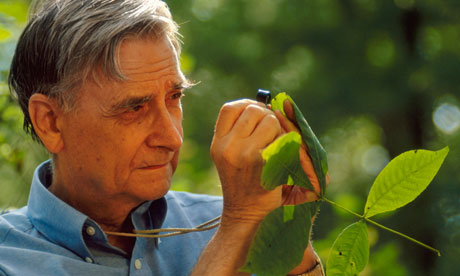
I recently read The Future of Life by respected biologist, environmentalist, and Pulitzer prize-winning author Edward O. Wilson, who is not only the world’s foremost expert in myrmecology (study of ants) but also one of the most vocal crusaders for biodiversity.  And he’s not just a scientist, he’s a great lover of nature.  Early in the book he recounts one of the “most memorable events” of his life, when in 1994, in a back room of the Cincinnati Zoo, he encountered a four-year-old Sumatran rhinoceros named Emi.  He gazed into her “lugubrious face,” placed a hand on her flank, and communed with the solitary animal, as he pondered the critically endangered status of her species.

His love for nature leads Wilson to issue a harsh indictment:  “Humanity has so far played the role of planetary killer, concerned only with its own short-term survival,” he warns.  “We have cut much of the heart out of biodiversity.”  By this he means, we are responsible for a rise in the rate of extinctions and a decline in the remaining number of species.  The causes are well known:  hunting and poaching, loss of habitat, spread of invasive species, and now global warming.  Wilson states that by 2030, the species count for plants and animals could be down by 20%, and if we freeze conservation efforts at current levels, he claims that 1/2 of plant and animal species could be gone by 2100.

An Armageddon is approaching at the beginning of the third millennium. But it is not the cosmic war and fiery collapse of mankind foretold in sacred scripture. It is the wreckage of the planet by an exuberantly plentiful and ingenious humanity.

— Edward O. Wilson, The Future of Life

After finishing the book, I reflected on this warning.  I’m in favor of preserving wilderness, and I too would like to see the Sumatran rhinoceros flourishing again in the jungles of southeast Asia.  But for Wilson, biodiversity means more than protecting Emi, it means maximizing the total worldwide species count.  And here, his logic left me unpersuaded.  There are better metrics for measuring biodiversity, it seems to me, and stronger arguments for conservation.

What I most appreciated about the book was Wilson’s emotional connection with nature, and on the very last page, I thought his comments were spot on….

Dr.-E.O.-Wilson--006
Edward O. Wilson.  Photograph: Frans Lanting/Corbis

Continue reading “We may care about biodiversity, but does Nature?”

We may care about biodiversity, but does Nature?

Encountering Catskill Mosses

Last weekend, the weather was unseasonably warm for mid-March, with afternoon temperatures in the 60s.  It was a great day to wander through the Catskills adding additional peaks to the list of completions.  Rounding a bend on the trail between Balsam Lake and Graham mountains, I glanced to the right and spotted a marvelous moss tumbling down the side of an embankment, a cascade of silver feathery fronds.

20160312_165034 (1).jpg

Continue reading “Encountering Catskill Mosses”

Encountering Catskill Mosses