Burroughs on “Observing”

The east coast naturalist John Burroughs was a passionate observer of the forests, animals, and especially the birds of his native Catskill Mountains.  He wrote unabashedly, “I find I see, almost without effort, nearly every bird within sight in the field or wood I pass through (a flit of the wing, a flirt of the tail are enough, though the flickering leaves do all conspire to hide them).”

This was no idle boast.  Theodore Roosevelt, himself a great birder, acknowledged Burroughs’ mastery in his 1905 book, Outdoor Pastimes of an American Hunter, where he wrote that “No bird escaped John Burroughs’ eye; no bird note escaped his ear.”

As a Burroughs fan and someone trying to improve his own skills, I was thrilled to discover recently that the master had left behind some advice on the art of observation.  Several of his essays contain how-to tips, including “The Art of Seeing Things,” “Sharp Eyes” and The Gospel of Nature, which I’ve tried to summarize in this blog post.

But first a few words of caution, in the form of a caveat Burroughs offered his readers:  “I have as little hope of being able to tell the reader how to see things as I would have in trying to tell him how to fall in love or to enjoy his dinner. Either he does or he does not, and that is about all there is of it. Some people seem born with eyes in their heads, and others with buttons or painted marbles.”

Continue reading “Burroughs on “Observing””

Burroughs on “Observing”

What’s a Totoro?

The acclaimed Japanese animated filmmaker Hayao Miyazaki’s 1988 classic My Neighbor Totoro tells the story of two young sisters who encounter friendly forest spirits in postwar rural Japan.  The film has won numerous awards, and the Totoro has been ranked among the most popular animated characters.

There are many reasons for the film’s success, including the carefully crafted animation, the endearing portrayal of the two sisters, the lush watercolor backgrounds, and the pastoral simplicity of the setting.  After watching the movie recently, I asked myself, what is a Totoro?  And what was Miyazaki’s purpose in creating this movie?

Continue reading “What’s a Totoro?”

What’s a Totoro?

In Search of Autumnal Tints

Henry David Thoreau’s 1862 essay, “Autumnal Tints,” contains colorful descriptions of New England’s fall foliage, including sugar maple and northern red oak, as well as more humble plants like bearded grass and pokeweed.  Of special interest to me was Thoreau’s commentary on the red maple (Acer rubrum):  he’d noticed that as early as the 25th of September a small red maple on the edge of a meadow had already turned a “far brighter red than the blossoms of any tree in summer” and that the tree was all the “more conspicuous” in contrast with the rest of the forest, which was still green:

Some single trees, wholly bright scarlet, seen against others of their kind still freshly green, or against evergreens, are more memorable than whole groves will be by-and-by. How beautiful, when a whole tree is like one great scarlet fruit full of ripe juices, every leaf, from lowest limb to topmost spire, all aglow, especially if you look toward the sun!

— Henry David Thoreau, Autumnal Tints

In recent weeks I’d spotted solitary maple leaves dotting the trail, splashes of scarlet among the prevailing greens and browns of the forest floor.  This Sunday would be the 25th of September — and based on Thoreau’s essay it seemed precisely the right time to go scouting for the season’s first red maples to have fully changed their color.  My friend Steve Aaron was looking for a mountain to climb, so I invited him to join me and  Odie the Labradoodle for an attempt on Fir Mountain, one of several pathless peaks that rise above the headwaters of the Esopus Creek.

20160925_124326

Continue reading “In Search of Autumnal Tints”

In Search of Autumnal Tints

Askeisis in the Catskills

This is a revised version of an earlier post in which I described an adventure in the Catskills undertaken in part as an experiment in “askeisis,” the ancient Greek concept of physical and spiritual training.  The revised version was published Saturday in Stoicism Today, a blog sponsored by University of Exeter on the topic of ancient Greek and Roman Stoic philosophy applied to modern living.

To read the post, click here:

stoicism today

Askeisis in the Catskills

Shifting into Neutral

In the Bhagavad Gita, Krishna advises Arjuna to “strive to still the mind,” which reminds me of a point made by 2nd century Roman emperor and Stoic philosopher Marcus Aurelius:

It is in your power, whenever you choose, to retire into yourself. For nowhere either with more quiet or more freedom from trouble does a man retire than into his own soul.

— Marcus Aurelius, Meditations

One day, while waiting for the subway, I decided to give it a try.   Instead of fretting at the wait, I put away my phone and stood still.  Anxiety faded, and the surroundings came into focus, as I slowly let out my breath.

A visual image had helped me make the transition: I imagined moving a gear shift into neutral.  Then I wondered, could I shift into neutral while running?

neutral2

Continue reading “Shifting into Neutral”

Shifting into Neutral

There’s Grit, and Then There’s True Grit

(An updated version of this blog post was published in The New Rambler)

In her recent book, Grit:  The Power of Passion and Perseverance, psychologist Angela Duckworth argues that the secret to success — whether for parents, students, educators, athletes, or business people — is not talent, but a combination of passion and perseverance she calls “grit.”

The dictionary definition of “grit” is “mental toughness or courage.” The term calls to mind gritting or clenching the teeth when facing up to an unpleasant task, or it makes us think of small particles of sand or stone that irritate skin, get in the eyes, clog machinery — the idea being that an individual with grit perseveres in the face of these frictions.

The gritty individual approaches achievement as a marathon; his or her advantage is stamina. Whereas disappointment or boredom signals to others that it is time to change trajectory and cut losses, the gritty individual stays the course.

Duckworth, Peterson, Matthews, Kelly, Journal of Personality and Social Psychology, 2007

Packaged for a self-help audience, the book is filled with stories about how grit contributed to the achievements of celebrities and other successful individuals, and it makes for fun and informative reading.  However, many of us understand the point already, if for no other reason than we’ve seen the movie, True Grit (either the 1969 version starring John Wayne or the 2010 version with Jeff Bridges) or read the 1968 novel by Charles Portis on which the films were based.

While Duckworth does a nice job, her thesis falls short in that it fails to consider grit in the context of alternative mental strategies or consider the drawbacks and risks of grit.  Interestingly, a more balanced assessment comes through in a close reading of True Grit.

Continue reading “There’s Grit, and Then There’s True Grit”

There’s Grit, and Then There’s True Grit

Getting to Know Thoreau

Henry David Thoreau, the 19th century Transcendentalist and author of Walden, came under attack in the New Yorker last fall for his individualistic philosophy and seemingly anti-social attitude.  This isn’t a new issue.  His contemporaries regarded him as crusty and contrary and called him a hard man to like.  The naturalist John Burroughs wrote that he lacked sympathy and compassion.

Is it OK to admire Thoreau’s writing, if he was really such an unfriendly person?

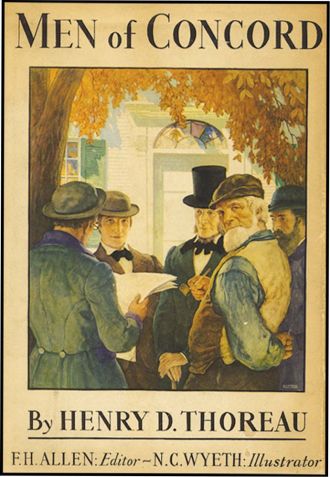
It was with this question in mind that I recently read Men of Concord, a book published in 1936 that contained selected entries from Thoreau’s journal over the period 1838-1860, with a special focus on interactions with his neighbors in the Massachusetts town of Concord.  The idea came from N. C. Wyeth (1881-1945), a popular illustrator during the early 20th century and a great admirer of Thoreau’s work, who conceived of the book as a way to help the public appreciate Thoreau as a great American philosopher.  He contributed twelve original oil panels, which were reproduced as color plates in the book and which are on display today at a museum exhibition in Concord.

men of concord

Continue reading “Getting to Know Thoreau”

Getting to Know Thoreau

Will the Real Cynic Please Stand Up?

In a New Yorker article last fall, Kathryn Schultz attacked the legacy of Henry David Thoreau, calling Walden’s author “pond scum” and dismissing as unrealistic any political vision built upon his “rugged individualism.”  Based on her reaction to Thoreau, she’d likely recoil in horror from Diogenes of Sinope (412-323 BCE), founder of the Cynic school of philosophy in ancient Greece.  Known as “The Dog,” Diogenes lived in a tub, begged for food, and went barefoot, haranguing rich and poor alike for their pointless conformity, irrational behavior, and moral bankruptcy.  Compared to Diogenes, Thoreau was pampered and tame.

You might be familiar with the image of a white-haired man carrying a lamp in  daylight, searching for an honest man.  That was Diogenes.

Diogenes-statue-Sinop-enhanced
Statue of Diogenes in Sinop, Turkey.  Source:  Wikipedia

Brilliant philosopher, shameless exhibitionist, ragamuffin — take your pick, but before we concede to people like Schultz and dismiss the man, we have to ask the question, why is Diogenes still remembered some twenty-four hundred years after his death?

I recently came across a book by Professor Luis Navia of New York Institute of Technology, Diogenes the Critic:  The War Against the World, which sheds some interesting light on this question.

diogenes book

Continue reading “Will the Real Cynic Please Stand Up?”

Will the Real Cynic Please Stand Up?

Burroughs: Don’t Lose Your Connectivity with Nature

In Whitman:  A Study, the Catskills nature-writer, essayist, and philosopher John Burroughs  (1837-1921) defended Walt Whitman (1819-1892) against the hostile reactions of contemporary scholars, for whom Whitman’s poetry was too coarse, racy, and controversial.  In the book, Burroughs presented Walt Whitman as the “poet of democracy” and described him as a primal man, visionary of the open air, barbarian in the parlor, force of nature, and prophet.  But Whitman:  A Study isn’t just about Whitman, it’s also an exposition of Burroughs’ philosophy.  Inspired by both science and nature, Burroughs saw natural processes at work within society, and he explained how both physical strength and the vitality of culture can fade if we lose our connection with the natural world.  This message seems just as relevant for our information age as it was 120 years ago when  Whitman: A Study was first published.

Continue reading “Burroughs: Don’t Lose Your Connectivity with Nature”

Burroughs: Don’t Lose Your Connectivity with Nature

Bringing “Askeisis” to the Catskills 9

(Note:  a revised version of this post has been published in the blog Stocism Today)

Saturday evening after dinner I drove out to the Catskills to make another attempt on the “Nine,” a 19-mile circuit that crosses nine mountain peaks,  with the special distinction that five of the peaks are accessed off trail, that is by bushwhacking through the forest.  I’d run the Nine twice before during the day and once at night and also bagged eight of the nine during the winter.  But this time I’d be going without shoes, part of a quixotic quest to climb all 35 of the Catskills’ highest peaks barefoot.

Madness perhaps, but not without method.  Ancient Greek philosophers advocated the practice of “askeisis,” which means “rigorous training.”  Especially favored were practices that entailed endurance, resistance to the elements, or going without food and water.  Askeisis is the root of the modern word “asceticism,” and while the Greek concept was not associated with a lifestyle of self-denial, it was thought that rigorous training would lead to both athletic and spiritual development.  The ultimate goal was to achieve the states of “ataraxia” (tranquility, serenity, freedom from worry) and “apatheia” (equanimity, composure, freedom from unruly passions).

As a runner, I’m often looking for a chance to add some askeisis into my adventures, recognizing that my spiritual development needs all the help it can get.  On this trip I’d carry no food or water, and with the weather forecast calling for a low of 36 F, sleeping outside in the cold sounded like another fun option (John Muir used to go for days in the Sierras during chilly fall weather, without bringing blanket or coat).  After further thought, I grabbed a light sleeping bag and tossed it in the pack.

Continue reading “Bringing “Askeisis” to the Catskills 9″

Bringing “Askeisis” to the Catskills 9