Consider subscribing to the Long Brown Path on Substack –> https://thelongbrownpath.substack.com/
My friend Richard D’Ambrosio, who publishes thoughtful essays on Substack under the handle Mindful Masculinity, writes about the challenges men face in trying to figure out what it means to be a man today. Traditional societal expectations aren’t always helpful, especially when they promote stoic attitudes at the expense of emotional connection. Don’t be a cowboy, Rich warns, pointing to the 1960 classic, The Magnificent Seven, whose characters come across to him as “loners,” undertaking dangerous low-paid work without clear rationale and expressing little visible emotional affect. Rich would advise young men not to glorify the tough guy stereotype, if that means repressing your feelings.[1]
Rich’s comment gave me a new perspective on the 1995 movie Heat, which portrays its male characters as so focused on the action, they end up without meaningful relationships. The film stars Al Pacino as LAPD detective Vincent Hanna and Robert De Niro as master thief Neil McCauley. The movie is famous for the scene in which the two characters come face-to-face at the iconic Beverly Hills restaurant Kate Mantilini – which was the first time ever the actors Pacino and De Niro appeared together in the same frame. Over coffee, cop and robber discover they share much in common – both are “totally self-aware” and “completely conscious,” in the words of director-writer Michael Mann. Indeed, he calls them “authors of their fate,” which sounds like a nod to psychologist Abraham Maslow’s concept of self-actualization.
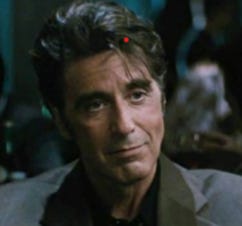
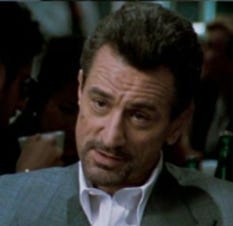
Both characters are men of action. Mann describes them as “raw” and “wired” and devoid of illusions or self-deception. Indeed, he calls them “predators,” so focused on the chase that they have little time for or interest in relationships. Hanna teases McCauley for being a “monk,” then admits his own personal life is a “disaster zone.”
The movie is also famous for the sound of machinegun fire echoing through the canyons of downtown LA. This scene, which takes place when Hanna and his detectives intercept McCauley’s crew outside a bank, is thought to have inspired the North Hollywood Shootout, a real-world bank robbery that took place in 1997 in which the perpetrators wore body armor and employed automatic weapons.
Can a crime genre film offer useful guidance for contemporary men? Most people would say, probably not. HEAT was snubbed by critics when first released in 1995.[2]
Yet the movie has stood the test of time. Today it’s considered a classic.
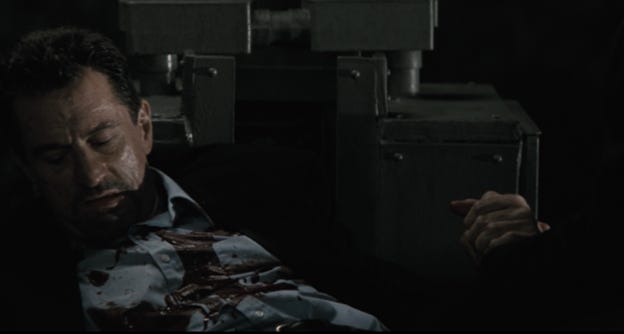
The final scene contains the key to the film’s message. Hanna chases McCauley across a runway at LAX and into a grassy field, where he guns him down, then holds McCaulley’s hand as the master thief loses consciousness and dies. It’s a gesture of sympathy and respect, all the more meaningful between adversaries, which plays to the hope we all have that human connection can ultimately transcend conflict. Indeed, the film champions connection, while acknowledging the real-world challenges to sustaining it.
In conceiving of the movie, Mann says he imagined the ending first, then wrote the rest of the story to propel the two protagonists toward this final “conjunction.” The plot’s inner logic presents a message which seems as relevant to men (and women) today as it was 31 years ago when the film was released, or a hundred years earlier during frontier days – relationships depend on making the right moral decisions.
Hanna as Hunter
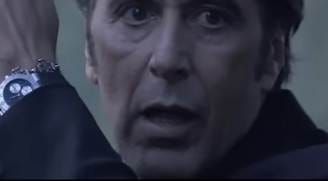
The film’s presumptive hero is Vincent Hanna, lieutenant of the elite robbery-homicide division of the LAPD, who’s presented as a relentless hunter — a paragon of those traditional male attributes which Richard cautions us not to glorify. Hanna is a fighter. He’s fast, ruthless, highly skilled, supremely disciplined, always in motion. We see him flying down the highway in pursuit of McCauley, whipping past cars in other lanes – cruising in a helicopter above LA’s nighttime skyline en route to an intercept — jogging down a flight of stairs after receiving an important message on his pager – processing new information nonstop and barking orders .
Hanna is so amped, it seems like he’s on stimulants. In interviews, the actor Al Pacino says he imagined Hanna as someone who “chipped” cocaine (i.e., used it episodically) and that Mann “egged him on” to make the character come across as bold, aggressive, flamboyant, and erratic. The original screenplay[3] contains a scene in which Hanna snorts crack in order to be at his mental peak during a critical meeting, but Mann said he cut that scene from the final version because “it might have sent the wrong message.”
Nonetheless, in the novel, Heat 2, which Mann published in 2022 as a prequel/sequel to the movie,[4] stimulants remain a motif. For example, as a young Marine fighting in Vietnam, Hanna gobbled government-issued dextroamphetamine pills like they were M&M’s – they turned his world “bright and aggressive and electric” and made him feel invulnerable. Years later, as an aging captain in LAPD, Hanna takes Adderall for the hit, the energy, the focus, and he’s described as rolling into work “pumped” on espresso.
Neither the movie nor the novel shows Hanna struggling with downside effects from this usage. Nor is he totally out of the norm, what with 85% of Americans taking caffeine, 7% taking prescription stimulants, and 3.5% illegal stimulants including cocaine.[5] We might interpret the passages linking Hanna with stimulants as a narrative trope — meant to signal the enormous energy he derives from pursuing bad guys.
Drawing Energy from Action
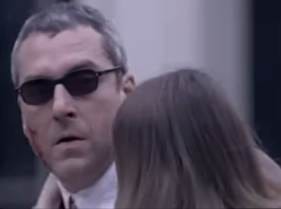
Both the cops and the criminals in HEAT are high-energy characters for whom the cliche, “adrenaline junky,” fits perfectly. Consider one of McCauley’s crew members, Michael Cerrito (played by Tom Sizemore), who’s described in the screenplay as “the nicest guy on the block and a loving father,” but also called out as a “cowboy” – “If you get in his way, he’ll kill you as soon as look at you.” In a pivotal scene, McCauley gathers his crew, reveals that LAPD is after them, and offers each man the chance to drop out of the bank score they’re planning to take down. Turning to Cerrito, McCauley practically begs him to walk, pointing to the strong relationship Cerrito enjoys with his wife Elaine and the fact he’s already accumulated plenty of money. Cerrito thinks about this for a moment, makes as if to speak, pauses, and then smiles. “I’m in,” he says — “for me, the action is the juice.”
Which is just as true for Hanna.
Hanna’s style is aggressive, theatrical, and sometimes erratic. He bullies informants to extract information, threatening and manhandling them. He struts around, shouting manically. At one point, he returns home to discover his wife with another man. He stifles the surprise and chokes back the anger. Then grabs a portable TV and storms out, as if to demonstrate that he has at least this as a claim on marital property. Tires squealing, he races off, then screeches to a stop at a traffic light – recognizes the ridiculousness of his action — opens the passenger door and kicks the TV out onto the pavement, to the bewilderment of pedestrians.
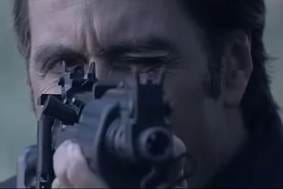
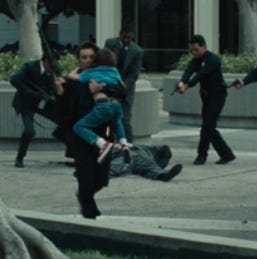
He may seem crazy, but Hanna remains strictly in control. Nowhere is this clearer than during the shootout at the LA bank. He’s racing after the crew as they flee on foot, firing single shots from his FN military rifle to avoid endangering innocent bystanders, ducking behind shelter when the crew returns fire on full auto. Separated from the rest of the crew, Cerrito runs through a shopping plaza, short-barreled M-16 brandished in one hand, a duffel bag full of cash strapped to his back. He jumps across a fountain, trips and falls in the shallow water, stands up and spots a five-year old girl, whom he grabs as a human shield while firing back towards the police. Hanna raises rifle to shoulder. Takes a deep breath and lets it out. Peers through the iron sights, waiting for Cerrito to spin around, then squeezes off a shot. The expression on Hanna’s face shows relief as Cerrito falls – tinged with astonishment that he pulled off such a difficult shot. It was a risky move, because he might have hit the girl or missed completely, prompting Cerrito to return fire at him or spray the crowds indiscriminately. But it was exactly the right risk-reward calculation, because to let a ruthless killer like Cerrito escape would have been unthinkable. Hanna rushes toward the fallen criminal, grabs the girl, and carries her away to safety.
Nowhere in the movie, or in the prequel/sequel Heat 2, do we see Hanna slip up, lose control, or make an obvious mistake. As odd as it seems for someone who’s so amped up, he is a paradigm of self-discipline.
Hanna’s Weakness is Relationships
When it comes to chasing bad guys, Hanna is extraordinary, but when it comes to sustaining relationships with women, he’s failing. Already divorced twice, he admits to McCauley during their fateful meeting that he’s “on the downslope” of marriage number three. In one of his essays, Rich D’Ambrosio cites survey data showing that women place a premium on emotional accessibility. Research finds that men with “emotional access deficits” are at risk of being expelled from romantic relationships.[6] Hanna could be a case study. When he arrives home late, four hours after she prepared dinner, his wife Justine (played by Diane Venora) asks how his day went. He declines to answer. The details are too gruesome.
At a party, his pager goes off, and he leaves her behind. Later, she confronts him about their relationship, telling him that he “has got to be present, like a normal guy, some of the time.” He gets curt. Refuses to share the angst. His mantra is “all I am is what I’m going after.” What he means by this is that he’s dedicated his life to his mission. He comes home late, or leaves a party early because he can’t afford to let up in the pursuit and risk losing the trail of the criminals he’s trying so hard to stop. He can’t allow people to be victimized. He dreams about the bloated bodies of murder victims, whom he couldn’t save; they stare at him, wordless. At the coffee meeting with McCauley, he feels a sympathetic connection with the master thief but warns him – “if it’s between you and some poor bastard whose wife you’re going to make into a widow, brother, you are gonna go down.”
Heat stands as a warning to anyone determined to succeed in a competitive career. You’d think Hanna could spare a few more minutes for his family, but the problem is that the criminals move fast. If McCauley’s willing to fly in 30 seconds, then Hanna has to do the same. This challenge faces people in all sorts of demanding careers. You’d think bankers, lawyers, investors, doctors, performers, entrepreneurs, executives, etc. could spend a few more minutes with their families, but that time could mean losing a client to the competition, missing an important trade, failing to get a project wrapped up on time and budget. In America today, researchers estimate that overall 41% of marriages end in divorce, with 60% of second marriages ending in divorce, and 73% of third marriages, and the US ranks as having the sixth highest divorce rate in the world.[7] It may well be that this data reflects the competitive nature of American culture, which emphasizes individual freedom and places a huge premium on career success. In this context, Hanna’s experience is more extreme than many, but once again, hardly out of the norm.
Part of the problem is that Hanna’s wife appears to be struggling with her own set of issues. Justine’s demands for Hanna to “be present” and “share” can be interpreted in different ways. Sharing feelings and vulnerabilities can be the cornerstone of an authentic, intimate relationship. But in some cases, demands to share feelings can represent a form of “emotional surveillance,” which is a control strategy triggered by deep-seated anxieties and an inability to trust the partner. Justine may be unwilling to respect the need for certain “boundaries” in a relationship.[8]
In the screenplay we learn that Justine spends a lot of time in therapy; indeed, she blames Hanna for forcing her to pay someone to figure out her life with him. She describes herself and her daughter as “not OK.” Admits to being “stoned on grass and Prozac.” Chooses to “demean” herself with a lover as a strategy to seek closure with Hanna. We don’t have enough backstory to understand her issues, but what’s interesting is how Mann uses drugs to draw a contrast between the two, with Hanna amped up on stimulants, while his wife is associated with sedatives and antidepressants. In the novel Heat 2, we find this same contrast in Hanna’s backstory, where his first wife took Prozac and drank heavily to deal with feelings of loneliness and a sense of failure. Mann seems to be drawing a contrast between those who move quickly through life, and those who cannot manage the energy.
For Hanna, these unfortunate circumstances create a moral conundrum. Where should he spend the next hour of his time to create a better moral outcome for the world – saving innocent victims by getting violent criminals off the street? Or trying to be present for a partner who may be struggling or confused?
These are difficult questions for anyone. Should we sacrifice relationships to reach for success? Or sacrifice success to sustain relationships? The moral calculus is complex, situation-dependent, and clouded with emotions. In competitive professions, both excitement and anxiety make it hard for people to slow down. Some relationships can flourish with just a little extra time. But others, sadly, are doomed, even when mental health professionals are brought in for support. HEAT’s message for men, as well as women, is to make these kinds of tradeoffs thoughtfully.
For McCauley, Discipline Precludes Attachments
Like Hanna, McCauley is high-energy and supremely competent, although instead of behaving flamboyantly, he acts discretely in order to blend in. Early in the movie, he’s standing watch outside a warehouse his crew is burglarizing. He takes a step backward into the shadows and literally disappears.
Military experience, jail time, and a life of crime have taught McCauley that discipline is non-negotiable. He summarizes his philosophy in a statement that represents one of the movie’s key themes – “Don’t let yourself get attached to anything you are not willing to walk out on in 30 seconds flat if you feel the heat around the corner.” The implication is simple – if you want to be successful in a life of crime, don’t let yourself get attached. It’s a minimalist philosophy taken to the extreme, and to illustrate this point, McCauley’s expensive ocean front house is barely furnished. In their coffee meeting, Hanna challenges him, asking would he walk out on a woman in 30 seconds if he felt the heat? To which McCauley responds, “That’s the discipline.”
Mann seems to feel equivocal about the character he created. In some interviews, he describes McCauley as too extreme, calling him a “rigid ideologue” and “somewhat sociopathic.” But elsewhere he takes pains to present McCauley as caring and sympathetic.
The viewer sees McCauley treating his crew fairly and with respect, and his attitude towards them goes beyond that of comrades in arms, for it’s clear that he cares about their families, too. When the crew goes out to dinner to celebrate their successes, McCauley picks up the tab, and his smiles are honest – he loves his people. Which is why, when the LAPD comes after them, he gives each crew member the option to bail on their next score, practically begging Cerrito to do so, citing his wife, Elaine, who takes good care of him.
McCauley’s sympathy comes across during the bank robbery, too, when clad in suit and ski mask and brandishing an automatic weapon, he orders the frightened customers to sit on the floor. Yet, in a measured voice, reassures them – “we’re here for the bank’s money, not yours.” Then tells anyone who feels sick or has heart trouble to lean back against the wall. Useful crowd control tactics for sure, but the screenplay describes his tone of voice as “nice,” and actor De Niro injects a sense of sincerity.
McCauley is presented as himself a victim of circumstances. In the novel HEAT 2, we learn that McCauley’s mother abandoned the family when he was three. Unable or unwilling to provide care, his father put Neil and his brother into foster care and disappeared from their lives. At age 18, Neil was arrested for a robbery and given the choice of prison or enlisting. Like Hanna, he fought as a Marine in Vietnam, but afterwards ended up in Folsom Penitentiary in Represa, California, spending years “in the hole,” meaning in solitary confinement, for reasons we do not know.
McCauley Falls in Love
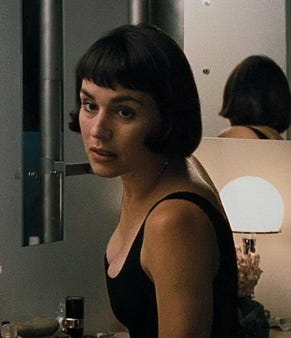
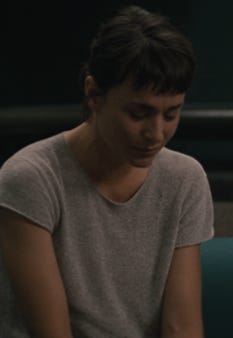
A young woman named Eady sees him in a book store and approaches him, and after gruffly dismissing her advance, he softens. They end up talking at a restaurant, and she invites him to her apartment, where they admire the city’s nighttime lights. When he calls the next day, Eady worries that it was a one-night stand, but McCauley replies, “not for me it wasn’t.” The screenplay describes a “tenderness” in his touch, as if he and Eady were longtime lovers. It turns out that behind the rough exterior, there is someone who hungers for an intimate relationship.
He tells Eady, “I’m alone. I’m not lonely.” Which is an interesting phrase, calling to mind philosopher and theologian Paul Tillich, who characterizes the modern existential hero as being like the knight in Albrecht Dürer’s famous engraving, flanked by the devil on one side and death on the other — “He is alone but he is not lonely. In his solitude he participates in the power which gives him the courage to affirm himself in spite of the presence of the negativities of existence.”[9]
Or maybe McCauley really is quite lonely. In HEAT 2, the reader discovers that McCauley’s fear of attachments results from past trauma. Years ago, he had a lover who was also a member of his crew. He called her the “glory of my life.” Told her that after years in prison, she’d brought him “back to life.” The woman’s daughter recalled how the three of them felt like a family — “we were happy.” Unfortunately, a rival crew moved in on one of McCauley’s scores, encountered the woman, took her hostage. McCauley tried to save her, but in the ensuing shoot-out she was hit. She died in his arms. He blamed himself for her death. Realized that in his profession, attachment “gets people you love – killed.” Decided never to put another person at risk.
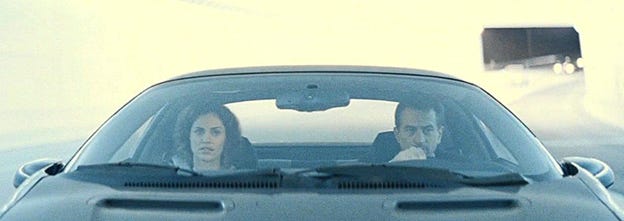
Even without the backstory, viewers of the movie appreciate that within this rigid man, there beats a tender heart. Now that he’s accumulated enough money, there’s finally a chance to turn his back on crime and start a new life with Eady. The camera shows them in his car, on the road to a private hangar at LAX where a charter jet is waiting to fly them to New Zealand and a new life together.
But then he throws this all away.
They’re almost to the airport, when a call comes in from the crew’s fence Nate (played by John Voight), confirming the flight is waiting for them — “You’re home free,” he says, then mentions casually that Waingro is staying at a nearby hotel under an assumed name. Waingro is the original catalyst for McCauley’s problems, because his bad actions during an armed robbery is what first attracted the LAPD. Nate adds “I figured you wouldn’t give a shit,” to which McCauley responds, “you figured right.”
The car travels through a tunnel, the overhead lights casting McCauley and Eady in a momentary glare. The camera zooms in on his expression — his eyes flicker, as he processes what Nate told him. He glances over at Eady, and a subtle smile lights his face. Then his eyes flicker again, and the mask comes down. His features contort back into De Niro’s trademark scowl, and he jerks the car onto an offramp.
Turning to Eady, he explains that he’s got to “take care of something.” Pulls into the utility area behind the hotel where Waingro is holed up. Tells Eady to stay there with engine running.
Why Did McCauley Have to Take Vengeance?
For McCauley, the decision to go after Waingro doesn’t end well, because it gives Hanna the chance to find him, leading to that final scene where Hanna guns him down, then holds his hand as he’s dying, in a gesture of sympathy and respect that transcends the strange relationship between two adversaries who share so much in common.
It may seem like a bad decision, prioritizing vengeance over love and life, but McCauley had no choice — or we could say that Mann had no choice but to make his character do this.
We met Waingro in the movie’s first action scene, where he joined McCauley’s crew to help with the takedown of an armored car. According to the screenplay, Waingro is a young man who’s already served in prison. He’s described as “anxious,” “trying hard to do good,” but he talks too much. He’s out of synch. Cerrito mutters, “stop talking, OK slick?”
The crew rams the armored car with a giant tow truck, blows open the back door with shaped charges, and drags out three security guards. Waingro is told to guard one of these men, who appears stunned from the explosion, but Waingro takes offense at something the guard says, or something Waingro imagines he’s saying – and shoots him point blank in the head.
This prompts the second guard to draw a pistol from a hidden ankle holster, forcing McCauley to open fire, and then McCauley gives the nod to Cerrito to kill the third man, because now that they’re on the hook for murder (not just armed robbery), it would be better not to leave any witnesses. A ruthless decision, but the correct risk-reward call.
Afterwards, McCauley is furious. The shootings were uncalled for. They only served to attract the attention of LAPD, including Hanna.
You could interpret Waingro as an agent of entropy – an example of how one thing going wrong can bring down chaos. Interestingly, Waingro is a considered a “cowboy” – that’s how he refers to himself, and that’s what Hanna calls him, too.
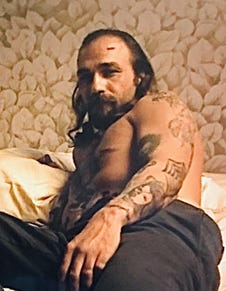
But there’s more to Waingro than recklessness or impulsiveness. We discover that he has a taste for underage prostitutes. Following one encounter, we watch as he turns to the unlucky woman and whispers, “Grim Reaper’s visiting with you.” Evidently, he is a serial murderer. If you look closely while he’s lounging on the bed, you can see an Aryan Brotherhood swastika tattooed on his stomach.
Waingro tracks down one of McCauley’s crew members, rapes and kills his wife, tortures the man until he reveals the crew’s plans for the bank robbery, and then tips off the police – resulting in the shoot-out at the bank.
To summarize, Mann went to great lengths to make Waingro a one-dimensional villain. You could call him the face of evil. For McCauley, it was a moral imperative to take him out, even if it meant risking everything.
McCauley’s Redemption
McCauley needed to be redeemed. Notwithstanding the trauma he grew up with and the sympathetic and loving side of his character, he has the ethos of a criminal – “if someone gets in my way, that’s their problem.” We can accept this attitude up to a point. However, by the time the movie is over, McCauley is responsible for the deaths of as many as 13 innocent people – 3 security guards from the armored car robbery, one of which he shot, and 1 detective, 6 policemen and 3 bystanders in the shootout at the bank. Plus he’s indirectly responsible for the death of two crew members during the shootout, as well as the crew member and wife whom Waingro killed. Not to mention that he and his crew killed various criminals.
Now, you could blame Waingro for catalyzing the chain of events that led to these bad outcomes, but McCauley is still liable under the principle of “proximate cause,” because as the leader of a highline crew, he should have understood (and no doubt did understand) that the nature of his activities could lead to harm.
There’s too much blood on his hands. Especially when the entire story is tied together by the final scene, in when Hanna extends that gesture of sympathy and respect.
Because this kind of gesture can only be extended from one hero to another. We would not want to see an evil character, like Waingro, holding the hand of someone he’d just shot (that would be sinister and disgusting). Nor would we want to watch Hanna holding someone like Waingro’s hand.
For Mann’s movie to end the way he wanted it to, McCauley had to make himself a worthy recipient of that powerful gesture. To redeem himself, he had to do something positive that would outweigh the damage he’d caused. Even if it meant risking the chance for a new life and happiness. Even if it meant losing everything.
Don’t Give Up Hope
Let’s heed Richard D’Ambrosio’s wise advice not to glorify the role of cowboy (or cowgirl for that matter), especially if the work involves real guns. You can still be the hero of your life story, however you choose to conceive of it, as long as you understand the sacrifices entailed in reaching for success and as long as you follow a moral code.
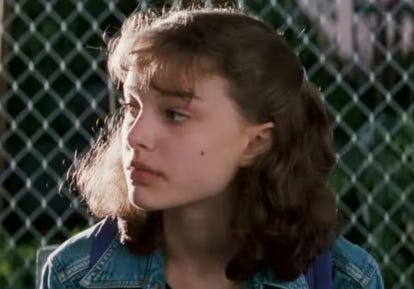
Towards the end of the movie, Hanna discovers Justine’s daughter in a bath tub, bleeding from self-inflicted cuts in the wrists and legs. “What a waste,” he shouts as he ties up her wounds and rushes her to the hospital, where Justine meets them. We see Hanna and Justine sitting in the waiting room, hugging each other for comfort. A doctor tells them the girl is stable and out of risk. Suddenly, Hanna’s pager goes off. This time, Hanna acts differently – he ignores the pager and stays focused on his wife. Justine looks at him and asks, “is there any way it could work out between us?” She seems to be reassessing the possibilities, weighing his shortcomings (limited emotional availability) against his strengths (just saved her daughter’s life). She tells him to go ahead and respond to the pager, affirming “I can handle this.” Tells him to be safe and to call her to let her know he’s OK. The next moment he’s flying down the stairs, on the way to that final confrontation with McCauley.
It’s an encouraging scene. Hanna and Justine together solved for the best possible outcome – daughter saved plus criminal stopped.
But if you read HEAT 2, you’ll find that the two end up divorced. Hanna tries to stay in touch, as he seems to have a real fondness for Justine. He listens as she lectures him that his energy is self-destructive, especially when amplified by stimulants. Eventually she stops taking his calls.
He’s able to stay in touch with Justine’s daughter. He calls to praise her for participating in a high school art show, hoping the positivity of this experience will pull her farther away from the “downward ride” which he senses is still out there. She sounds upbeat. The fist around his heart eases up by a millimeter or two.
“Love you,” he tells her. Then ends the call, “later, kiddo.”
[1] Richard D’Ambrosio, Don’t Let Your Sons Grow Up to Be Cowboys, Mindful Masculinity
 Mindful Masculinity
Don’t Let Your Sons Grow Up to be Cowboys
a month ago · 4 likes · 6 comments · Richard DAmbrosio
[2] https://www.esquire.com/uk/culture/film/a36208553/why-heat-could-be-the-greatest-oscars-snub-ever/
[3] The screenplay available online is dated March 3, 1994 and marked “For educational purposes only.” It is very similar to the final movie, although certain scenes have been cut, and the dialogue was modified in places, too. Accessed at https://www.dailyscript.com/scripts/Heat.pdf
[4] Co-written with Meg Gardiner and published in 2022
[5] Mitchell DC, Knight CA, Hockenberry J, Teplansky R, Hartman TJ. Beverage caffeine intakes in the U.S. Food Chem Toxicol. 2014 Jan;63:136-42. doi: 10.1016/j.fct.2013.10.042. Epub 2013 Nov 1. PMID: 24189158. https://www.psychologytoday.com/us/blog/the-last-normal-child/202304/in-the-united-states-of-adderall. https://drugabusestatistics.org/
[6] Wade TJ and Mogilski J (2018) Emotional Accessibility Is More Important Than Sexual Accessibility in Evaluating Romantic Relationships – Especially for Women: A Conjoint Analysis. Front. Psychol. 9:632. doi: 10.3389/fpsyg.2018.00632
[7] https://www.wf-lawyers.com/divorce-statistics-and-facts/
[8] 2 Ways to Guard Against Emotional Surveillance in a Relationship: When emotional availability starts to feel like you’re being watched. Psychology Today, March 18, 2026. https://www.psychologytoday.com/us/blog/social-instincts/202603/2-ways-to-guard-against-emotional-surveillance-in-a-relationship and Women Wanting Emotionally Available Men is a Lie. The World’s “Happiest” Medium Nov 25, 2024 https://medium.com/@theworldshappiestpodcast/women-wanting-emotionally-available-men-is-a-lie-2000b49d5528
[9] Tillich, Paul. The Courage to Be (The Terry Lectures Series) (p. 161). Yale University Press. Kindle Edition.

