Ninety minutes outside Albuquerque, New Mexico, Mt. Taylor (11,301 feet) rears its lofty head. The Navajo call this peak Tsoodził, translated as Blue Bead or Turquoise Mountain. Tsoodził is considered a sacred mountain, marking the southern extent of the Dinétah or ancestral homeland of the Navajo people. As I neared the summit, I wondered if I might encounter Turquoise Boy, Blue Corn Girl, or Cougar, who are Holy People said to live there.
My interest in Navajo culture dated from the year before, when my peak-bagging quest took me up Humphreys Peak (12,637 feet) in the San Francisco Mountains, lying outside Flagstaff, Arizona. This ancient volcano is the western sacred mountain, called Dookʼoʼoosłííd, and associated with the color yellow. I’d hunkered down on the gravelly summit, watched a crow hanging motionless in the flow. A distant gash on the face of the Earth was presumably the Grand Canyon. A faint pink smear to the north was presumably the desert plains of the Navajo Nation.
Later I came across a video by Wally Brown, a teacher of traditional Navajo lore, in which he explains how to live a life of “unshakeable confidence.” Just do what the Holy People would want you to do. If you’re not sure, ask them.
The Holy People (Diyin Dine’é) are said to be spiritual beings, associated with the Navajo emergence story. They live in a separate dimension from ours, traveling back and forth on rainbows. According to Wally Brown, they like it when people live in harmony, which is called “walking the beauty path way.” This is not considered an easy task. The Holy People expect us to think, plan, make a concerted effort, stand up for ourselves and fight if necessary, but they don’t like anger, hatred, or cruelty.
A Navajo writer named Blackhorse Mitchell wrote a memoir about growing up on the reservation in the 1940s and later attending school in Colorado, where he learned English. After graduating, he returned to the remote farmstead of his youth, where his sister welcomes him, mentions a stranger she’s seen standing on a nearby hill. She has seen him four times, always facing away. That evening it rains steadily. The next morning, Blackhorse heads out into the fog. Indeed, there is someone standing on the hill, back turned. Blackhorse approaches, feeling curious at first. But the wind picks up, driving sheets of mist around him. He becomes apprehensive. He feels the world starting to spin. Maybe he is going to faint? Maybe he is going to die. In the north a rainbow flashes – red, blue, yellow, dark purple. The figure turns to face him, and Blackhorse, deeply frightened, looks down at his feet and murmurs a single question — “Is this the end of my days?” To which the figure replies, smiling — “no, it is only the beginning.” And vanishes.
When I read this passage, I was perplexed. That a spiritual being would visit a school boy to offer encouragement was such a surprising idea. Raised in the Western tradition, I was taught that we are a fallen people. Our ancestors were expelled from the Garden because they sinned. We are expected to comply with commandments. To obey the priests and rabbis. Everyone remembers Moses’s wrath, when he descended from the mount with the ten commandments, only to find the people dancing naked around a golden calf – everyone remembers how, in a fit of rage, he smashed the tablets to pieces. But that wasn’t all. Next Moses grabs the calf, burns it, mixes the ashes with water, and forces the people to drink this noxious liquid. Then he calls on the Sons of Levi to teach the people a lesson with their swords. According to the King James version of the bible, “approximately three thousand died.” Such is the anger of the priestly class when you fail to follow orders. Or how about Abraham, who was tasked with executing his only son. Demonstrate blind, unreasoning obedience — and you pass the test.
The story of the Holy Person visiting Blackhorse was strange to me, yet it resonated. Maybe because at this point in my life, I, too, needed some encouragement. When my wife first called me to disclose her intentions, I was shocked and disappointed, because I’d taken a vow to stand by her until death, and for me, vows are non-negotiable. But as I thought about her decision, I concluded it was my duty to support her. I sat down with her to discuss lawyers and next steps and promptly shared all my information. But the negotiations did not go well. Her attorneys demanded, but did not reciprocate. There were long unexplained delays. When the documents finally came back, they contained malicious errors. No-one was interested in listening.
For thirty years I had provided for the family and her and stood by her faithfully. I was so angry to be treated like this. I kept waking up in the middle of the night, so upset I couldn’t sleep.
In his video lecture, Wally Brown said when in doubt, ask the Holy People. I have never been a religious person — I am too proud to pray to or beg favors from anyone. But I allowed that if there were such things as Holy People, and if they took questions from Bilagáana (people of European descent), why then I’d be open to considering their point of view.
Thirty minutes later, an image popped up in my mind. It was the reflection of my face looking into a mirror, features contorted with rage. I got the point immediately. Anger is not a good look.
(Later I decided, as an experiment, to type in some particulars about the situation into ChatGPT and prompt it to recommend a strategy.[i] It counseled patience. Said I should wait until my wife was ready to negotiate. Suggested I keep track of every communication. Cautioned me to avoid confrontational tactics that might escalate tensions, because a judge – if we ended up in court – might not like that.)
Friends and family suggested mediation. It took two years to convince my wife of this.
When the mediation session finally arrived, we sat down with our lawyers and a retired judge in a small conference room, the walls decorated with metallic prints of southwestern desert scenes. My wife’s lawyer opened with claims that they’d been open and straightforward – she insisted “there was no sleight of hand.” Well, this was a pretty easy ball to slam back into their court — I interrupted and laid out my complaints in a calm but forceful manner, citing details about the unfair process and their unwillingness to negotiate, making sure to repeat the phrase “sleight of hand” a few extra times, for the benefit of the judge. I offered to take the group through every single letter, email, phone call, and conversation of the last four years. There were no takers.
Then I cracked a joke. The tension in the room broke, and everyone smiled. The outlines of a compromise began to come together. Later we were holding up our phones, sharing dog pictures.
Still, it was a draining session. Afterwards, I caught a taxi to the airport, boarded my flight, endured a delay with the connection. By the time I’d rented car and reached hotel, my nerves were frayed, and then I couldn’t find a place to park. I slept fitfully, woke up exhausted.
The drive to the trailhead took nearly two hours. I parked in a forest of graceful pine and ghostly aspen. Headed out along a trail that was covered in needles. Another Navajo story came to mind. In Gus Bighorse’s memoirs, he tells the story of returning home one morning only to find his mother and father lying dead, arrows scattered on the floor, a trail of blood in the sand outdoors. He buried them, then headed towards Tsoodził, walking through the same forest as I was now, listening for the voices of his people, looking to link up with the warriors operating in the fight against the US Army. In his memoir, Gus recalls a lesson from his father, who was also a warrior –“A man should be right to stand up straight for what he believes.” Gus’ daughter, Tiana Bighorse, published her father’s “brave stories” to teach younger generations that the Navajo Nation was not a gift. Their ancestors fought for it.

The trail emerged from the forest onto a steep slope, covered in wavy grasses. I charged uphill aggressively, eager to reach the top, until my head began to ache from the elevation, nearly 10,000 feet. Tsoodził is associated with the female spirit and is said to be draped in female mists and soft rain. Maybe I was being too aggressive in my ascent. Maybe I should be smoother and more gentle, more in control, more in sync with the surroundings. I slowed my pace and the headache faded.
I reached the summit ridge, and from here the trail wound beneath an outcropping of volcanic rock. The path was littered with chunks of basaltic material and fragments thereof, the rocks not sharp, but pocked and edged, and the bumps pressed uncomfortably into the skin of my soles. Above me, the wind gusted through a grove of spruce. I thought of the Navajo wind spirit Níłchʼi, who guided the people from lower to higher levels of creation in the emergence story. In one story, Níłchʼi defeated a gambling spirit who had beaten the Pueblo people at games of chance, taken their wealth and enslaved them, and then forced them to build great houses in Chaco Canyon for his amusement. In another, Níłchʼi played advisor to Last Brother Sloppy Brother, helping the young man defeat his sister, who had married Coyote, become a sorceress, transformed herself into a ferocious she-bear, and tricked and killed his eleven brothers. Now I interpreted the wind as whispering to step carefully and keep moving, which seemed like good advice.
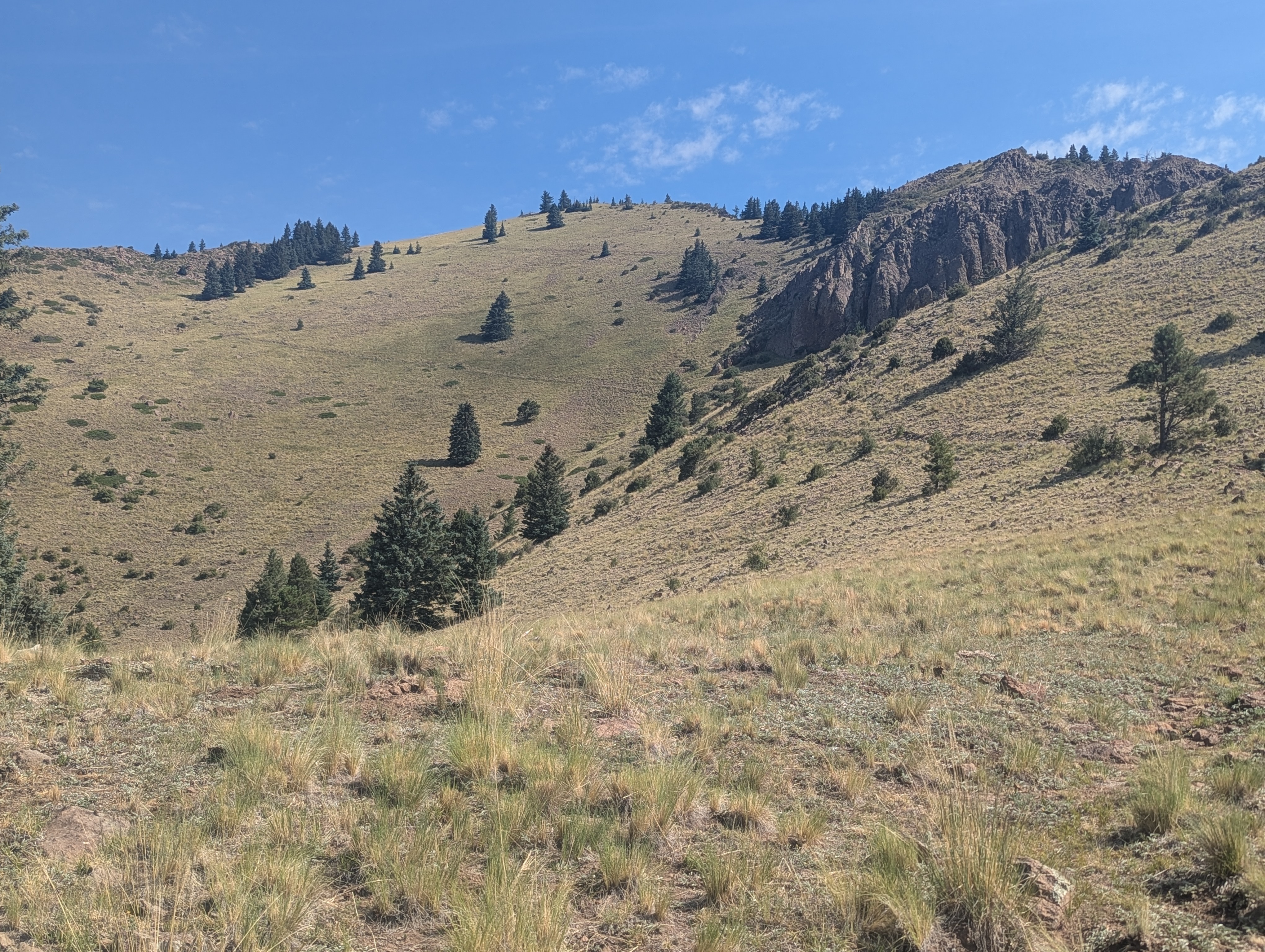
I reached the summit. Looked around at the surrounding desert plains. Took some panorama shots, and a selfie. Walked a few paces towards a grove of spruce trees festooned with beard lichen. Took a seat in the shade. Listened to sparrows. Spotted a raptor gliding between the branches. Took a sip of water. When the fifth level of the world was created, the four sacred mountains were formed from materials in the fourth world, and anchored to the surface with giant knives. According to the emergence story, several Holy People were directed to live on Tsoodził, including Turquoise Boy and Girl, Blue Corn Boy and Girl, and Cougar.
What if I encountered them here?
I tried to picture a Navajo Holy Person. Their eyes would surely have a special clarity and sparkle. As for Cougar, whose job is to protect the girls, I imagined him lying on a boulder, basking in the sun, like the mountain lion I’d seen the year before in the Tucson zoo. If I encountered Cougar, I’d be clear that my intentions were honorable. I simply wanted to thank the Holy People for the helpful advice I’d received during the conflict with my wife. Relinquishing the spirit of anger had made me more effective, when it came time to stand up for myself.
From the direction of the summit rang out what sounded like a laugh. Probably just birds. Then I wondered, what would Holy People sound like? Would Turquoise Girl sound like the Elf queen Galadriel, played by Cate Blanchett in the 2001 version of The Lord of the Rings — which is to say ethereal, calm, imbued with a sense of ancient wisdom, sometimes tinged with a hint of melancholy and foreboding, sometimes soothing and almost maternal.
Or maybe Turquoise Boy and Turquoise Girl would chatter and laugh like kids.
It was time to head back.
I emerged from the spruce grove and passed by the summit for a final look around, heard another laugh, saw two women sitting nearby, backs toward me. I thought of interrupting them to ask if perchance one of them was Turquoise Girl. But they were deep in conversation and unaware of my presence, and I didn’t want to startle them.
Also, they were blondes, whereas I assumed, rightly or not, that Navajo spirits would have black hair. Then I thought that Holy People might not want to draw unwanted attention from tourists like myself, so maybe they assumed the forms of contemporary day hikers to stay unnoticed.
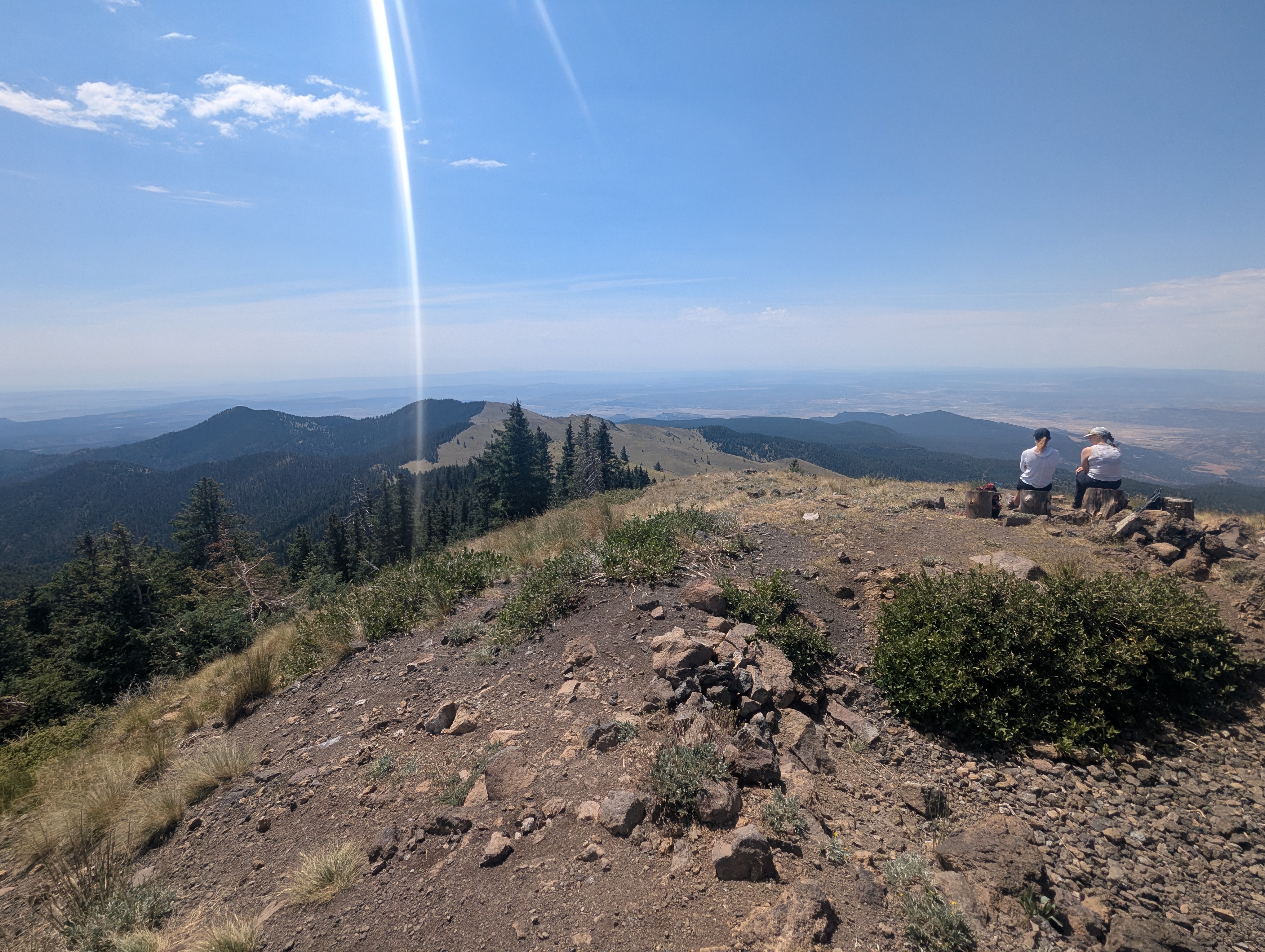
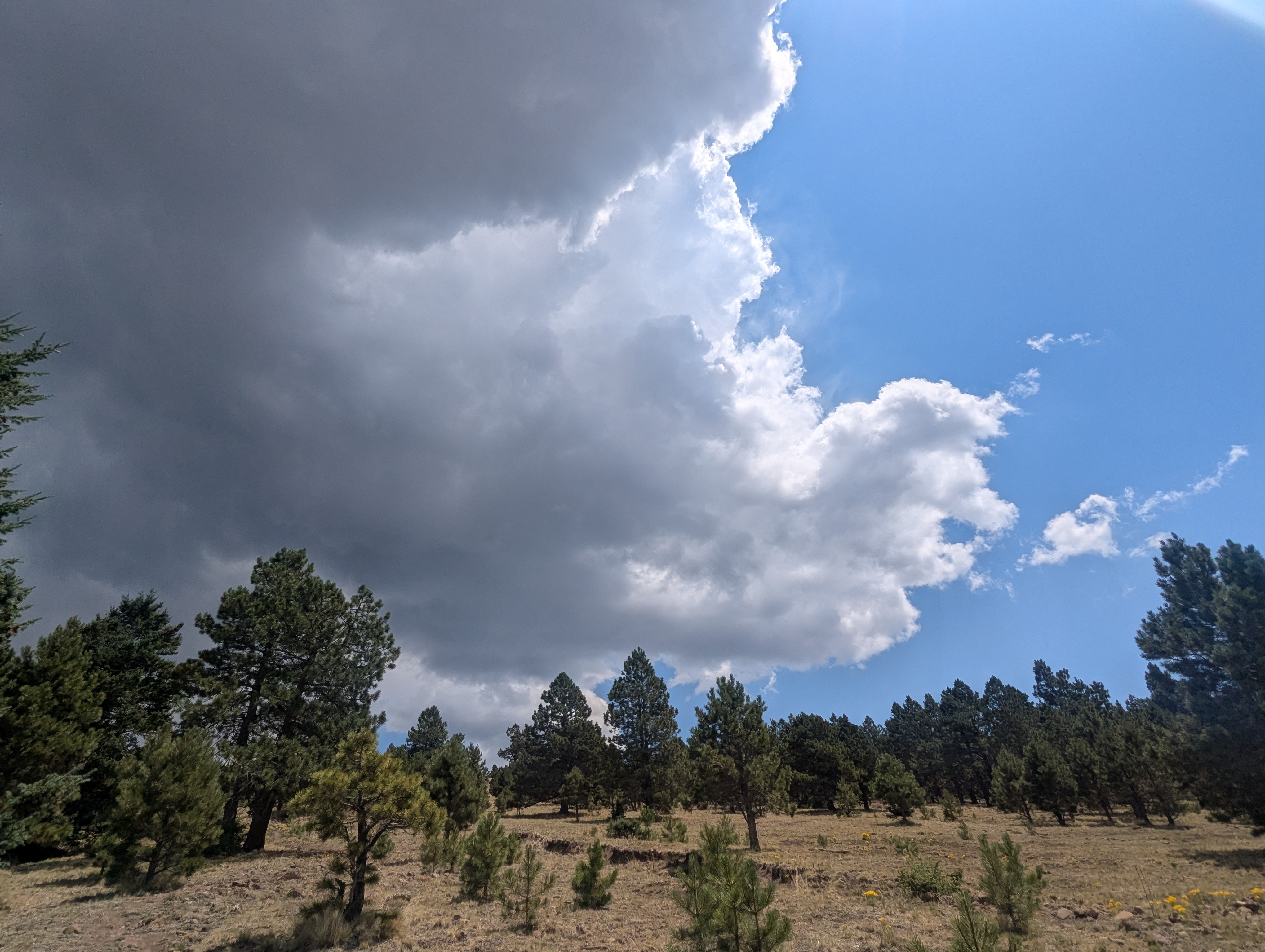
The descent was slower and more difficult than the ascent, as my feet were getting tired from the rocks, and the sun was now directly overhead and heating up the sand. I paused and looked behind me. Gray clouds were gathering behind the summit. A single clap of thunder cracked the air. The wind began to whistle through the spruce and set the aspen leaves to fluttering. I thought once more of the wind spirit Níłchʼi, who is said to be a source of good advice to those who keep an open ear, and now I thought indeed it was better not to loiter on a mountain when a storm was brewing and made an effort to hustle along. It is often the case when hiking barefoot that the mountain shows a friendlier face on the ascent, and what seemed like smooth and friendly trails going up, were turning rocky and uncomfortable on the way down. So I gritted my teeth and tried to place each step with care, aiming to land on clusters of soft pine needles and dodge the abundant irritating grit and rock fragments. As I walked along, I saw the sandy footpath dotted with my barefoot prints from the ascent. But there were no other tracks. Those two women on the summit had somehow moved along the trail without leaving any marks. Or perhaps they’d ascended from a different direction.
Tsoodził was barefoot ascent number 551 in my quest to climb 1,000 mountains without shoes.
A few days later I swung by Santa Fe, coincidentally during Indian Market, and strolled past stalls displaying paintings, sculptures, and jewelry. There were thousands of people there, like me curious about Indian art and culture. I appreciate the Navajo people for sharing their stories, which seem full of positive ideas and pragmatic good sense, but it’s not surprising that their Holy People would be reticent to engage face-to-face – there are so many of us modern people hungry for better ways to understand the world, we would probably overwhelm them.
[i] Afterwards I considered the question – what is the difference between a prayer and a prompt?
One difference is the dataset. Large language models are trained with massive amounts of data drawn from public sources. For example, ChatGPT 4 was trained on 1 petabyte of data, resulting in 1.76 trillion parameters. However, big data does not mean you will necessarily get better answers. As Nassim Taleb points out in his book, “Anti-fragile,” big datasets contain massive amounts of noise and spurious correlations, allowing researchers to promote a large variety of conflicting claims. Additionally, much of the data available on the web is supported by financial interests with considerable budgets for marketing and PR. Think of the web not as a source of truth, but as a Wild West for marketing, propaganda, and the conspiracy theories that arise when the conventional narrative is not convincing, which means the advice from AI models is going to often be questionable.
If you think of the Navajo Holy People as spiritual beings, it’s hard to know what kind of dataset they are drawing upon. However, suppose you preferred to take a slightly more “scientific” approach, in which case you could describe spiritual beings like the Holy People as personifications of the data in our minds. Scientists estimate that the human brain contains around 1 trillion interconnected neurons. Yet, these connections represent not only the experiences we accumulate in memory, but also what has been encoded in the genetic architecture of our brains over hundreds of millions of years of evolution. Your dialogue with a spiritual being could be one way in which you query the embedded wisdom of a collective ancestral tradition of which you are part.
Chasing the Grid is now available on Amazon!

 The Long Brown Path
[…] summer I climbed Mt. Tsoodził in New Mexcio, one of four Navajo sacred peaks, wondering if I might encounter some of the Navajo Holy People […]
LikeLike
[…] August, I traveled to New Mexico, where I summited Mt. Taylor (11,305 feet), which is the southern sacred peak of the Navajo and known to them as Tsoodził. As […]
LikeLike