Josh Dickson is a UK-based therapist, thought leader in the field of human potential psychology, and student of “flow,” the super-productive state of consciousness experienced by athletes and other high-performers. Core to his practice is the idea of “mindfulness,” which is sought traditionally through gentle and voluntary techniques, like relaxation. But in a series of recent articles, Dickson brings up a different approach, which he calls “forced mindfulness.” Forced in that this kind of mindfulness requires “conscious and intentional effort” to deal with intensity — sense of urgency — the risk of pain.
The other day Josh asked me, might barefoot running be a form of forced mindfulness?
I looked at him. Considered the question. Said I’d think about it.
The next morning, it was 55 F (13 C) and raining, and I can assure you that mindfulness (forced or otherwise) was not the foremost question on my mind when I woke up at 5:00 am (and then again when the second alarm went off at 5:30 am). Rather, the question was how anyone (shoes or not) could go running in such dismal conditions. After a long warm summer, including daytime temps of 110 F (43 C ) during trips to Dallas, I was having a hard time wrapping my head around the transition to autumnal weather. Deep in my sleepy mind, I thought that surely it must be possible, since I’d done it myself in years gone by – and not to mention, the night before, I’d stood around as a volunteer serving snacks inside a tent as runners trotted by on a soggy trail, in steady cold rain, all night long, in order to finish 100 miles.
With a grunt, I rolled out of bed. Recalled my introduction to forced mindfulness, forty years ago — when U.S. Army drill sergeants and Ranger instructors told us to “pay attention to detail.” If you screwed up, they got in your face – “drop and give me 20 pushups!”
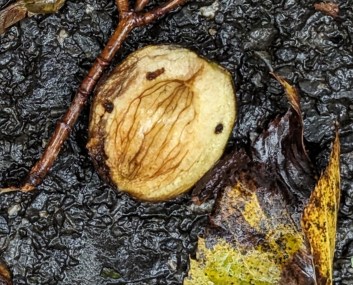
That was admittedly a long time ago. Today I have more experience. Sometimes I even know what to do. At 8:00 am, I pulled into a parking spot in the small village of Wurtsboro, New York and emerged from my Jeep wearing sweat pants over shorts, long sleeve shirt, fleece sweater, windbreaker, and hat. I paid the registration fee and pinned on my bib, and after about ½ mile of trotting around I was getting uncomfortably warm and sticky (and a little irritated, too, from having to dodge hickory nut husks, which split apart into sharp-edged pointy quadrants). Starting your warm-up overdressed is a great strategy – soon enough you appreciate a cool breeze. Honestly, it wasn’t particularly cold (60 F or 16 C) , and by this time the rain had pretty much stopped.
When the horn sounded, I headed out at a moderate pace, mindful of what lay ahead – and paying attention to some lingering tightness in my left groin muscle, which had been sore for several days. The leaders disappeared into the distance. If I wasn’t fast, at least I was wearing a shirt with some attitude — bold racing stripes, a glaring skull, and the motto, “Run or Die.” Now I stripped it off and tied it around my waist. Running shirtless also conveys some attitude, and an aggressive mindset was going to be necessary, because now the pavement began to rise. We were running along the shoulder of Mamakating Road, which heads south out of Wurtsboro and climbs onto the shoulder of the Shawangunk Mountains. Not only is the grade quite steep, but you’ve got to stay vigilant about pickup trucks careening down the mountain at highway speed.
So far, so good. The shoulder is wide. The trucks are slowing down. And best of all, the pavement is smooth as glass, which matters for a barefoot runner. I’m moving steadily. In control. Hardly out of breath. Feet are feeling fine. I pass a girl in a blue shirt (I think her name is Danielle) and a couple of men and then another woman with black ponytails.
Soon we’re passing a side road that’s quite familiar. Three weeks earlier I was hanging out here at 2:00 am, waiting for ultra-runners in the SRT Run 70-mile division (this is checkpoint #2). Over to the side, there’s some kind of junkyard. I remember dogs barking there all night. Once I swung my headlamp in that direction and saw a pair of eyes staring back at me.
The grade begins to ease. I think the worst of the climb must be over (it’s not). I push a little harder, until my pace drops to a 9-minute mile (5:40 min/km), according to my GPS watch. Maybe this is too aggressive, though, given tightness in the groin, and the fact that we’re only 2 miles into a 12-mile race (3.2 km into 19.3 km) . But I’m feeling good, and there are four runners in sight, and I’m on track to overtake them.

We take a hard left turn off Mamakating Road, onto Shawanga Lodge Road — and now I have a problem. There’s a different kind of pavement here, called “chip and seal.” It’s a low-cost paving method, popular in low-traffic rural zones, in which they lay down oil, spread finely-crushed aggregate, and tamp it down with heavy rubber-wheeled rollers. You might notice chip and seal while driving in a car, as the rough surface generates considerably more roadway noise than asphalt or concrete. Bicyclists will experience increased vibration, rolling resistance, and tire wear. For me, those tiny sharp-edged stones are poking painfully into my soft wet feet.
Well, as I mentioned, I’ve got some experience, and I know what to do. Flex the knees. Crouch down a little lower. Concentrate on landing and lifting off precisely. And needless to say, slow the f*ck down.
The pavement looks a little smoother along the center. I zig from the shoulder into the middle of the road and hang out there until I spot oncoming headlights. At which point, I zag back onto the shoulder, groaning as my feet impact upon an especially bumpy section full of sharp prickly stones.
It’s drizzling. I wipe off drops from the face of my watch. My pace reads 11:27 (7:08 min/km). For someone who likes to go fast, this is mortifying.
Those four runners leave me behind. They disappear around a bend.
My mind is flying with contingencies — and boiling over with frustration (I hate getting left behind) – and now a sense of panic sets in. I just passed mile 2 (3.2 km), and the turn-around’s at mile 6 (9.6 km) – which means there could be as many as four miles of this nasty stuff in front of me — meaning eight miles total. Will I survive? Flashback to a marathon in Oklahoma on path that started smooth and then deteriorated and ended up winding through a construction site. So, yeah, I can probably get this done – but do I want to? I picture myself rolling across the finish line in last place.
When running barefoot, standard operating procedures call for carrying a pair of Fitkick’s in a pocket. These are like slippers but with thin Vibram soles. I bring them for just this kind of situation. I could pull them on right now — and catch back up to the pack and resume passing people, the way I like to.
But that would be the wrong path. I transitioned to barefoot running ten years ago, when I reached a point in my career when too much intensity was leading to injuries. Barefoot was a strategy to slow down. I can’t go back.
A crazy thought – I could turn around right now and head back to the start – and get there in time to run the 5k race, which starts later in the morning. It would be a manageable distance, no matter what kind of surface.
While I’m considering options, Danielle catches me and moves ahead. Rapidly. Then the woman with ponytails passes me, too, as well as three or four men. The road straightens out, and through the mist I spot small figures in the distance.
The wind is blowing forcefully here, half-way up the mountain. I’m moving too slowly to generate much body heat. I’m starting to feel cold.
In the forest somewhere, a crack rings out. Sounds like a .45 caliber automatic, or maybe an AR-15. This is rural country. Like in the movie, Deliverance.
Sheets of mist are tearing through the trees and whipping across the road. The road is still rising. Up ahead I see a runner who’s slowed to a walk. He’s power-hiking now, swinging his arms with vigor – with each swing his hands reach up to the level of his ears.
I make a concentrated effort to move. Watch shows pace accelerating to 11:17 (7:04 min/km). A moment later, 11:04.

A mile goes by. Up ahead, I spot an intersection. From the way the water shines, it looks like smoother pavement. Maybe one road was paved in a different manner from the other, or maybe the intersection got some extra attention from the rollers. I pick up a little speed. On the far side, I can see the chip and seal is back, but it looks a little bit less bumpy.
A little bit is all I need.
I’m back in action, cruising at a 9-minute pace. Watch buzzes – another mile’s gone by. Which means two more miles to turn-around. I overtake another runner, as the road dips and rises. Pass some volunteers standing in the mist, a mom and two kids, holding out cups of water — but who needs that on a cool wet day.
The road gets very steep as we near the crest. I pass three more runners who’ve slowed to walk. I’m directing energy into short strong steps – while being mindful of my hamstrings. Once I strained the left proximal hamstring tendon while running hill repeats. That tendon took two years to fully heal.
Up ahead, three runners vanish around a turn. A moment later, they’re coming toward me. Which means the turn-around is just ahead – and as I reach the traffic cone which marks the point and slow and step around it, I shift into a more aggressive mindset. Because from here, as they say, it’s all downhill. But that doesn’t mean it’s time to go all out – not yet. Two years ago, I jammed my knees (I don’t know how else to describe the injury) racing downhill. The left one especially. They’ve fully recovered (I think) — but even so, downhill rhythm is different. You’ve got to give the body a moment to adjust. The key — stay low, and let the knees flex (like doing lunges in the gym).
Up ahead I see a woman in a yellow jacket. She runs, then walks for a few steps. My pace drops below 8-minute mile (5:00 min/km). I’ve got her in my sights.
It’s raining heavily. My clothes are wet, including the shirt around my waist. The wind tussles the forest canopy and sends drops spattering against the pavement.
I pass those volunteers again – flash the kids a thumbs-up and mock salute, like Tom Cruise from the cockpit. “He’s a warrior,” the mom explains, but I shake my head. In our culture, only military personnel play that role.
Watch shows pace dropping into low 7s and then it breaks to 6:55 (4:17 min/km). Momentary twinge in right calf – right shin slightly numb (those muscles play an important role stabilizing the foot, especially with the heavier impact running downhill). So I back off for a moment, flex knees, get lower.
I’ve been out here for an hour. So much intensity, urgency, pain – and it flashed by in a blink.
Runner ahead, his gray shirt soaked — I’m closing on him steadily and now I’m tearing past. But then it’s back onto that rough section of chip and seal. My pace slows into the 9s, but what a difference this time through — because I know it doesn’t last! I pass the woman in the yellow jacket who was taking walking breaks. Up ahead I see a blue shirt – it’s Danielle.
The road is twisting to the left and right and dropping steeply – this forces me to brake – and then it’s the hard right back onto the smooth slick shoulder of Mamakating Road. The chip and seal is nothing but a flicker in the past.
Silver streak of water running down steep black pavement — it suddenly feels slippery. I check my pace. Adjust posture. Resume full power.
Man running 100 yards ahead, and I’m gaining slowly. I remind myself not to push the body — to let it run. I know this from studying the sport of race car driving (I do a lot of research). As I fly past, I sense him dialing back, as if discouraged to be overtaken.
Sounds of my feet slapping smooth wet pavement. Water beading on watch face. Pace reads 6:33. 6:22. 6:14 (3:52 min/km). Tenseness in right lower quadricep (the shockwaves have to go somewhere). A flash of blue. Danielle is moving left to pass someone. I swing out farther – into the middle of the road – cocking one ear back for sounds of traffic – and then I’m past her and back onto the shoulder and tearing down the mountain.
The hill is over. The grade flattens out. End in sight. So is the woman with ponytails. A hard right turn is looming ahead — volunteer standing there and pointing — I’m scanning pavement for debris, picking my line, cutting through a puddle – hammering. She’s breathing hard and slowing. I fly past her, make another left, and there’s the finish line.
Afterwards, I stood and clapped for all the winners, young and old, and smiled as I was handed first place prize for males 60-69.

Saw some friends and hung around for a few more minutes, sharing the positivity. Until my damp clothing began to chill me.
On the drive back, I reflected on Josh’s question — whether barefoot running might indeed be a form of forced mindfulness. Josh is a surfer, by the way. He writes of the excitement as the waves gather. Points out that when surfing, “you must be fully immersed in the moment or wipe out.” I’ve never so much as touched a surf board in my life (although I’ve had a few misadventures with windsurfers), but I think Josh may be on to something. Ralph Waldo Emerson, the American Transcendentalist, wrote that man could never be strong and happy, until he learned to “live with nature in the present, above time.” The question is — what kind of training, practice, or technique will get you to that point. Not that there’s anything wrong with relaxation. It’s just that, depending on who you are, you might need something more intense. You might need to see your “limitations transgressed,” as Henry David Thoreau put it, in explaining the importance of wildness.
Otherwise, I may not have a definite answer for Josh. I’m not a clinician, coach, or therapist. I’m not even sure I understand what “flow state” really means.
On the way home, the rain is smacking against the windshield as I whizz around the bend of a narrow mountain road (following the racer’s line through the curve, as best I can). Standing on the shoulder I spot a fawn. The doe is nearby in the brush. For a moment, the fawn studies me out of the corner of its eye as my Jeep comes barreling straight towards it. Then it’s bounding in the air, high-stepping through the vegetation, disappearing with its mom back into the windy wet forest. Which used to be the home for people, too, in pre-modern times.
Forced mindfulness. I guess I might recognize it when I see it.

Running the Long Path is available on Amazon!

 The Long Brown Path
[…] Roosa Gap Roller Coaster – an 11-mile exercise in forced mindfulness […]
LikeLike
[…] of elevation gain — and someone else said the same thing when I was running barefoot in an 12-mile race in the Shawangunk Mountains. I used to be a warrior. I wore Vietnam-era jungle fatigues and […]
LikeLike