Team Red White & Blue Rocks the Ridge

Team Red White & Blue ready to take on 50 miles at Rock The Ridge, May 2, 2015

The first virtue in a soldier is endurance of fatigue; courage is only the second virtue.

— Napoleon Bonaparte

Just a few minutes before the start, eight members of Team Red White & Blue posed for the camera, dressed in red shirts emblazoned with white eagles, smiling shyly in the pre-dawn light.  For most of the team, it would be their first attempt at 50 miles — a distance nearly double that of the marathon and sixteen times the 5k.  50 miles is not easy to get your head around, even if you’ve run it before.

I was both a member of the team and one of the organizers of this race, called Rock The Ridge, which takes place in New York’s Hudson Valley.  The race had been created to showcase the beauty of the Shawangunk Mountains, raise funds for a nature preserve that safeguards this wilderness, and encourage people to take on an endurance challenge that would be epic yet achievable.

In 2013, the first year of the event, I was putting some extra markings out on the course, just as dusk was falling, when I encountered an older woman hiking up the trail, a determined look on her face.

“What are you doing here?” I asked, surprised and a little curious.  Her name was Myriam Bouchard, and she was running the 50 miles of Rock The Ridge to celebrate her 50th birthday.  Then she mentioned something else:  her son had enlisted in the Army and volunteered for the Special Forces, and she wanted to set an example for him.

I had served in the Army many years ago and experienced my fair share of runs, road marches, and cross-country movements.  Indeed the idea for Rock The Ridge came in part from military-style endurance challenges, like the Hong Kong Trailwalker.  We had modeled the event specifically after President John F. Kennedy’s 1963 challenge to the US Marines:  could they still march 50 miles in 20 hours, as once required by Teddy Roosevelt?

JFK believed that physical and moral strength were linked.  In 1960 he had written an article for Sports Illustrated entitled, “The Soft American”.

The knowledge that the physical well-being of the citizen is an important foundation for the vigor and vitality of all the activities of the nation, is as old as Western civilization itself. But it is a knowledge which today, in American, we are in danger of forgetting.For physical fitness is not only one of the most important keys to a healthy body; it is the basis of dynamic and creative intellectual activity. The relationship between the soundness of the body and the activities of the mind is subtle and complex. Much is not yet understood. But we do know what the Greeks knew: that intelligence and skill can only function at the peak of their capacity when the body is healthy and strong; that hardy spirits and tough minds usually inhabit sound bodies.

He ended the article by warning, “We do not want our children to become a generation of spectators.  Rather, we want each of them to be a participant in the vigorous life.”

After the Marines successfully responded to the Kennedy Challenge, JFK’s brother, attorney general Robert Kennedy decided that anyone should be able to do this – even if they had no training.  He gathered his staff and headed out on a snowy morning wearing a pair of scuffed oxfords.  His staff gradually dropped out.  At mile 35, Bobby told the last departing aid, “You’re lucky your brother isn’t president of the United States.”

Nonetheless, he finished the 50 miles, in 17 hours and 50 minutes.
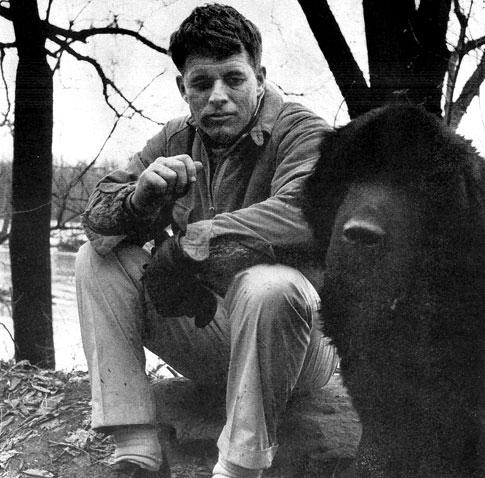
Bobby & Brumis
Robert F. Kennedy with his canine companion Brumis. Brumis made most of the 50. Bobby walked it all. Source: Life Magazine 2/22/63, The Big Walk, “A Little Stiff for a Man of 37…”

The Kennedy Challenge attracted enormous publicity, and soon a fad for 50 mile hikes was sweeping the nation. Life Magazine devoted an entire issue to the phenomenon.  Popular musicians wrote songs.  The young, the old, even high school kids were on the march.

Unfortunately, the mass enthusiasm for endurance challenges faded with Kennedy’s untimely death.

Every calamity is to be overcome by endurance.

— Virgil

In 2013, fifty years after Kennedy’s challenge to the Marines, Myriam Bouchard signed up for Rock The Ridge.  She wrote in her blog about the motivation for participating in such a grueling event, referring to her son who had recently enlisted:

In my deep love for him, I felt if I succeeded in this 50-mile endurance race, I could pass along my determination – something to take with him when things got rough during his multiple assessments where he might be tempted to give up. If I finished, I wanted him to remember that once you set your mind on something, it’s possible to reach your goal by sticking to it. That was my hope anyhow: that I’d make it to the end so I could inspire him to move beyond his own limitations, or what he perceived as such.

After reading Myriam’s words, I had a sudden vision of military personnel and civilians moving together along the mountainous trails, celebrating the spirit of endurance that is so necessary for all of life’s difficult missions.

A quick internet search led me to Mike Erwin, founder of Team Red White & Blue, a not-for-profit organization whose mission is to enhance veterans’ lives through physical and social activities.  After meeting Mike, I started running with a Team Red White & Blue group in Central Park on Wednesday evenings.  There I met a retired military policeman named Joseph Coureur who carried the US flag during our evening runs.

“Why don’t you carry the flag at Rock The Ridge?” I asked innocently.

An experienced marathoner, Joseph wrote in his blog that “lately my running is less running and more exploring and accomplishing.”  I kept asking until the idea of running 50 miles finally hooked him.

And so it came to pass that one fine morning in May 2015, among two hundred other participants, Joseph, myself, and six other members from Team Red White & Blue were standing at the start of Rock The Ridge.  The sun was just peeking over the horizon.  It was going to be a beautiful day.

Endurance is nobler than strength, and patience than beauty
— John Ruskin

As soon as the starter’s gun went off, Team Red White & Blue members Nina DiPinto and Julie Daigle joined up with Joseph, and the three of them headed out together.  They moved as a team, vigorously hiking the hills, running the flats, taking in the views across the valleys, and braving the afternoon heat.  At mile 37, they pulled into one of the aid stations to regroup.  Nina was suffering from bronchitis and a sinus infection, and she worried that to keep going would unfairly slow the others and potentially jeopardize them finishing.  She made the difficult decision to drop out.  Joseph unlaced his shoes for a few minutes and ate some soup and crackers.  During the day, his emotions had ranged from denial to suffering to acceptance.  Now he and Julie decided it was time to run.

Just after dark, Joseph and Julie crossed the finish, the US flag held high.  Joseph sat down heavily, momentarily dizzy.  He had never run 50 miles before, and the hills and warm temperatures had taken a toll.  Later he explained to me that he perceived himself to have “no choice.” As long as he was carrying the colors, “quitting was not an option.”

Joseph, Julie, and Nina on the move.  Credit:  Mohonk Preserve Volunteer Photographers
Joseph, Julie, and Nina on the move. Credit: Mohonk Preserve Volunteer Photographers

Julie was all smiles and sparkling eyes.  Evidently indefatigable, she looked like she was ready to take on another 50 miles.

Adam Freed and Phillip McIntire, who had served together with New York’s 69th Infantry Regiment, arrived at the finish line a couple of hours later.  They were in high spirits, although they sheepishly admitted they needn’t have carried 30-pound packs.  It’s just that as infantrymen, they were used to 50 pounds.of gear or more.

Along the way, they found the blisters agonizing, and Phillip nearly dropped out at mile 43, when he felt himself “completed exhausted physically.and mentally.”  But he persevered, thanks in part to Adam’s companionship and another racer who fell in with them and suddenly they found themselves exhilirated to be running on the ridge under the moonlit sky.

They had plenty of experience moving on foot, but had never covered anything near to 50 miles, and certainly not on such varied terrain.  This was an enormous accomplishment which Phillip reports has “redefined” his goals.

Adam and Phil decided to carry 30-lb packs.  Credit:  Mohonk Preserve Volunteer Photographers
Adam Freed and Phillip McIntire decided to carry 30-lb packs. Credit: Mohonk Preserve Volunteer Photographers
Marine veteran Bob Harris setting a new PR.  Credit:  Mohonk Preserve Volunteer Photographers
Marine veteran Bob Harris setting a new PR. Credit: Mohonk Preserve Volunteer Photographers
Jenny.  Credit:  Mohonk Preserve Volunteer Photographers
Jenny Hollenbeck. Credit: Mohonk Preserve Volunteer Photographers

Bob Harris, an experienced trail runner and former Marine, covered the distance in 9 hours 55 minutes, setting a new personal record, despite coming off a lingering injury.  He credits his military training for instilling mental perseverance, flexibility to overcome unexpected setbacks, and commitment to high expectations.  Bob ran much of the race with a friend; he felt “a great sense of humbleness” at his friend’s compassion and unselfishness for keeping him company at the expense of his own goals.

Serving on active duty with the Army in Maryland, Jenni Hollenbeck had signed up for Rock The Ridge because she’s passionate about fitness, loves trail running, and was eager to experience the Shawangunk Mountains.  One of her goals is to spread awareness for preservation our environment at the Mohonk Preserve and areas all across the U.S.  She finished the event in just under 12 hours, a model of steadiness and consistency.

I managed to complete the 50 miles and was pleased with my time, although I’m an old hand at long-distance running.  This year’s Rock The Ridge was my 62nd race of marathon distance or longer.

Heroism is endurance for one moment more.

— George F. Kennan

For each of us, the race had been a different mix of highs and lows and included lessons in focus, determination, and teamwork that we might be able to apply to important real-world goals.  I’d like to think JFK would have approved of our performance.

A few days after the race was over, I re-read Myriam’s blog.  Her words reminded me that the real world can pose challenges much tougher than running 50 miles.

Perhaps joining the Special Forces, providing he did make it through the selection process, could be the best thing that happened to him. Perhaps, it could be the worst. I couldn’t fathom losing my son to battle. Every cell of my body, as a mother and pacifist, screamed “No!” The fear of loss was unbearable. So, I’d go work out and I’d cry.

Before Rock The Ridge, Myriam had never run more than 10 miles.  She trained intensely for three months and completed the 50 miles in just over 15 hours.  She tells me her son has made it through the first level of Special Forces training although he still faces a long road.  To make it this far, he must be a determined young man.

I think I know where he gets his spirit.

Myriam Bouchard at Castle Point, mile 30 of Rock The Ridge
Team Red White & Blue Rocks the Ridge

2015 Boston Marathon — Recap

Life is just a place to spend time between races.

— George Sheehan, Running & Being: The Total Experience

Happy to report I completed my third Boston Marathon in 2:58:52.  This was just over a minute faster than last year.  It’s my 8th marathon PR, my 5th PR this year, and my 12th PR since turning 50.  It was my 61st marathon/ultra and — strangely — I came in 61st in my age group….

Boston 2015

For A races, I typically develop a specific pace plan, especially if I’ve had prior experience with the course.  The blue line below shows the plan for 2015:  it starts relatively slowly then settles down to a 6:40 pace, with some allowance for the hills in Newton, and then ends at a steady pace.

2015 Boston Marathon Plan vs. Actual

My actual performance was a little different (the red line).  I started out faster, based on the advice of Chris Solarz, who is now an 11-time Boston veteran and a very fast runner.  He pointed out that the first mile is a steep downhill, so why not take advantage of that?

I did this and saved about 30 seconds vs. plan.  But I spent most of the race closer to a 6:45 pace (instead of 6:40) and fell a little further behind in the Newton Hills.  Arriving at the finish line, I was about 90 seconds behind plan goal of 2:57.

While I did end up a little behind, that may reflect the rain and some headwinds or the fact that I’m just getting over a minor head cold.  Also, this was my first time racing the marathon with zero calories.  Last year I took about 120-140 calories during the race.  I felt good this year and decided that even if it cost me a little time, it was just as important to get the experience racing at high intensity without the supplemental sugar — the goal being to improve my capability to burn fat.  (That capability will be very important for some adventures I have planned for later this summer.)

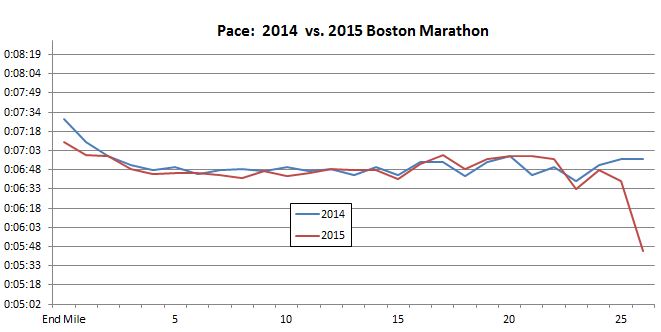
Compared to 2014, I was really pleased with my performance.  Not only did I start out faster, but I finished with a decent kick, the final mile at 6:39 and the last 1/4 at 5:44, whereas last year I pushed really hard through the hills and then fell apart during the last few miles.

2014 v 2015 Boston Marathon Pace

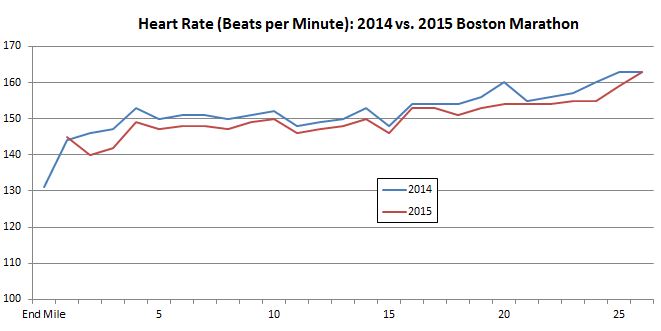
Even better, when comparing average heart rates in 2014 and 2015, I ran faster this year at a lower heart rate.  Faster with less effort — that would be progress!

Heart Rate 2014 vx. 2015 Boston Marathon

A final comment: the Boston Marathon is great fun because of the high-spirited locals and the chance to see running friends from all over.  Here I am (in the back, wearing the black cap and blue shirt) surrounded by a bunch of super-fast runners, including a woman (Keila Merino) who will be undertaking a trans-continental run across the US this summer, Chris Solarz (who holds multiple Guiness Records for extreme running events), and other people who are much faster than I.

FullSizeRender

2015 Boston Marathon — Recap

A Manifesto for Minimalist Races

As we all know, the best trail races are well-marked and have great aid stations.

So why would anyone offer a race with neither?

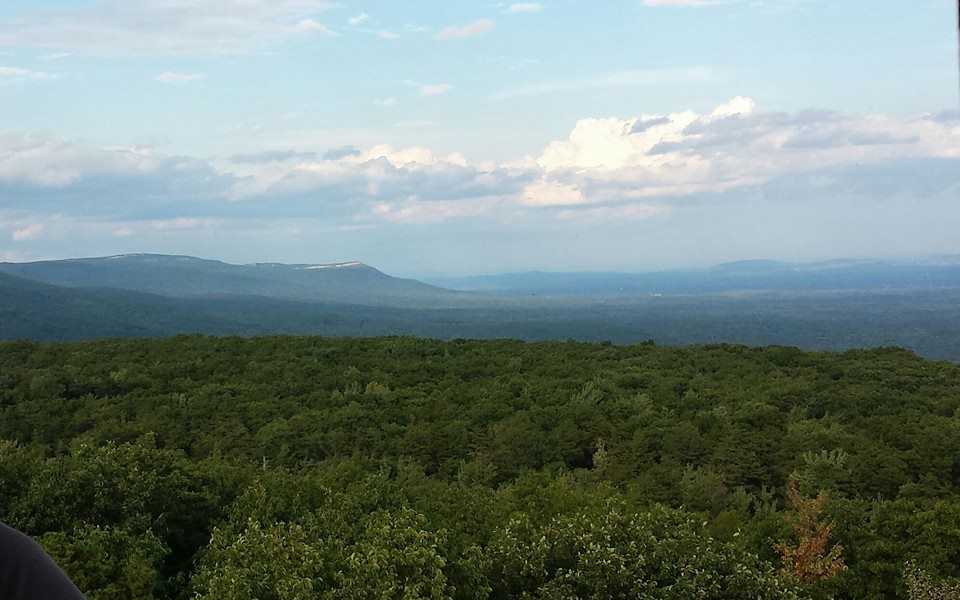
Last year, my friend Todd Jennings and I organized a race to celebrate the Shawangunk Ridge Trail (SRT), a magical footpath that traverses the entire 74-mile length of the Shawangunk Mountains in New York’s Hudson Valley.  For those not familiar, the trail starts at High Point State Park in New Jersey at a junction with the Appalachian Trail, follows the western edge of the Great Appalachian Valley, passes rare pitch pine barrens and glacier-polished cliffs and talus fields, and ends just beyond a restored railway trestle high above the town of Rosendale, NY.

The Shawangunk Mountains

I had discovered the SRT by thru-running it, and the idea was – rightly or wrongly – to provide a format where other runners could experience the adventure of following the SRT through the wilderness, unassisted.

That meant no aid stations and no supplemental course markings.

Frankly, I was happy to do away with aid stations.  I don’t feel good providing people with highly processed sugary foods.  This stuff is increasingly linked with obesity, diabetes, heart disease, and dementia.  At the same time, the kind of food I personally favor isn’t necessarily the right answer for others.  If my goal was to lay out a smorgasbord of high-quality tasty foodstuffs, I would have opened a restaurant instead or organizing a race.

There’s an easy solution:  Let each runners take responsibility for managing his or her nutrition.  After all, that’s what people do when they head out on the trails on their own.

I don’t have a problem providing water.  But why would people who love nature want their water collected in plastic bottles?  Here’s a lower-impact answer:  Let runners bring water filters.  After all, the SRT passes streams, ponds, rivers, lakes, and the incredible Bashakill, which is southern New York’s largest wetlands.  This isn’t Death Valley.

Filtering water from a stream in the Shawangunks

Just because we don’t have aid stations for the SRT, doesn’t mean we have a casual attitude towards safety.  We have checkpoints to ensure accountability of all participants, and we work with highly-trained search & rescue teams should it be necessary to extract someone from the course.  As race director for SRT, I wasn’t hanging out at the finish line; rather, I was out on the course for 36 hours straight just to make sure everyone was OK.

What about course markings?

The SRT is blazed with paint splashes and plastic disks from start to finish.  I verified this by thru-running the course two times, taking detailed notes along the way, and then working with volunteers from the New York-New Jersey Trail Conference to clean up certain portions of the course.

Even so, running a blazed course is surprisingly difficult.  We runners tend to look down, so we don’t trip.  That makes it easy to miss a blaze at a key intersection and head off in the wrong direction.  Trust me, I’ve done it plenty of times.

Typical paint and disk blazes on the SRT

To help runners stay on course, we provided paper maps and a free smartphone app which shows where you are relative to the SRT at the push of a button.

The goal of the SRT event is not to lure unsuspecting participants into an orienteering challenge or a bushwhacking adventure for which they are not prepared.  After all, if someone gets lost, the race director bears the responsibility for finding them.

What’s required is that you pay attention.  Call it being “mindful.”  And, yes, it’s an added mental challenge on top of the physical.

But we feel good asking runners to step up to this extra challenge, because being mindful is a critical component of moving through the wilderness safely.  So why not practice it in races?

Another reason not to like supplemental markings:  I can name races where the volunteers put up the markings in the wrong spots, course marshals steered people in the wrong direction, or vandals even took down the markings and put them up heading the wrong way.

Plus I happen to think trees look nicer without orange tape.

In the future, racing might be an altogether different experience.  Maybe there won’t be blazes or markings.  Maybe you’ll just see turn signals flashing on your Apple Watch or in your Google Glasses.  That’s OK.  However technology may evolve, the principles of Minimalist Racing should remain the same:

  • respect for the wilderness in as close to its natural state as possible
  • an expectation that runners will be responsible and mindful

(If you’re interested in minimalist racing in New York’s Hudson Valley, check out the SRT Run/Hike or the Ellenville Mountain Running Festival.)

A Manifesto for Minimalist Races

Tales of the Timbisha: The Race to Koso Hot Springs

DV
View of Death Valley and the Panamints from Zabriskie Point Source: http://parks.mapquest.com/national-parks/death-valley-national-park/

In a previous post I mentioned that after running the Badwater Ultramarathon, I became curious about the Timbisha Shoshone Indians who have long lived in the harsh but beautiful landscape of Death Valley.  This is one of their stories, passed down from generation to generation.  What does it mean to you?

*          *          *

A long time ago, the animals were people.  Even Sun was a person.

At one time many people lived at Koso Hot Springs in the Saline Valley, on the eastern side of the Inyo Mountains, not too far from Owen Lake and what is today the town of Lone Pine, California.

The people were going to have a race.  In this race they bet their lives.  Mudhen dug a pit and built a fire to cook those who lost the race.

The people headed to the starting place in the southern part of Saline Valley.  There was a marsh with willows and other plants, and many of the people went there to gather leaves to eat and branches for arrows.  Coyote went with them.

The race started, but Coyote was busy sucking the sugary sap from the willow stems.

Frog went over to Coyote and struck him.   “What are you doing?  The race has started.”

Coyote ignored him and kept eating.  Frog got angry.  So he urinated on Coyote.

Coyote emerged from the willows, and found that all the people had gone.  He started to run; but he was way behind.  As he ran he saw Frog ahead of him, sitting under a creosote bush.

“Why aren’t you running?” Coyote asked.  Frog didn’t answer.  So Coyote stopped and urinated on Frog. Then he went on.

Now the people were getting close to Koso Hot Springs.  Coyote could see the dust far ahead, at least twenty miles away, so he picked up the pace and ran as fast as he could.

While they were running, Frog caught up with Coyote and then took a flying leap and bounded over him.  While in midair, he made sure to urinate on Coyote.

“Stop it!” Coyote shouted.

The people were nearly to Koso Hot Springs.  Frog took a final jump and landed right at the edge of the fire hole.  He won the race.  Coyote came in second, close on his heels.

After the race, the firetenders threw the losers into the fire. Only Bear and Sun remained. When they started to drag Bear to the fire, he roared, but they pushed him in.  Now only Sun was left. The people started to talk.

“We’d better leave him or they’re won’t be any light,” they said.

“No way,” Coyote shouted.  “If he had beaten me, he would have thrown me in.  We must throw him into the fire.”

Coyote took hold of Sun.  When he did this, Duck, Woodpecker, Nighthawk, Chipmunk, and all the other people ran for the house.

Coyote dragged Sun to the fire. Then he paused, and before pitching him in, he looked to see which way was the house and made sure to fix that image in his memory.  Then he pushed Sun into the fire.  All went dark.

Coyote ran in the direction of the house but despite his precaution, he couldn’t find it. He ran around in the dark, shouting for help. The people in the house heard him, but didn’t answer, because they were angry with him for extinguishing the light.

All this happened in the fall.  Coyote traveled around all winter looking for the house.  He stumbled around in the snow, fell off mountains, and got lost.  He went way back in the High Sierra.  He crawled around, feeling with his hands, until he recognized Mt. Whitney.

“This is where I used to go and this is the trail I used to follow,” he said.

He crawled around on his hands and knees until he got close to the house again.   While he was looking for the house, the people inside reconsidered.

“Maybe we should let him in,” Frog said.  “He’s smart. He might tell us how to get the sun back.”

After this, they answered Coyote when he shouted and invited him inside.  They fed him the plants they had been gathering all winter, until he regained some strength.

Coyote started to talk. “There are a lot of different kinds of people here. Some of us ought to know how to make the sun.”

The people said, “You’re right.”

Some of them started to shout, and a little light appeared.

Coyote noticed this and said, “When I shout, the sun will come out.”

Coyote shouted loudly, and it became completely dark again.

Duck said, “Quack,” and every animal made his noise, trying to bring Sun back. When Duck quacked, a little light, like dawn, began to show.  Duck quacked again, and the light got brighter. The third time Duck quacked, Sun came out.

The people saw that it was springtime.  They emerged from the house.  Everything was green.

(Adapted from Anne M. Smith, Shoshone Tales, 1993 and Julian H. Steward, Some Western Shoshoni Myths, 1943, http://www.sacred-texts.com/nam/ca/wsm/)

Tales of the Timbisha: The Race to Koso Hot Springs

Tales of the Timbisha: The First Relay Race

Death Valley from Zabriskie Point. Source:  http://parks.mapquest.com/national-parks/death-valley-national-park/
Death Valley from Zabriskie Point. Source: http://parks.mapquest.com/national-parks/death-valley-national-park/

In a previous post I mentioned that after running the Badwater Ultramarathon, I became curious about the Timbisha Shoshone Indians who had long lived in the harsh but beautiful landscape of Death Valley.  This is one of their stories, passed down from generation to generation.  I thought this one might be helpful to people running in relay races….what do you think?

*          *          *

A long time ago, the animals were people. They had no fire in this part of the country.  It was cold.

Lizard was lying in the sun, trying to keep warm.  He looked up just as a particle of ash, blown by the south wind, drifted slowly to the ground.  It looked like the burned stem of a bulrush plant.  All the people came over to look.  They wondered where it had come from.

Crow thought he smelled smoke, but no-one could see anything.

Coyote walked by and pointed at the ash.

“What’s this?” he asked.  The people all shook their heads.

“You don’t know what this is?” Coyote asked, “This is ash from a fire in another country.”

They stared at him blankly.

“We need somebody to fly up in the sky,” Coyote said, “to see where it came from.”

Chickadee jumped up into the air, flapped his tiny wings, and flew a little ways up.  But he quickly tired and fell back to the ground.  Then Woodpecker and Blue Jay tried, but after a little bit they fainted and fell all the way back to earth.  Coyote put some water on their heads to wake them up.

Then Hummingbird said, “I can do this.”  As all the people watched, he soared high into the air and hovered there for quite some time, turning first to the west, then the north, then the east, and finally the south.  Coyote craned his neck and squinted, trying to see where Hummingbird was looking.  Then Hummingbird fluttered back down.

When he was on the earth again, everybody gathered around. They wanted to know what he had seen.  He told them of a big body of water far off in the south. There were many people on the shore, he said, dancing around a huge fire.

“We must go there,” Coyote said, “and get that fire.”

They all started running toward the south. They ran all day without taking any breaks until they reached a mountain peak, where they rested during the night.  The next day they ran until they reached another mountain.  On each mountain, Coyote stationed one of the people. They kept running, they did not walk, until they had crossed nine mountain peaks and sat on the tenth.  From this vantage, they could see the water that Hummingbird had first spotted and the fire burning brightly on its shore.

Evidently, the people there were having a big celebration.  They were dancing around a giant bonfire. Coyote trotted down the mountain and ripped a handful of milkweed from the ground with which he fashioned a fake beard. Then he joined the people and danced with them around the fire.  The old women eyed him suspiciously, especially the fake beard.  They weren’t stupid, they worried that he was going to steal their fire.  But their chief didn’t notice.  As Coyote danced, he moved closer and closer to the fire and then he leaned his head over the flames until the beard caught fire. As soon as it was lit, he ran off — and the fire in the camp went out.  The old women howled in dismay — and the people took off in pursuit, desperate to recover their fire.  It wasn’t hard to follow Coyote, his burning beard glowed as brightly as if he were carrying a lantern.

Coyote ran to the first person he had posted on the mountain peak closest to the lake and passed the fire to him. This person ran with it to the next one on the next mountain peak, and in this way they passed the fire along. The pursuers were close on their trail, and when they caught up to Coyote, they killed him, and then they killed everyone else who had stopped after passing the fire on.

The fire was relayed from one person to another until it was passed to Jackrabbit, who put the fire on his tail, which turned black from the soot.  Then he passed it on to Rabbit.  As Rabbit ran with the fire, the pursuers used their powers to summon dark clouds and cause hail to fall from the sky.  The hail hurt Rabbit, and he squealed in pain and fear as he ran.

Rat was living alone on the top of Lida Mountain, just north of Death Valley, in a house  surrounded by sheer cliffs.  He heard Rabbit crying and scrambled down the slope.  Rat took the fire from Rabbit and ran with it back up to his house.  The fire burned a red spot on his breast.

The pursuers gathered around Rat’s house. “Catch him,” they shouted to each other, “but don’t kill him.  We want the fire.”  But they couldn’t climb up the cliffs.

Rat took the fire and lit a large pile of brush.  Then he scattered the burning brush all over the country.

The pursuers fell down and died.

(Adapted from Anne M. Smith, Shoshone Tales, 1993 and Julian H. Steward, Some Western Shoshoni Myths, 1943, http://www.sacred-texts.com/nam/ca/wsm/)

Tales of the Timbisha: The First Relay Race

Tales of the Timbisha: Coyote Races

DV
View of Death Valley and the Panamints from Zabriskie Point Source: http://parks.mapquest.com/national-parks/death-valley-national-park/

A long time ago, the animals were people.

Coyote’s brother Wolf told Coyote, “I want you to run a race with the five Mountain Sheep brothers.”  The mountain sheep weren’t very fast, Wolf thought.

“Just as soon as you outrun the five brothers,” Wolf said, “I will be there to cut their throats.”

Wolf had picked a certain place for them to start, at the crest of a mountain.  Witnesses were stationed at key points along the course.  As they milled around the starting place, people got to saying that the mountain sheep were good runners.  Then they saw Coyote, looking strong and fresh.

The race started.  Coyote had little trouble outrunning the sheep.  Before they were halfway, the Mountain Sheep were panting, gasping for air.  Coyote got to the end of the course with ease.  He went around doubled over, pretending he was out of breath.  The people saw him and laughed.  He was most pleased with himself.

Wolf was glad.  He cut the throats of the mountain sheep and prepared a big feast.  The people ate until they were full, and then they ate some more.  Coyote was proud.  He became very sure of himself.

“There’s one thing more,” Wolf said.  “I want you to race the Magpies.”

He gestured to a distant peak.  “The race will start way up on that mountaintop over there.  Three magpies will race you.”

Coyote didn’t like the sound of this.

“You’re not serious, are you?” he asked.  “The Magpies are mighty birds.  If I lose, they’ll kill me and eat me.”

“There would be lots of spectators,” Wolf said, shrugging.  “All the people would be watching you.”

So the day of the race came.  The Magpies arrived before Coyote.  Then Coyote came, stepping from rock to rock (as was his superstition).  One of the witnesses sounded the start.  On both sides of the course, the spectators cheered and shouted.

Wolf had told Coyote, “If we win, we’ll get all the pretty feathers of the Magpies.  I want the feathers for my head.  The wings I want for my buckskin suit.”  Now Wolf took up his station at the end of the course and waited there patiently with a long, sharp knife, its blade glinting in the desert sun.

Coyote started.  He tore along on the ground, raising a cloud of dust.  But the Magpies folded their wings against their bodies and dove.  The course was all downhill, and the Magpies hurtled through the air.  When Coyote reached the bottom of the valley, the Magpies were already there, waiting for him.

Coyote didn’t know what to do.  He tried to hide.

“All right now,” the Magpies said, “we’re ready to butcher you.”

“Don’t butcher me right away,” Coyote pleaded.  “Let me go bathe in the cool creek before I die.  That way, I’ll be clean.”  They agreed.

Coyote ran to the creek and dove under the water. He tried to hide under some green weeds that were growing in the running water.  But the Magpies’ quick eyes found him.  They ducked under the water and dragged him out.  They killed him.

Wolf did not get his feathers.

(Adapted from Anne M. Smith, Shoshone Tales, 1993 and Julian H. Steward, Some Western Shoshoni Myths, 1943, http://www.sacred-texts.com/nam/ca/wsm/)

Tales of the Timbisha: Coyote Races