If you want to go fast in an F-16 Fighting Falcon, it’s easy. Just push the throttle forward all the way (this position is called “Military Power”) and then twist it to the left and push again to engage the afterburners. Depending on aircraft configuration and atmospheric conditions, you might reach Mach 2.0 (roughly 1,300 miles per hour at high altitude).
But there’s a catch. The afterburners, which dump fuel into the jet engine’s hot exhaust stream, burn a lot of fuel. As much as 60,000 pounds per hour, which could deplete the aircraft’s load in something like 10 minutes. Which is why afterburners are used sparingly, generally for take-off and during combat maneuvers.
If you go faster than you should and run low on fuel – no worries, probably there’s a mid-air refueling tanker, like the Boeing KC-46 Pegasus, circling around somewhere. But you’ll need to slow down to match the tanker’s airspeed, typically around 300 knots per hour. Even so, you have a very narrow envelope to operate in. You do not want to approach the drogue basket trailing behind the tanker at faster than a walking pace. Impact the drogue with too much force, and you could send a sinusoidal shock wave up the 80-yard hose to the tanker and down again, which could not only disrupt the connection, but possibly damage the aircraft’s fuel probe. In which case you might have a serious problem, if you’re out of fuel and there’s no safe place to land nearby.
There’s a point here for all of us, even if we’re not piloting advanced fighter platforms. You shouldn’t go fast if you’re not in control.
Stay. In. Control.
This theme applies throughout life – why, even to recreational runners. Run too fast and you burn out and risk injury. Runners who start out too fast in a marathon might crack a rueful joke about “crashing and burning.” Actually, it’s not funny.
But forget running. What about life? What happens if you go to fast and don’t keep control?
Or let me ask the question a different way — how can we stay in control when we operate constantly at high speed?

This question was top of mind for me back in August 2023. I recall I’d driven to the local grasslands, stepped out of my Jeep, and pushed the start button on my GPS watch, which is standard procedure for me since I keep a record of every run in my training log. I don’t remember the details of that day, since there was a lot on my mind, but no doubt I enjoyed the soft grassy trail underfoot, except where I had to dodge thistles. Admired the goldenrod beginning to turn yellow and the deep purple blooms of New England aster. Maybe saw one of the season’s last Monarch butterflies flitting about the milkweed pods just starting to crack open.
After four or five miles, I returned to the Jeep, pulled out of the parking spot, and drove off along the entrance road, headed for home, moving slowly on account of the prominent speed bumps designed to keep traffic to 5 MPH — when I was startled by a beep. My GPS watch had just chirped off another mile. Which means I’d forgotten to push the stop button at the conclusion of my run.
Call this an error. Not one with significant consequence. But even so, a breakdown in my standard operating procedures, which were to measure the distance of the run, not that distance plus the drive back home.
Now, we all make mistakes from time to time – why, it’s part of being human. Misplace the keys. Forget an appointment. Forget to brush your teeth. Walk somewhere in a rush and cross the street without looking both ways.
As mentioned, I had a lot on my mind. Six months earlier, I’d received an email from an attorney who announced that she had been engaged by my wife to represent her in reaching an “amicable and efficient resolution” of the details (financial and otherwise) pursuant to a separation agreement. Taking my wife and her attorney at their word, I made every effort to cooperate, providing all the information requested, and responding promptly to their proposals. But then nothing happened. I was left wondering what was next. People talk about divorce being a “rollercoaster of emotions.” Well, I’d provided for my wife and family for 30 years while honoring my vows. Apparently, the reward for this commitment was a process that would be amicable and efficient, but untransparent.
A few days later, I returned to the grasslands for another run. It was another chance to log some miles, feel the grassy trails underfoot, admire the flowers and butterflies. As I was driving off, once again I heard a beep as I was getting ready to exit onto a local road.
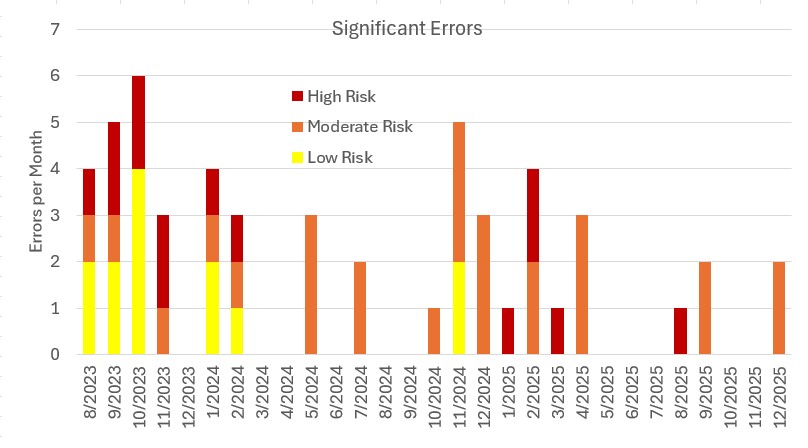
While the consequences were still trivial, I didn’t like the pattern that was starting to form. I had a thought – maybe I could create a “control” in my training log – a new column to note these kinds of stupid mistakes. This would be a strategy to remind myself that during periods of emotional stress, I still had to pay attention.
By the end of August 2023, I’d logged 4 errors. In addition to the watch button mishap, I’d forgotten to roll up the windows on my Jeep when parking at the grocery store, which I considered another low-risk error. Annoyingly, I’d driven off somewhere on an errand forgetting to bring my wallet. Most concerning of all, I’d made a left hand-turn only to be surprised by a car that came barreling down from the other direction. No big deal – no collision, no screeching tires, no-one honking at me or flipping me off enraged at my sloppy and inconsiderate maneuver. But still, this error had a higher-risk profile, which made me feel uneasy.
For the next six months, my training log averaged around 4 errors per month. There were more trivial mistakes, like dropping my phone, as well as more serious ones, like leaving a cast-iron skillet on the stove unattended. I’d washed it out, then put it on at low heat to dry out, but forgot about it for a like 10 or 15 minutes while distracted by something on my phone. I have no idea what would happen if you left a skillet on the stove for hours or all night (and hope never to find out).
One of my errors was quite embarrassing. En route to the airport I suddenly realized that while I’d picked out the flight, I’d never bought a ticket. It took only a minute or two to do so on my phone, so a travel logistics catastrophe was averted. In this case, however, I think I understand the root cause. A few days earlier, I’d gotten a phone call — a good friend of mine had been involved in a serious crash. He suffered broken ribs and pelvis and a ruptured spleen. I showed up at the hospital with some flowers and a teddy bear even before they were letting visitors in. Saw him lying on the bed, attached to tubes and wires. Gave him a smile and a little wave. He looked me in the eyes and moved his hand. By the way, it took many months, but he recovered.
The worst errors during this period involved two occasions when I lost my temper. On a business trip to Florida, I showed up late at the conference site and tried to check in, only to be told I had to take a shuttle somewhere else. I was so tired, I snarled at the clerk, who looked at me and shrugged. On another hotel visit, I couldn’t figure out how to turn out the light over a built-in bar. I searched everywhere. Rang for help. A fellow showed up at my door, pointed to the switch, and I just felt old and incompetent and helpless. I made some inane rude comment about bad design, which wasn’t fair to a person who had just helped me out. These are the worst errors in my eyes, because I have no business being antagonistic towards other people.
Meanwhile, the divorce negotiations had broken down. I made a proposal, got no response. The delays stretched out, and documents came back with what appeared to be deliberate malicious errors. I discovered that my wife had actually hired her attorney almost two years earlier than they’d let on. I finally filed the divorce complaint (which I should have done much earlier but abstained, not wanting to come across as anything but collaborative), and when my wife and her attorney refused to cooperate, arranged to have them served. Someone waited for her to leave the apartment building where she was living and then confronted her with the papers. Like in the movies! After which, nothing happened.
During the spring and summer, I made a total of 5 medium-risk errors. Specifically, I drove to the gym forgetting my swimsuit, left a t-shirt behind at a race, misplaced 1 towel, and lost 2 water bottles.
However, while life remained somewhat turbulent, the new control system was helping. Documenting specific errors helped me reprogram my brain, so to speak, in order not to repeat them. There were no more instances of failing to push the stop button on my GPS watch, or leaving the cast iron skillet unattended on a hot burner.
Nonetheless, over the winter problems began to multiply again. Besides the range of normal trivial things, like losing a pair of reading glasses, I made three mistakes with communications. For example, I know two people named “Jay,” one of whom is my CEO, and I sent a couple of texts to the wrong one. Later I forwarded a document to the wrong email address. There were no bad consequences – but these were obvious signs of mental stress. Like sending off an email in a rush and forgetting to attach the referenced attachment. At least I didn’t do that.
In fact, there was at this time a second source of stress – my employer was going through negotiations to sell itself to another company. This was exciting, because the industrial logic of the combination was compelling. But it was also a source of anxiety, since I’d worked at my the company for several years and whether I’d have a role going forward was unclear.
Speaking of anxiety, I believe I’ve inherited something of a high-strung nature from my mom. By the way, she called me the other day, sounding flustered, mentioned that she was deeply worried — the most recent heating bill for her house was higher than the month before. I got another call a few days later – she’d discovered the problem. It was an auxiliary heating unit which someone (not her) had left on inadvertently. Nice catch, Mom!
August and September 2025 saw a few more mistakes. The keypad on the garage had died, and the door could not be opened. My work-around consisted of placing an extra remote control on the kitchen window sill, allowing me to press the button and open or close the door remotely. But as with any new system, it took some getting used to. My log shows a total of four (4) episodes in which the garage door got left open overnight or while I was away. I consider this a medium-risk error, because I don’t leave the keys in the Jeep, so it would be hard to steal it, and otherwise the garage is mostly filled with my ex-wife’s junk, which she declined to clear out, citing it as “leverage” in our negotiations.
In August, we met in front of a mediator. I threatened to drag my wife in front of a judge and explain precisely who had made the financial contributions during the marriage, as well as take the court through every email, text, letter, and conversation of the last four years. But then I offered up a deal. Stepped out of the conference room to let them think about it and walked around the block. Got some bad espresso and began to feel jittery and unwell. In any case, by the time I returned, they’d decided to accept, and soon everyone was sharing dog photos on their phones. With negotiations completed, I raced for the airport, caught my flight, flew off to New Mexico for a mountain-climbing trip, landed, got my rental car, found the hotel, but couldn’t for the life of me figure out the parking lot. It was quite late, and I was exhausted. When I finally tracked down the clerk, I’m afraid I didn’t conform to my normal standards for politeness and respect.
Hasard Lee is a former F-16 pilot with extensive training and combat experience. In his excellent book, “The Art of Clear Decision-making,” he talks about the importance of managing cognitive load, pointing out that “as stress increases, our IQ level decreases, and we often make poor decisions.”
As I look back on this time period, the increase in my day-to-day mental error rate was concerning. But, despite the various sources of turbulence in my life, I still managed to get a lot done, not only managing the divorce to a happy ending, but doing my part at work, playing a role in the community on important not-for-profit projects, staying in touch with family and friends, publishing a book, and keeping up my physical and mental health with lots of mileage. Indeed, my training log shows I ran, hiked, and walked 4,276 miles over this time period, completed 55 races of which 10 were marathons or ultras, and climbed 224 mountains barefoot. For what it’s worth, I also published 36 articles on this blog and participated in nearly 30 podcasts.
For me, this was a productive period. And productivity, by definition, is about getting stuff done fast.
For what it’s worth, the amount of travel during this period for both work and vacation was through the roof. I do not have a tally for how my flights I took or different hotel rooms I stayed in. It seems better not to know.
In December I got to the Dallas airport early, dropped off my rental car and took the shuttle to the terminal, only to realize I still had the car keys in my pocket. I sighed wistfully, unhappy at the oversight, but managed to keep my cool. Took the shuttle right back to the rental car center and handed the keys to a clerk. She looked at me in surprise that I’d bothered to do this, smiled, and said thank you.
So far in January, everything is cool. I feel like I’m cruising along with throttle pushed only half-way to Military Power. There’s a winter storm inbound with frigid temperatures and 16-22” of precipitation, which means I need to stock up on groceries and stack firewood. There are a couple of events next week to plan for. But work is quiet, with my role in the newly-merged company still uncertain. I eye the throttle and decide, for now, to just keep cruising.
Chasing the Grid is available on Amazon!

 The Long Brown Path