In his Substack series, “Mindful Masculinity,” Rich D’Ambrosio comments on the crisis he sees impacting contemporary men. There’s a conflict, he believes, between societal expectations, typically centered on traditional male roles of provider, fighter, stoic — and our personal intentions, which might be different. Rich elaborated on this point in a podcast with Damon Mitchell, another Substack author writing on themes of masculinity and a coach for men. During their discussion, Rich spoke of his long career at American Express, where his team focused relentlessly on sales goals. But then confided what mattered to him most was to be a sensitive and loving father. His point was that conflict between work goals and personal intentions creates huge pressure for men — can even leave us feeling “disconnected” from our emotions.
At first, I questioned Rich’s narrative. I’m a stubborn man and purposeful. I’ve never experienced a state of “disconnection,” nor have I observed this condition in others.
But few days later at a holiday party, a young man named K**** looked me in the eyes, distress written across his face, and blurted out “That’s exactly how I feel – and why I’m on anti-depressants.” I’d tossed out the topic of emotional disconnection, curious to see what people thought.
Upon reflection, I suppose the world has become more complicated. Back when people lived in a state of nature, societal goals and personal intentions would have been tightly aligned around survival and reproduction.
Back then we lived in the Garden. In a dreamlike state, perhaps. Without knowledge of good and evil. Without rules. Without priests, soldiers, specialization of labor, commandments, or what Freud described as the super-ego, i.e., the guilty conscience that comes from internalizing societal expectations.
Having said that, even back then there would have been complexities. Decisions about where to hunt and how to divide the spoils and when to pack up and move on. Disagreements between men and women, who follow different reproductive strategies, according to evolutionary scientists, premised on different attitudes towards risk. There would have been violent conflicts with other tribes, as well as opportunities for trade and festivals and alliances. Individuals would have wondered about the different chapters of life — as children, as parents, as elders, and what comes after.
Maybe forging connections has always taken work. Connections between goals and intentions. Between what we feel deep in our souls and new information about the complex, dynamic environment in which we operate.
As for myself, over this holiday vacation, I’d settled into a funk. Notwithstanding the joy of seeing family, I found myself waking up each morning a little bit later. Without much on my mind other than food and coffee. I took advantage of warm weather to wander around the city. Passed luxury shops, fine restaurants, and tourist destinations without stopping. Spent more time than I should have scrolling on my phone and playing word games. I put some desultory effort into planning out the new year, but decided mostly to keep on doing what I was already engaged in. Tried to figure out next steps at work, where the way forward is obscured by a fog of ambiguity. Toyed with the idea of visiting Phoenix for a week, to do some hiking in warm conditions, before settling back into the cold dark January groove in New York, although the prospect of more travel was unappealing.
An odd snippet of history came to mind. A story about the 13th century Mongol warlord Chinggis Khan. As a young man, he was said to have climbed Mount Burkhan Khaldun, seeking guidance from Tengri, the god of the eternal blue sky, as he struggled with how to unify the neighboring tribes. This was before he conquered China and eastern Europe, creating the largest empire the world had ever seen.
Indeed, in many cultures, the act of climbing mountains has been associated with vision and dream-questing. Could this practice hold a key to the question of connection? Since the city of Phoenix is ringed with mountains, a trip there offered the possibility for an experiment – and a moment later I’d booked my flight.
Camelback
The 1.5-mile climb had taken concentration, since I wasn’t wearing shoes, and the hard-packed sandy trail was full of grit and gravel until half-way up, at which point the trail crawled onto the spine of the ridge and clambered across jagged granite blocks thought to be 1.5 billion years old.
I dropped my pack and settled onto a crusty block. At 2,704 feet, the summit of Camelback Mountain is a popular spot, typically thronged with day hikers, since the peak is situated within Phoenix city limits, in fact nestled next to a luxury resort, and today the splendid weather had attracted quite a crowd. A woman approached with three boys. Said they were from Minnesota. Asked if I would take their picture, and of course I was glad to. As I handed back her phone, one of the boys asked about going barefoot. It was fun, I explained, and added extra challenge. Mentioned my project to climb 1,000 mountains barefoot, of which this trip up Camelback was number 601. He thought for a moment and nodded, as if in approval of my quest, then asked about the height of the various peaks I’d climbed. Mt. Whitney and Mt. Elbert were over 14,000 feet, I replied, which would be something like five times higher than where we stood now. His eyes widened.
The family departed, and I turned to study the views.
The sky was bright and mostly clear, chased with high-altitude cirrus streamers, while the air was completely calm.
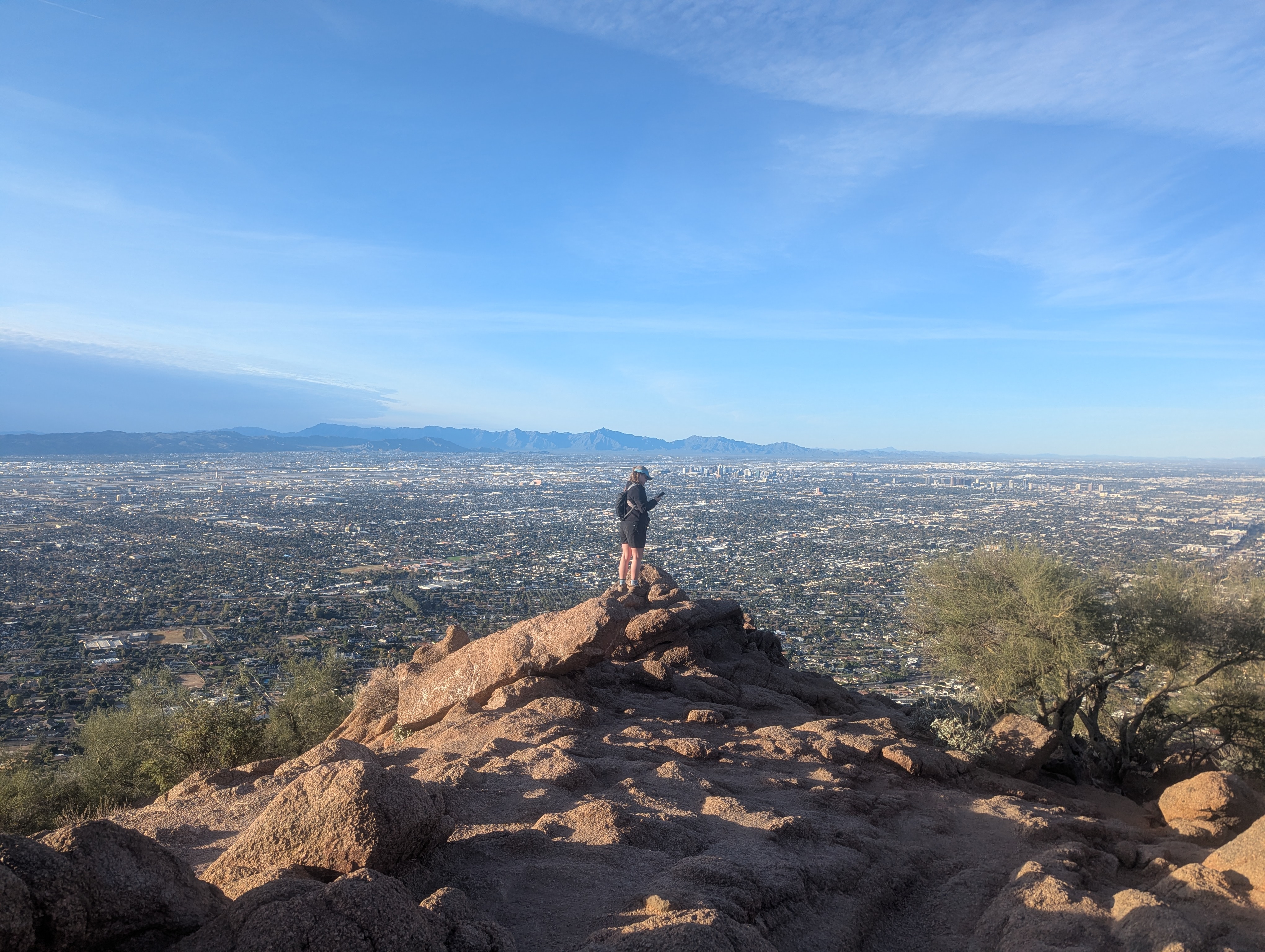
Below the mountain sprawled the Phoenix metro area, occupying a vast desert bowl overlaid with a grid of streets and thoroughfares, appearing vaguely hieroglyphic, stretching out in all directions, with office towers sprouting to the southwest like a cluster of mushrooms. To the west lay emerald fields, flat, square, expansive. To the northwest, loomed Piestewa Peak, a sharp rocky triangle, which I’d climbed a handful of times before. To the northeast, a long ridge dropping into the valley, containing Sunrise Peak, which I’d also climbed, and to the southeast, the toothy crest of the Superstition Mountains, where two years earlier on the descent I’d witnessed a sunset of deep cherry red and flaming vermillion, which ranks as one of the most striking visions I’ve been privileged to experience. Due south, a long mountain wall, antenna farm situated on one shoulder, beyond which lies Tucson some 100 miles distant; the highway there snakes around the eastern rampart of this range. To the north, endless ragged ridgelines, representing unfamiliar places, and somewhere out there Prescott, Sedona, Flagstaff.
I turned back to the east, peered down at Camelback’s granite spine which I’d scrambled up to get here, placing naked feet on the rough surfaces with care, and now I could see a line of brightly-clad tourists inching forward to join the throng already on the summit.
In times before maps, people would have climbed to vantage points like this to understand their world. To see the connections between different places. To grasp the lay of the land. Now, sitting on a crusty block on the summit of Camelback, above the great grid and below the eternal blue sky, I felt a powerful sense of clarity.
That evening, back in my hotel room, I slept fitfully, rest interrupted by weird dreams. Why, I’m dressed in a suit, leaning back on a desk chair – this looks like the expensive midtown office space of a company where I used to work. I’m offering advice to someone, who’s evidently trying to raise some kind of investment fund. I’m explaining themes that investors would need to understand. Which is something I’m good at. But I’ve never raised a fund.
It was already light when I awoke, and then I rolled over and went back to sleep. By the time I dragged myself out from the covers, I felt a little more purposeful than I had over the holidays. The dream had reminded me that I’m good at some things, but not at others. And this was an incremental bit of clarity. I realized that progress at work would require balancing ambition with respect for others. I’d need to be as mindful in the office as I had been stepping barefoot across ancient blocks of stone.
My Phoenix mountain-climbing experiment was off to an encouraging start — and now it was time for peak number two.
Picacho
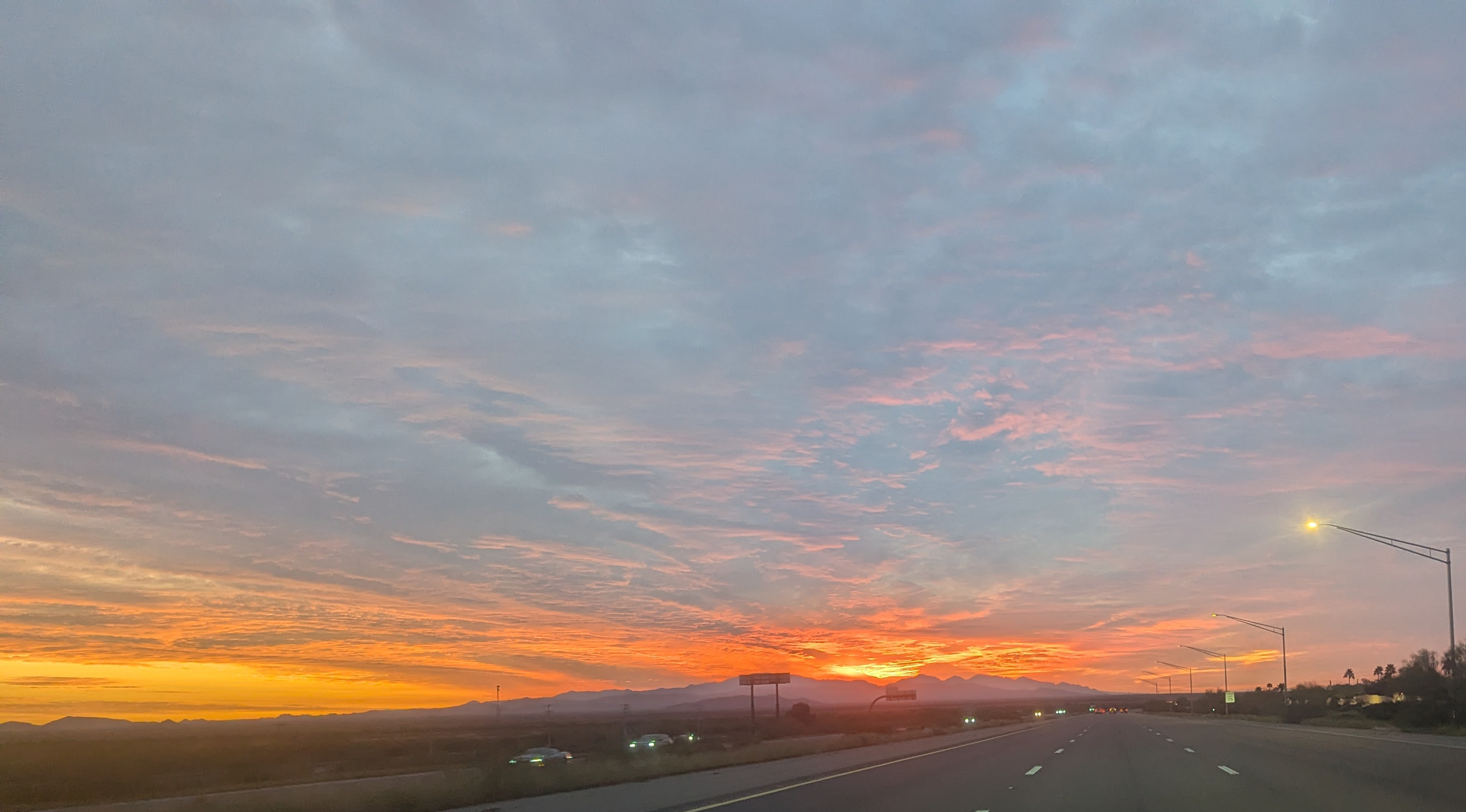
Flaming sunrise with molten orb peeking out from beneath ashen clouds — I’m taking pictures with one hand, steering with the other, trying to not veer out of lane and off the road.
3,374-foot tall Picacho looms to the front, rising sharply off the desert floor, shaped rather like a ship’s prow carving waves. It’s another block of ancient granite, but this one tilted up to a 40 degree angle when the Arizona crust stretched apart. This was during the period when basins and ranges were being formed throughout the southwest, 25 million years ago.
I’d been here once before. Told someone how the steep climb was a “hoot” — recalling steel cables bolted to rocks, reminiscent of “via ferrata” routes popular in the alps, but now as I started up the path, I found myself groaning with dismay. The path was full of broken rocks and gravel, which in bare feet are quite painful. And slow. Somehow I’d forgotten this part.
I have a bad habit of constantly comparing today to yesterday. Which is a bad idea for runners, especially as we get older. Now, I didn’t remember off the top of my head how long it had taken me to climb Picacho the last time, but now it seemed like my pace couldn’t possibly have been this slow.
I crept along the steep gravelly trail as it switched back and forth, in a couple of places grabbing steel cables to haul myself along or keep my balance. Then there was a steep descent on the backside with wooden ties for steps, followed by more cables bolted to rock faces nearly vertical – and even a stretch of fencing to protect against exposure.
Somewhere along the way, I made a decision – to accept my fate. Even if that meant going more slowly this year, and even slower next.
And with that, I relaxed.
A passerby saw me going barefoot, asked “What’s it like?”
“Well, there are a lot of rocks,” I replied somewhat ruefully – and they laughed.
Laughter for the win. Had I been battling to move faster, I would have glared and growled and avoided engaging.
At the top, I reflected. When to fight – and when to accept, that is the question. I thought back to stories of Native Americans and their battles with immigrant settlers. Recalled the memoirs of a Mono Indian and how he’d become angry at the history of injustice and spoke out with anger. But his grandmother cut him off. Told him the world is OK. Don’t argue – just accept it.
Maybe acceptance isn’t about surrender – but about dialing down the energy to a level that makes more sense?
Wasson Peak
The last time I’d climbed Wasson Peak, it was a miserable unrelenting rocky trail for 4 full miles. But that was from the south. There was a trail from the north that I seemed to recall was sandy. So this time I pulled into the northern trailhead.
That was a good call. The Sendero Esperanzo trail is flat and sandy for the first 1.5 miles. After which it turns uphill and passes through some gravel — forcing me to slow — but upon gaining the ridge crest, it turns flat and sandy again. What a delight to make steady progress and enjoy a little bit of momentum! But even so climbing is work. I feel a faint tinge of weariness.
I move along at a moderate pace, glancing up every so often at thick cloud cover, gray and indistinct. The air is calm, the light is uniform and dim, the kind of day you associate with a steady drizzle although it’s dry for now. As I made my way slowly higher, I felt again that touch of weariness.
Two hikers passed me, saw I wasn’t wearing shoes, cautioned me that the trail was rockier up ahead, and I nodded but did not otherwise respond because I already knew this.
Indeed, with 1 mile to go, the trail fell apart. The path carved its way between volcanic outcroppings, whose debris had spilled across the ground in piles of broken shards. Dark red, sharp-edged. I labored along, wincing with each step, trying to place unprotected soles with care, searching for spots where the rocks offered flat faces, but it made little difference. I pulled out a trekking pole to use as a walking stick, and with this help, limped up to what seemed to be the top, only to find there was another 0.3 miles of rocks to go.
At the summit, finally, I dropped to the ground, feeling angry and discouraged about the loss of momentum, dismayed by dismal cloud cover and dim views across desert plains. Even when I’m moving steadily, there is often that faint tinge of fatigue. Because I want so much to be better than I am. And maybe that is the price of life.
Fremont Saddle
For my last climb on this Phoenix trip, I was planning to take on Flatiron, one of the most popular, challenging, and notorious climbs in Arizona. Famous for the spectacular vantage from its flat top, with views across the Phoenix metroplex. For the 3,000-foot climb, which is a mess of scrambles along a trail which is unmarked and unmaintained. I’d watched several videos to familiarize myself with the course. Heard some comments about this not being a good climb for those who are afraid of heights. However, outweighing these concerns would be the bragging rights from making this climb without shoes (who knows, maybe I’d be the first?). I set the alarm for 4:00 am to get an early start and went to bed.
And woke up, an hour later, feeling anxious. Truthfully, I’m scared of heights.
Command decision — instead of Flatiron, I’ll hike to Fremont Ledge, which is an easier climb, with much less elevation gain and no scrambles. Instead of bragging rights, let’s go for the easy win.
I arrived before first light, and even with a headlamp, was moving very slowly. But the trail was hard-packed sand, dotted with smooth rocks. Slow but very doable.
The scene gradually lightened. Heavy fog hung in a narrow canyon. The environment was surprisingly lush, with small trees, bushes, cacti, and wild flowers. There was no wind, and it was silent, but for a distant bird calling.
A woman passed me, exclaimed “the view was amazing.”
Nearing the top, two young men were descending. I asked about the view, but they were dismissive. “All socked in.”
So I was curious what I would see, when I crested the top of the saddle — and honestly I was stunned when I saw the needle a mile away standing 1,000 feet above the valley floor, partially mist-shrouded. This was Weaver’s Needle, a layer of welded tuff, which is hot volcanic ash that settles from the sky and fuses together into dusky stone. At its base, rows of cracked ribs radiating outwards, like a squadron of dwarves clustered around the feet of a giant. Tentacles of mist moving in and among these ribs, brushing up against the needle’s back. A ray of sunlight breaks through the clouds, splashes upon the ribs, lights up a distant slope miles away. And then the clouds rolled back in, and the needle and its dwarf phalanx vanished.
I had this thought — that wasn’t it strange for the mountains to let me have a glimpse of such magic – and then another thought – that wouldn’t it be just as strange if this vision was merely random?
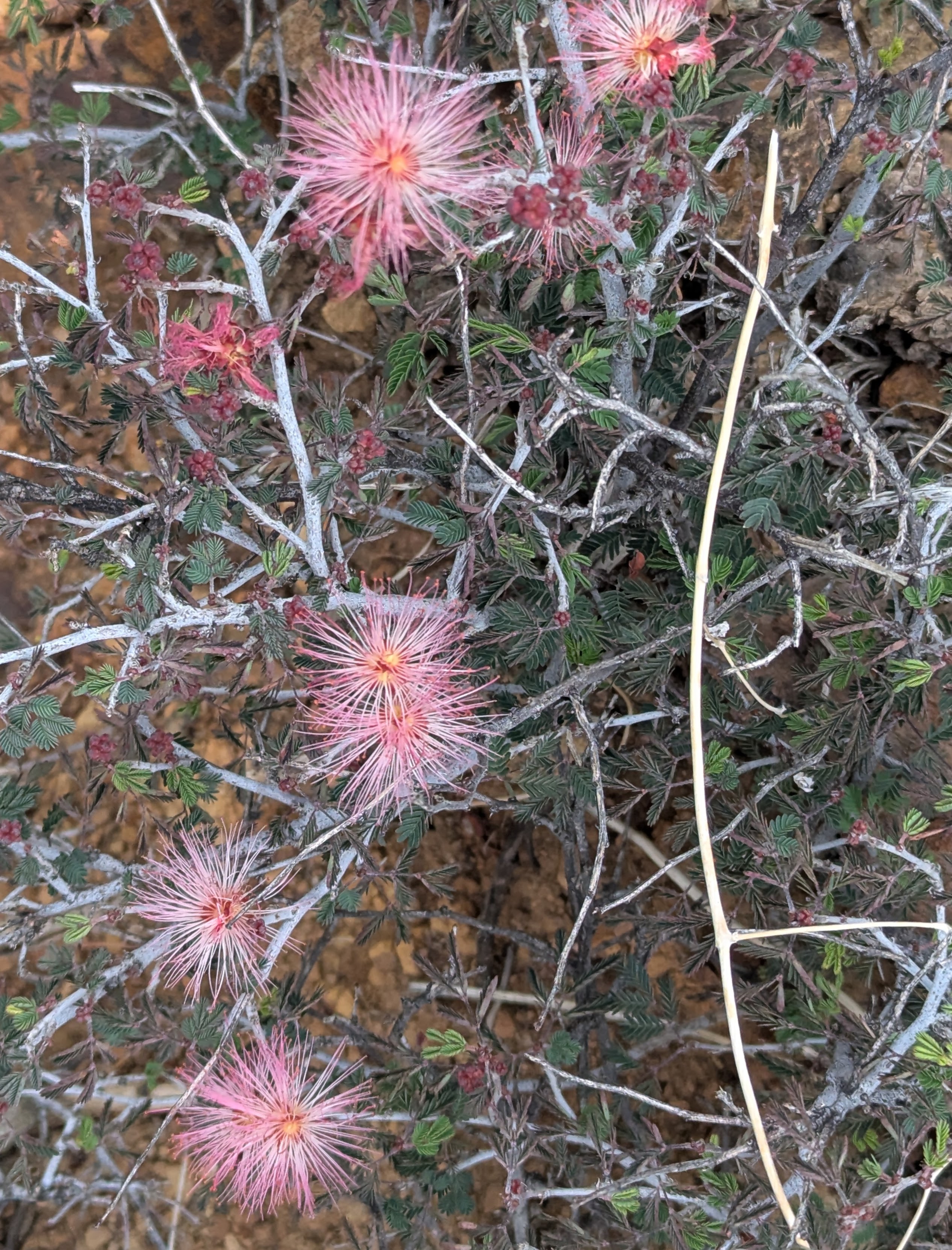
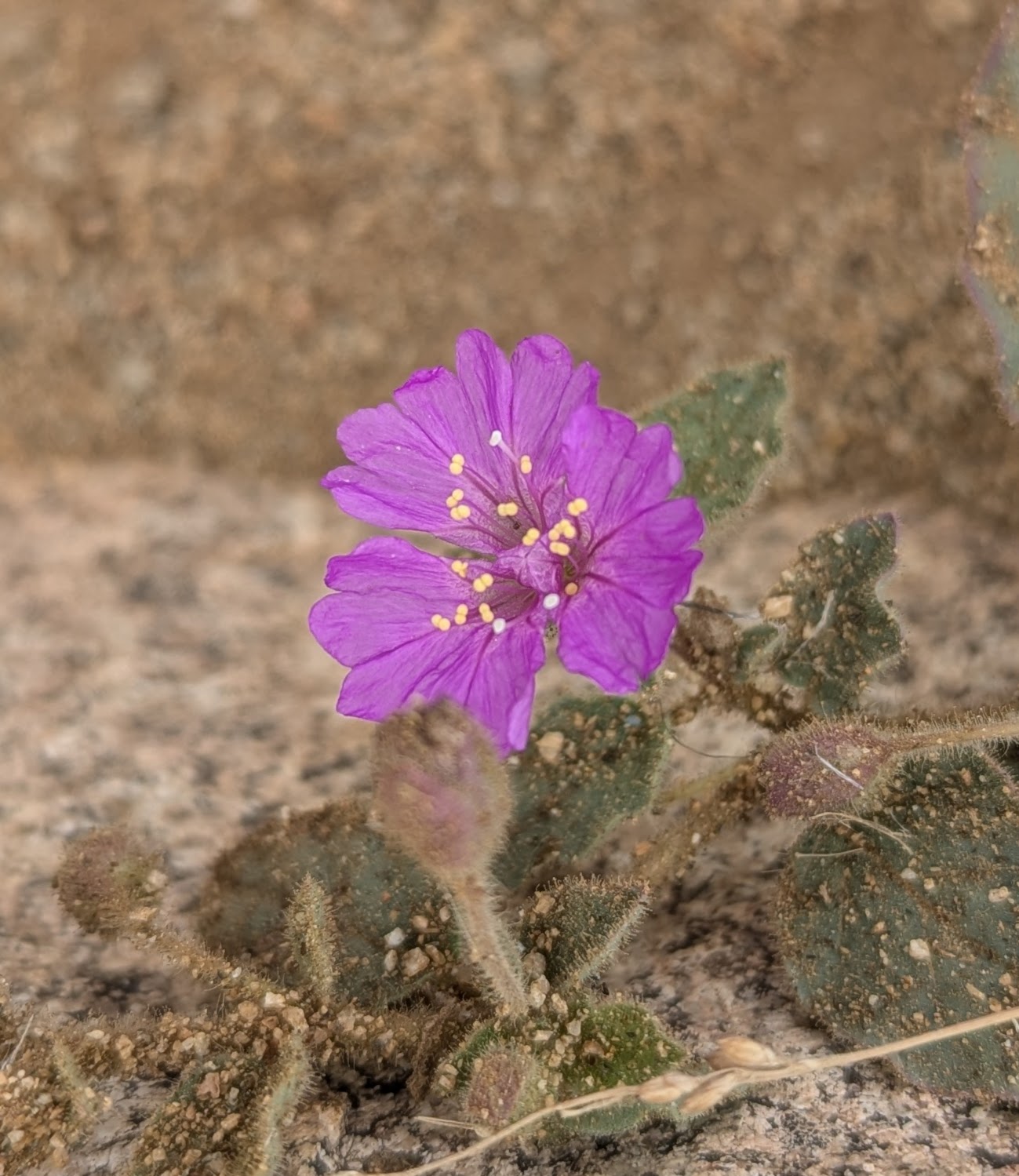
I headed back down. Passed clumps of Brittlebush with blue-green leaves and bright yellow flowers, while the Goldeneyes had similar yellow flowers but leaves of dark green. Purples dots flashing from the ground, flowers of Trailing Windmills on long stems. Bright orange petals of a mallow. Spiky white-pink balls of fairy duster. A clump of evening primrose — white cup-shaped flowers with yellow stamens sprouting from a salad of dark leaves.
The next day, I hung out at my hotel. Walked a half mile to get a cup of coffee. Had dinner with a Phoenix friend and told her about the needle. She begged me to come back and see more. That night I woke up, understanding she was right and that the vision had been something special.
Epilogue
The California Indians conceived of spiritual power, which they called “puha,” as an invisible force linked with memory and rationality, which concentrated on mountain peaks and flowed outward in radial and recursive concentric patterns, often associated with waterways and sacred trails. According to Jay Miller, an anthropologist of Lenape descent, and the California informants he consulted in his research, climbing mountains, fasting, thirsting, and holding vigils – these were thought to be effective training modalities for making a person attractive to power.
Now, at that holiday party, where K**** had cried out about his sense of disconnection, I’d mentioned something that Jay Abrams, a Karate coach who led a local club where I trained as a teenager, had suggested many years ago. Don’t let yourself get too excited, he’d advised. And don’t let yourself feel down. Try to stay steady as you move through life.
My sister-in-law overheard my comment, frowned. “That’s not right – you need to acknowledge your emotions.”
A young women named J**** gave me and K**** a knowing look. Waited a moment, then confided in a conspiratorial tone, “That’s how women gaslight men – by criticizing them if they don’t display emotional drama.”
K**** mentioned he has a trans friend who was born a woman but identifies as a man. They’d told him that as they took testosterone, they felt their emotions “getting flatter.”
I don’t know K**** well, but as I listened to him further, I concluded that he has the smarts and energy to figure out his complexities. Rich D’Ambrosio is as sincere, authentic, and caring as they come. I have no doubt both men will make meaningful contributions to the world.
As for my experiment in Phoenix, it reinforced the notion that physical training modalities, like peak-bagging, may be helpful for stimulating connectivity between different parts of our minds. Full mind-body engagement, and the associated sensations, may accelerate deep processing.
That said, a questions nags at me — to what extent does connection really matter? For the call of the Arizona mountains is so powerful, I wonder if Nature itself is the bedrock of emotional wellbeing. With a steady diet of mountains underfoot, could the rest of life be merely a set of pragmatic calculations?

Chasing the Grid is available on Amazon!

 The Long Brown Path
[…] to complete a second Social Hikers peak-bagging challenge. As part of this project, I hiked up to Fremont Saddle from which vantage point I looked out at Weaver’s Needle, a tower of welded tuft (fused volcanic […]
LikeLike