Bump — wheels down, LAX, right on schedule. Baggage secured, I’m on the bus to the rental car center and then barreling along the freeway to my cousin’s home to hang with his family for ten days. And climb some mountains, too – why, I have a long list of them.
From the highway, I see big peaks floating to the north. Faint silhouettes cloaked by haze and ocean mist. Baking in the late afternoon glare…
Evening shadows are lengthening as I turn into a quiet lane nestled between steep hills just south of Pasadena. Jacaranda trees with blue blossoms line the streets, and the sidewalks are littered with blue petals.
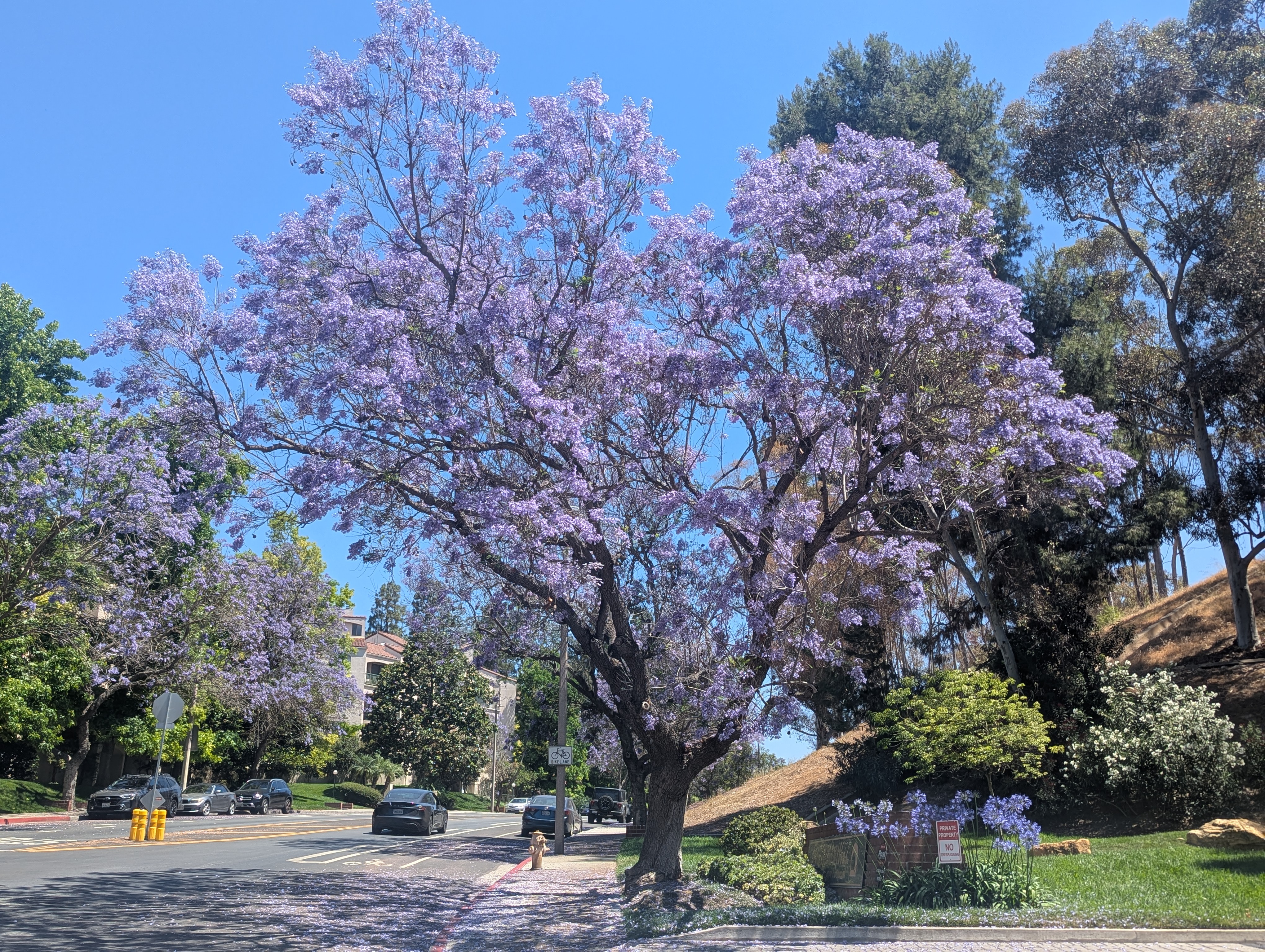
I settle in, catch up with Brandon Horn and his wife Wendy and their kids Pema and Tai, whom I’d last seen two years ago. After dinner, Brandon mentions an interview he’s seen recently, which he thought I might enjoy. Brandon has a thoughtful manner. A watchful expression, as if he were scanning the steppe for signs of movement. Last time I saw him, he encouraged me to read Yuval Noah Harari and think about AI. This time it’s an interview with Donald Hoffman, a cognitive scientist with controversial ideas about the nature of consciousness.
I listen as Hoffman claims that reality is an illusion. We do not perceive reality, and we are not conscious of it. Our brains evolved for fitness, which means taking action to survive. We did not evolve to understand the truth of things. Even our most cherished concepts, like space-time locality and unitarity are simplifications, not fundamental aspects of reality.
Brandon was particularly intrigued by Hoffman’s discussion of the “amplituhedron,” which is a geometric structure that predicts the probability distribution of subatomic particle interactions without making assumptions about their location in space-time. Which implies that space-time might be merely a construction of our imagination.
The next generation of theories to explain the world, according to Hoffman, will assume that consciousness is fundamental.
Harwood Mountain, Mt. Baldy, West Baldy
The next day, I head out on my first peak-bagging operation. The goal is ambitious – to climb eight mountains in two days with no food. No food because I practice intermittent fasting. But I’d like a cup of coffee, which means I show up at the trailhead in daylight, a little later than ideal.
A soft dirt road takes me uphill to a ski lift, where I turn left, climb further, walk out onto the Devil’s Backbone, a narrow ridge that hangs from the summit like a catwalk. To the west, vistas of Los Angeles wrapped in ocean fog. To the east glimpses of the tawny plains of the Mojave Desert broiling in the sun and farther off more mountains.
The ridge is open here, with a few short trees, but otherwise exposed to the sky, and the heat and glare surprise me. I blink, perplexed by the brightness, starting to feel slightly overwhelmed. My shadow lies to my front, signaling the sun is at my back, pouring its rays onto the ground at nearly a perpendicular angle, and the sand is beginning to cook. A stunted lodgepole pine offers a spot of shade. I drop to the ground. Drink some water. Let my feet cool off. Back home in New York, we’ve had a cold wet spring with maybe one or two nice days so far. I am not acclimated to the high desert environment in these Southern California mountains.
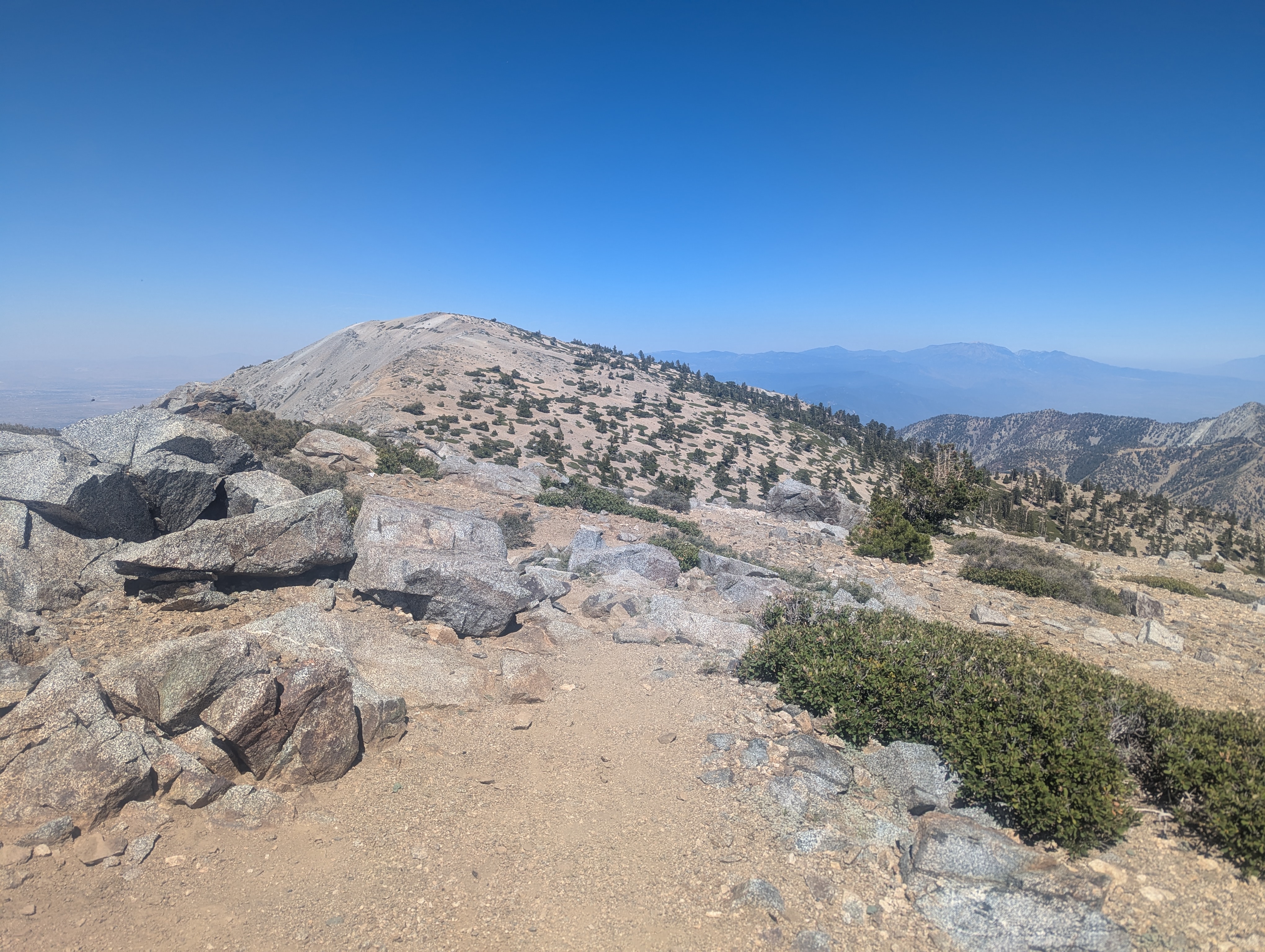
I creep up the flank of Mount Harwood (9,556 feet), the first of my objectives, find another tree, take another break. The surface is different – crusty rock shards are pricking my soles. I tip-toe across the summit and drop down into a shallow saddle that lies below Mount Baldy (10,064 feet). The brilliant light, hot air, and burning ground dog me on the climb to Baldy’s summit, which is also littered with edgy shards. Possibly a roof pendant layer, composed of volcanic flows that cooled on top of the granitic plutons that form the bedrock. From the top of Baldy, I spot the trail snaking up the modest bulge which is the summit of West Baldy (10,005 feet), one half mile away. Surely I can make it there to bag barefoot summit number three. A halting but determined effort gets me to the top. But my feet are now complaining loudly with every step – and my pace has slowed to a crawl. There is no choice but to pull out my shoes for the descent, which is steep, rocky, long, and wearisome – it’s 4,000 feet back down to the trailhead.
That night I camp without dinner. The next morning I’m on the trail to Cucamonga Peak (8,862 feet) at first light, treading through a canyon which is impossibly deep. Chipmunks and lizards dart about in the shadows, dislodging pebbles which tinkle down rock walls which are impossibly steep. Cold clear water trills down below, and from a seep along the trail springs a patch of columbines with red-yellow cup-shaped flowers drooping from long stems.
With no food in 36 hours, my mindset is patient and methodical. The trail is full of rocks, and my feet are tired from the day before. I make it in 2 miles before the morning sun finds me, splashes me with unpleasant warmth. I know the desert glare and heat are waiting for me higher up, and no, I am not ready. Cucamonga will have to wait for another time — I walk back to the trailhead and drive back to LA, stopping on route for some breakfast long overdue.
Mt. Harvard
After Baldy, I took a couple days off from the mountains to attend to some work-related calls. During a break in my schedule, I accompany the family on a shopping trip. We pile into Brandon’s Tesla, which drives us through sunny streets lined by jacaranda trees glowing brilliant blue. At our destination, Wendy leads the way through an outdoor market, selecting organic vegetables and fruits brought to market by local farmers whom she seems to know, while Pema and Tai chat and laugh, and Brandon and I lag behind, debating Hoffman’s theories. I edge up to a stall which offers a spot of shade to stand in, as the southern California sun is heating up the blacktop.
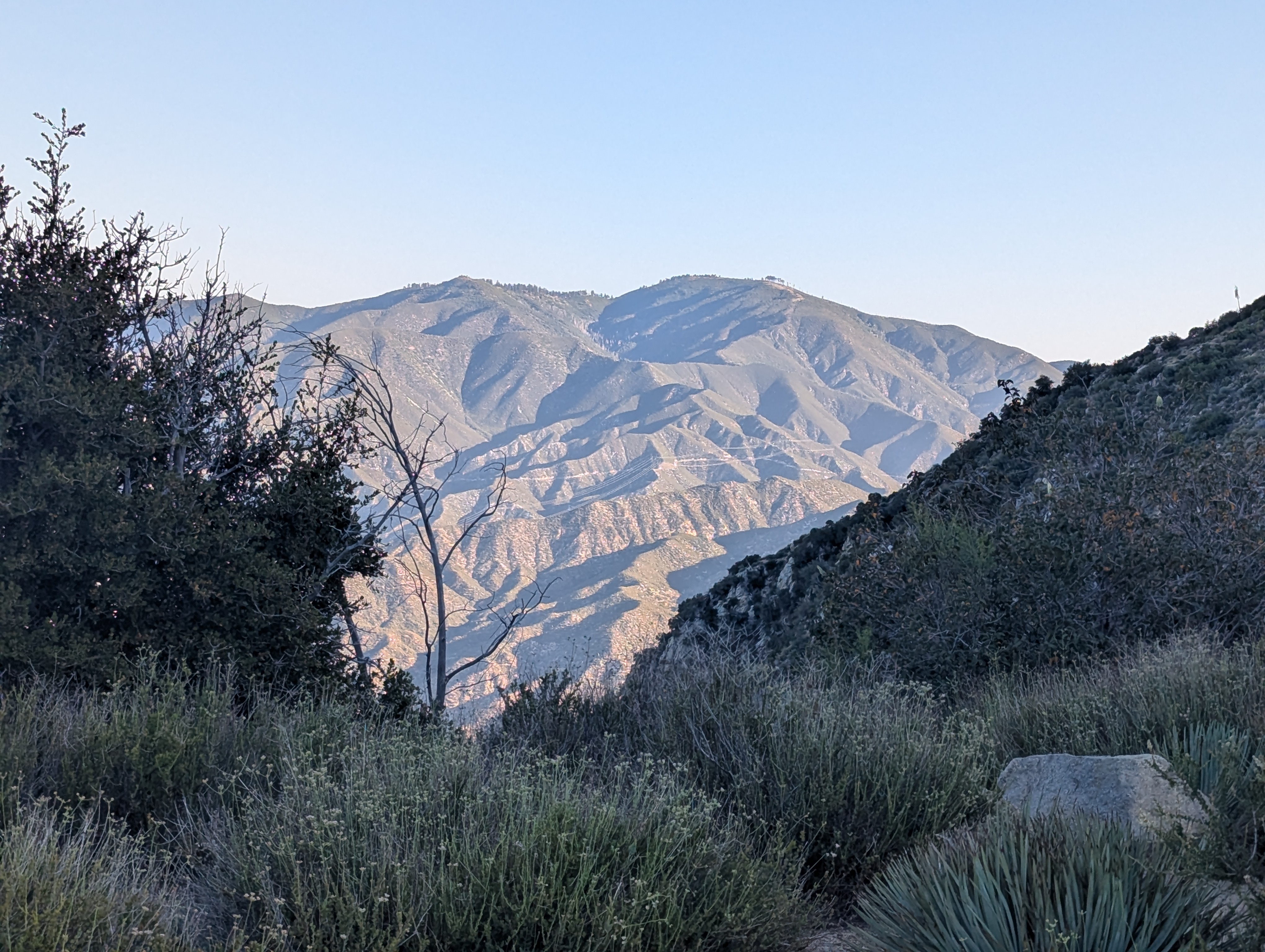
There are more calls the next day, but finishing early, I drive off to the Mt. Wilson observatory, intending to bag more peaks. It’s 3:00 pm when I arrive, which should have given the ground some time to cool, but the trail to Mt. Harvard (5,441 feet) is composed of a dark brown mix of sand and dirt, and it might as well have been on fire. I scamper through a burned-out forest, pausing beneath a charred tree to cool my feet in the shade cast by a blackened trunk, before dashing to the next small shadow. After a half mile, the trail reaches a gray gravel road that isn’t quite as hot, but the surface contains a quantity of shot rock, i.e., chunky sharp-edged gravel. And the grade is quite steep. The short climb to the summit is slow and painful. The reward for this effort is a radio tower installation. A sign on the chain-link fence warns that radiation levels may exceed federal safety standards, but the gate is open and a pickup truck is parked next to a squat building. I stroll in nonchalantly, stand on a slab of concrete and peer down at the route to the next mountain on the ridge. There is no path visible, merely a large power cable anchored to the rocks. I decide against going any farther.
That evening Wendy treats us to a dinner salad full of fresh ingredients. Brandon shows me a video of Tai completing a Kung Fu form. Dressed in black, brandishing a silver sword, Tai jumps and whirls, the rhythm of his moves alternating between rapid flourishes and languid swaying motions. I learn that Pema is studying math, heading off next year to college, and thinking ahead to a career in law or business.
The conversation drifts back to Hoffman. Whom at first I did not like. His idea that we do not perceive reality directly seems, well, obvious. Consider that Mt. Baldy is composed of a trillion tons of granite and volcanic rock – what “truth” about this volume of matter is a person supposed to hold in consciousness? In my mind, Mt. Baldy is a large gray granite triangle. Cooking under desert sun. Capped with crusty sharp-edged rocks — and then there’s that glimpse of the trail snaking off towards West Baldy one-half mile away.
As I watched more of the interview, though, Hoffman began to grow on me. His enthusiasm for complex theories was infectious. And when the interviewer pinned him down with specific questions, Hoffman gave precise answers, which gained my respect. The new theory he was working on starts with the idea that there are conscious agents who interact with each other in networks. Hoffman clarified — these are his assumptions. Assumptions are the “miracles” that cannot be explained.
Nonetheless, I caution Brandon, there’s a null hypothesis about consciousness. Riccardo Manzotti, an Italian robotics scientist, questions the traditional divide between subject and object. If you perceive an apple, your consciousness is that apple. There is no mechanism inside the brain where an image of the apple plays on a screen for a conscious agent to watch. Otherwise, that agent would need a screen inside its mind and a subsidiary observer to watch it — ad infinitum. “I am the world I call my experience,” Manzotti concludes. In other words, “I am the apple.” Manzotti worries that the traditional separation of subject and object lies at the heart of our troubles as individuals and as a society. We long to return Eden, hoping that we might do so after death, when we should understand we are here already.
Manzotti’s ideas imply the sense of animism expressed by nature lovers like John Muir, who perceived the granite peaks of the California mountains as “radiating divine thought.” Who referred to trees, flowers, and butterflies as “people.” Which usage echoes, incidentally, the language of Native Americans story tellers, whose myths took place “in the time when animals were people, too.” We are both subject and object of our perception, meaning that the sensory impressions come connected with the emotions, ideas, and memories that reside inside our minds, infusing the seemingly external environment with sentience and feeling.
Strawberry
For a change, the trail to Strawberry Peak (6,167 feet) is a delicious soft sandy trail, and I stroll along in high spirits until nearly at the top, where I get stuck on a scramble. The trail is not marked here – it’s a constant guessing game which way to go. Now sand and rocks are sliding out from under my bare feet, rolling down the slope, pouring off into space, while my fingers grope on shaky ledges for a firmer hold. According to phone and watch, I’m only 200 feet below the summit, and maybe a quarter mile away. I crane my neck and scan the steep tumble of boulders above me. The problem isn’t the just the climb. It’s the risk of getting stuck. I picture myself trying to turn about and descend, unsure which way I’d climbed to get there. Having to down climb with great care, then finding myself teetering over some unexpected edge – which forces me to scramble back up and look around for a different descent — and meanwhile the sun is rising, the shade is shrinking, the rocks and sand are starting to sizzle.
On the map, this had looked like a trail, but it was really only a track. Later I found trip reports from other hikers who’d turned around like I did, finding the unmarked overgrown scramble “too dicey.”
The next day I returned, but this time along the official trail, which reaches the summit from the other direction. It’s once again a beautiful sandy trail, steep in one or two spots, but no scrambling. I do the entire 7-mile round trip without shoes, feeling delighted.
That evening, the family watches a reality TV show, a favorite of Tai’s, in which contestants are situated along a cold lake in Patagonia. They must build shelters and find food. Tai is interested in survivalist techniques including knots and cordage, so I show him how to tie an overhand knot and a figure eight, the way I’d learned years ago in Ranger School, which means dressing the ends with half-hitches. Then I ask him to show me the trophy he’d won in a Kung Fu competition. It’s almost as tall as he is.
To Brandon, I opine that we use language to describe every aspect of our world, including ourselves. But language can only explain so much. The feeling we have about consciousness – the strange idea that there’s something eerie about our experience — is the residual. Meaning the variance unexplained by our equations. The mystery that’s left after we’ve said what we can. No system can be fully self-aware. Even if said system had extensive memory banks, the circuitry dedicated to calculations is separate from the memory – and while this circuitry would see past calculations stored in memory, the circuity would not be able to see its own wiring.
Brandon agrees. Suggests that maybe consciousness is not something we can understand through words. He quotes a line from the Chinese Taoist philosopher Chuang-Tsu, who is believed to have lived around 300 BCE. “Once upon a time, I dreamt that I was a butterfly, flitting around and enjoying myself. I had no idea I was a man. Then suddenly I woke up and was a man again. But I could not tell, had I been a man dreaming I was a butterfly, or was I a butterfly now dreaming it was a man?”
Despite all my efforts to be clever and informed, there are huge gaps in my personal database. So now I ask Brandon, are Zen and Buddhism the same or different? He explains that Zen is the Japanese version of Chan Buddhism, which originated in China, and all of this derived from the experience of the original buddha, Siddhartha Gautama, who lived in India during the 5th or 6th century BCE.
Cucamonga, Bighorn, and Ontario
A second try at Cucamonga, this time with breakfast and an early start. This time the rocky trail passes smoothly underfoot, and soon I reach the drooping red-yellow columbines, after which I pause to filter water from the cold clear stream. After 3 miles, the trail turns sandy, starts to rise steeply as it switches back and forth on the way to Icehouse Canyon Saddle, and after that it’s back to rocks. I feel a sting on the ball of my left foot. Find a rock to sit on. Grasp the thorn or needle, which is the size of a hair, between finger nails. Now, reading glasses on, I scan the skin and poke around with a pair of tweezers, but whatever’s still there is too small to be seen. I limp on, foot aching ominously.
There’s a 1200-foot climb to the summit. The trail passes through a talus field, and the surface crosses piles of cobbles, requiring me to aim heels and balls at flat surfaces in the tumble. The sting from the thorn or needle or whatever it was begins to fade.
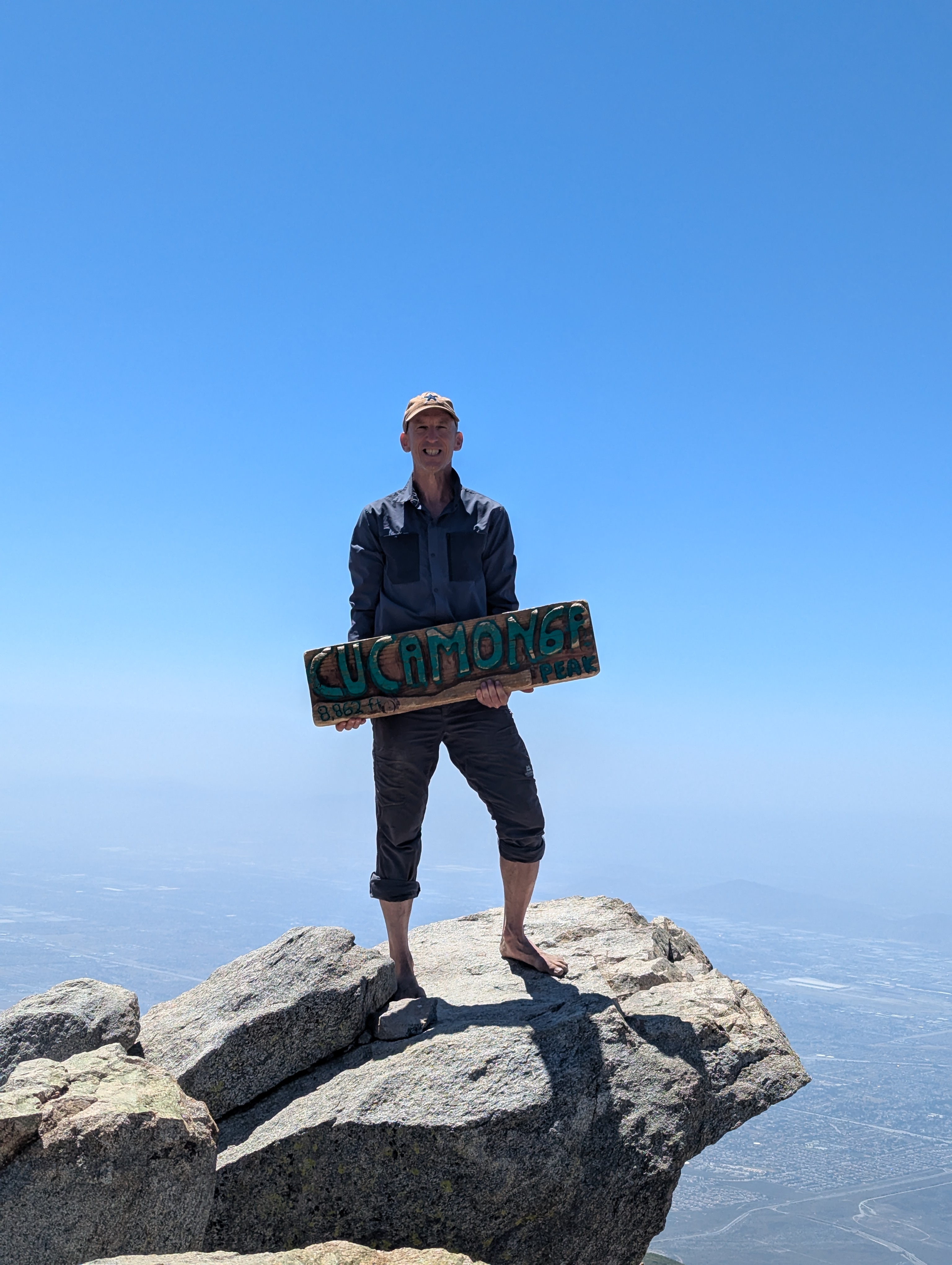
I make it to the top a little before 11:00 am. It’s a clear sunny day, not yet scorching. Cucamonga overlooks Los Angeles, 8,000 feet below. You can look straight down into the distant hieroglyphic patterns of streets and warehouses and residential neighborhoods, the scene reminiscent of an opened circuit board, and maybe there is a secret message hidden in the patterns, an intent even to communicate. Or maybe it is nothing more than the unmitigated chaos of modernity.
I step back from the summit. Progress this morning has been good. There is time to head out for two more peaks, Big Horn (8,441 feet) and Ontario (8,696 feet). In the interest of time, shoes go on for the descent to the base of Big Horn, and then I take them off again for the climb. Which is quite steep. I pull out a trekking pole to help leverage myself up the slope. The path is indistinct. I wonder off into a field of rocks dusted with Ponderosa Pine needles, which are dry and prickly underfoot. It’s nearly noon, and the ground is turning hot. There are sharp-edged metavolcanic fragments in black and red, littering the ground where they’ve shattered off outcroppings. The desert heat and glare are back in force. My feet are starting to hurt. My pace is staring to slow. I start taking breaks in the shadows of pine trees. Well, there’s no rush. I have all afternoon to play with. And it appears that I might need it. Going the one mile up and over Big Horn takes more than two hours.
It’s early afternoon. Ontario lies one mile away. But before I can reach the summit, I’ll need to make it to the half-way point, and before there, I’ll have to make it half-way to the half-way point. With my feet battered and on fire, that might take an eternity.
Realistically, I might have to put my shoes on, which would mean giving up. It would be a shame, having gotten so close to the objective.
I pull out my phone and stare at the map. I notice a junction lies just ahead. Ontario is a popular peak, I reason — it’s possible the trail to its summit is more developed than the sketchy track over Big Horn. A more developed trail might be sandy, with fewer rocks. Less of that grit that pokes like needles into sensitive, overheated skin.
Twenty minutes later, I’m at the junction, and it turns out my guess was good, for I’m greeted by something that looks a little more civilized – a trail with luscious sand. Now I’m moving a little more smoothly. The route curls along the backside of the ridge, climbs to the crest, passes two or three bumps before I finally see the top, looming ahead, like the bow of a ship, floating far above the ocean and the complexity of Los Angeles.
After this ordeal, a rest day is in order.
Chaung-Tzu reminded me of Diogenes, the founder of “cynicism,” an ancient Greek philosophy that criticized the affectations and artificial contrivances of society. I explain to Brandon how Diogenes advocated for a life of simplicity. His home was a barrel in the town square, where he hung out with the dogs. He had only three possessions: cloak, staff, and satchel. He believed in self-discipline, and to develop his physical and spiritual capabilities, he undertook physical training in the manner of the ancient Greeks, which is to say barefoot, even on snow in winter and burning sands in summer.
We agreed that there were similar critiques of civilization in both western and eastern cultures. As a Taoist, Chaung-Tzu was an advocate of the nature path, and a critic of the rules-based approach to life, the top-down morality, and the conformity implicit in Confucianism.
I offered up Nassim Taleb as a modern version of this attitude, with his theory of “anti-fragility” being consistent with a love for the robustness of nature, while he detested the hypocrisy of the educated and professional classes, who spun vast webs of intellectual fakery to hide the true volatility of life.
Brandon laughed. To him, Taleb seemed himself a fragile character – prone to extreme viewpoints, for example a hysterical fear of the COVID virus — and such a prickly arrogant character, raging against people who had different opinions.
Brandon returned to his theme of the day before. Maybe some topics cannot be explained with words, he suggested. Maybe they can only be experienced.
I raised an eyebrow.
He explained that the Buddha had awakened after a years-long spiritual quest that culminated in profound meditation. He did not achieve enlightenment by studying theory.
I wondered aloud whether it was conceivable that Hoffman had achieved enlightenment. Maybe his work on new theories of consciousness was motivated by personal experience. Maybe he had awakened and become himself a buddha.
Brandon shrugged. It would be hard to know.
Later it occurred to me that whatever spiritual attributes are characteristic of Homo sapiens, you’d have to believe they were present in our natural state. Otherwise, enlightenment would be a product of civilization and hence an artificial condition. Clearly that’s what spiritual/religious authorities would have you believe, otherwise their guidance would be unnecessary. Perhaps the path to nirvana will require one to master the operation of the amplituhedron and gain an understanding of conscious agents interacting in networks. Or maybe the way is simpler.
The next evening, we went out for dinner at an upscale grocery which offered a selection of prepared foods and sat outside in the warm California evening talking about career paths for Pema.
Was law a more secure field than business? Brandon worried about the risk of layoffs in the business world. Probably, I replied. I was thinking of mortgage companies, where staff reductions of 50% or 75% were not unheard of when interest rates went up and the market for new loans dried up.
But then I thought about Taleb’s theory of anti-fragility. Rather than hide from volatility, he wrote, embrace it. Learn from it. Position yourself for upside. Pema seemed like a smart young woman. She was doing well with her math studies. She was personable and engaging and had a lot of friends. Like her brother Tai, she studied Kung Fu and did not seem afraid to fight.
Pema should pick whichever career path interests her, I suggested. Instead of seeking job security, let her go in with the intention of kicking ass.
We walked around the streets of Pasadena and got some frozen yogurt, then hopped back in Brandon’s Tesla, which drove us home, although first we brought some dinner to Wendy who was working late.
I said goodbye, as I would be leaving early the next morning.
Sawmill and Mt. Pinos
I had one last hike planned before heading home. I drove off to a trailhead in Kern County, 2 hours away. Pulled into a parking lot where people had set up telescopes to study the night sky. Filled my water bottles and checked the map on my phone. Found the trail exiting the parking lot on a sandy dirt road, which seemed promising.
After the hot prickly adventures of the last few days, it was a welcome break to saunter along this sandy road, which rose at a comfortable moderate grade. I passed through a forest of pine trees. Spotted a snow plant with blood-red bracts and flowers poking through the ground. Silver-leaf lupine was beginning to bloom, while stalks of dusty red Indian paintbrush were sprouting all around. After two miles, I reached the summit of Mt. Pinos (8,847 feet).
An interpretive sign explained that the name for Mt. Pinos in the Chumash language is Iwihinmu, which means “place of mystery.” Their name for the summit is Liyikshup, which means “center of the universe.” The Chumash regard Liyikshup as a place of balance, harmony, and tranquility.
I headed out for the next peak, Mount Sawmill (8,822 feet) along a narrow footpath, which followed some lazy switchbacks down the hill. The drop wasn’t far, but unlike the sandy road, the path was cluttered with rocks, and soon my feet began to feel the points. From the summit of Sawmill, the Central Valley loomed to the north. Somewhere out there lay the town of Bakersfield. To the east lay the plains of the Mojave Desert, broiling in the sun. Later I would be driving through the desert, braving temperatures of 105 F, without air conditioning, of course, which I never use in cars when driving by myself. I have always hated the idea of hiding from reality.
I made my way back to Mt. Pinos and its summit, Liyikshup, my pace slowing as I dealt with the narrow rocky trail. As I neared the summit, I was startled by a flash of scarlet — the Indian paintbrush was growing so thick it had colored half the summit red.
To the south I heard the wind gathering in a hollow. A dust devil formed on the trail twenty feet to my front. Rushed at me and rustled my clothing. I wondered if a Chumash spirit resisted my presence here. I thought of people I know who seem angry and tense. The dust devil dissipated, as did the sense of anger.
A pink and tan granite outcropping seemed to mark the high point. I crept there through a patch of gravel, placing my feet on soft mounds of buckwheat where available. Sat in the shade of a lodgepole pine. Listened to bird calls I did not recognize. Watched a western tiger swallowtail flutter past. The sun was high overhead now, and a cool breeze seemed friendly and welcoming.
I sat there in a place of mystery, at the center of the universe, thinking about things which I no longer recall.
Then gathered myself together and made the 2-mile walk back along the sandy road. Although now the ground was warming up and there seemed to be more rocks than I remembered. My feet ached, and I fretted with impatience at the slowness of my pace.
Ten California peaks brings me to 535 mountains climbed without shoes, on the way hopefully to 1,000 before I get too old.

Chasing the Grid is available for pre-order on Amazon!

 The Long Brown Path
What an amazing adventure! California suits you 🙂
LikeLike
“I sat there in a place of mystery, at the center of the universe, thinking about things which I no longer recall.”
LikeLike
[…] Today, I am a barefoot hiker, moving slowly through the mountains. When the ground is hot, the stones are sharp, or the ferns are tangled with bindweed, I may be moving at less than 1 […]
LikeLike
[…] Mount Pinos, a high point in Kern County, whose name in the Chumash language is Liyikshup, meaning “center of the universe.” As I made my way toward the summit, a dust devil formed right on the trail and then blew past me, […]
LikeLike