9-hours in my faithful black Jeep, and maybe longer, as Google Maps just shunted me off the highway and now I’m rolling through small beach towns (signs flash Ogunquit and Kennebunk), where tourists stroll the streets and mill around in trendy bars, hanging out beneath tall gas lanterns on this cool summer evening — but I’ve got a dull ache in my butt (piriformis syndrome from doing squats again) and I just want to get to Millinocket – or anywhere, honestly.
Strictly speaking, this is vacation, but my mindset is all business. My mission — to climb the state’s 4,000-footers, of which there are 14. With long driving times between mountain ranges and interruptions for work calls that can’t be rescheduled, the schedule has little slack. And it’s not like I can just bang out these peaks. I hike barefoot. My pace is slow.
A few weeks ago, this strange thought popped into my mind – that Maine was the “land of the Black Sun.” The intuition being, I guess, that if you journeyed far enough from home, you’d find places so radically different from the familiar, that common attributes might shift into their opposites. Like when Clarence King traveled west from Connecticut to join the California Geologic Survey and then, as soon as the expedition was under way, begged permission to climb a mountain. Any mountain. How about the tallest one in sight. This was 1864. When he and a companion finally reached the summit of Mt. Tyndall, King looked into the sky and saw the darkness of vast yawning hollow space. While the desert basins below were blindingly bright. It was a “strange reversal.” The opposite of familiar sunlit skies and dark cool earth.
On occasion I, too, have experienced strange reversals. For example, I’ve noticed when wearing sunglasses with polarized lenses, that when I tilt my head, the contrast shifts. The brightness flickers. Shadows come awake.
I roll into Millinocket at 2 am. An envelope with my room key is taped to the door, just like they said it would.
North Brother
Suddenly I’m blinking awake. The plan was for a rest day, but sunlight’s streaming through the window. With 14 peaks to climb and not much time, I’m inclined to take action. Now.
When I reach the southern gate of Baxter State Park, pavement transitions to dirt, in some places slick with moisture. I slide around a turn — twist the wheel to keep from slipping onto shoulder — push the selector into 4-wheel drive and move forward more cautiously.
From the Marsten trailhead, the hike to North Brother is 4 miles of unfamiliar terrain. Not sure what to expect, I’m pleasantly surprised to find a path of soft moist dirt, which is pleasant underfoot. I balance for a moment on a gnarly root. Step next onto a bumpy rock with a rough prickly feel. The climb is big, but not too steep, and eventually I emerge into the treeless alpine zone. Clamber to the top through a field of jumbled crusty black broken boulders. Cinch my jacket against the wind. Look up into vast gray sky. Through a break in the mists there looms a jagged mountain wall, black as night, and a broad sweeping plateau shaped like a whale’s back. That is Katahdin. Tomorrow’s business.
I return to the Jeep, with the impression that Maine mountains are big and slow.

Katahdin and Hamlin
It’s 3:30 am the next morning when the alarm goes off. I pull into Baxter’s southern gate at 4:45 am, only to find four cars already in line in front of me. To climb Katahdin requires a parking permit, which were long gone by the time I visited the website. I called and waited on hold for quite some time, until someone picked up and said there might be cancellations, and a few slots available on a first-come, first-served basis – but better get there early. So now it’s 6:30 am, and I’m dozing in my Jeep when there’s a rapping on the window. The ranger takes $16, asks which trail I’ll be following. Finally, at 7:30 am she waves me through. I follow another long dirt road to a gravel parking lot.
The trail, when I finally reach it, starts out rocky and then turns steep. After a couple of miles, I emerge onto the summit of Pamola Peak, named for the Penobscot Indians’ thunder-god. Looking back into the valley, it’s a gray misty morning. A distant lake shines with the gruff tint of steel wool. Otherwise, the scene is blurry, like looking through the mesh of a screened-in porch. Out in front of me stretches the jagged black wall I saw the day before – this is the “Knife Edge,” which leads to Katahdin.
The Knife Edge is commonly referred to as an “arete,” which is the thin wall left between two glacial cols, although strictly speaking, the Knife Edge has only a single col (on its north side). Regardless, it’s a catwalk hanging above two great gulfs. The crest consists of a tumble of broken rocks, only three or four feet wide, through which the trail, if you can call it that, swerves back and forth. I place one foot on a flat rock, but the next step requires me to balance upon a pointy block. I perch there, naked arch of one foot supporting my weight, and hesitate – leaping to the next point seems like a questionable move. Instead, using both hands for support, I lower butt until there’s contact, and then reach out a foot in search of something flat. As I’m inching along, the wind picks up, barreling in from the north. I pull on a windbreaker. The sun pops out from behind the streaming mist, and inside the jacket I’m soon cooking. I take it off again. The sun slides once more behind the mist. I crawl along the Knife Edge’s serrated teeth, at a pace that is tentative and creeping. Eventually make it to Katahdin. From the summit looking east, the Knife-Edge winks back at me, a wall of black. To the north, in the depths of a massive col, shines Chimney Pond, its surface navy blue, the color of twilight.
Henry David Thoreau, the American Transcendentalist, climbed Katahdin in 1846 and experienced a strange epiphany. Standing in the alpine zone, he felt awestruck both by the primeval terrain (“fashioned by Chaos and Old Night”) and by the mystery of his own body – as if he suddenly understood that all nature, man and rock, is made of the same matter. “Contact! Contact!” he wrote, in astonishment.
I stand in awe of my body, this matter to which I am bound has become so strange to me. I fear not spirits, ghosts, of which I am one, — that my body might, — but I fear bodies, I tremble to meet them. What is this Titan that has possession of me? Talk of mysteries! Think of our life in nature, — daily to be shown matter, to come in contact with it, — rocks, trees, wind on our cheeks! the solid earth! the actual world! the common sense! Contact! Contact! Who are we? where are we?
Thoreau, Henry David. The Complete Works of Henry David Thoreau: Canoeing in the Wilderness, Walden, Walking, Civil Disobedience and More . Kindle Edition.
From Katahdin I stumbled east on a trail full of gravel and sharp-edged fragments to the broad summit of Hamlin and then clambered down Hamlin’s eastern shoulder, which was also steep and rocky. Eventually the trail flattened out, but by this point my lower back was aching, a complication of the inflamed piriformis and scrambling over the Knife Edge constantly bent over groping for handholds. The irritation woke me up during the night. The next morning, after taking a couple pills, I was in the Jeep bright and early for the 4-hour drive to the Bigelow Range, where I found a small motel. For the rest of the day I worked remotely on various projects and took some calls and then went to bed.
I woke up the next morning after a long and rambling dream. I was indoors somewhere. Alone. I don’t know what happened to my career, but I had no job. No colleagues. My family had lost interest in my fate. So had friends. I lay there for a few moments in a state of dread. Later that morning I was sitting on a bench outside my room while the sun gradually warmed the air, trying to let time slow. Resisting the urge to draw up the day’s list of tasks. Beyond the balcony and a small gravel parking lot, traffic whizzed by at highway speed on a narrow rural road. Sounds of engines roaring, tires snarling. Tourists in SUVs. Locals in pickups. Huge trucks hauling double trailers full of felled trees. The kind of road you wouldn’t walk along. Not if you’d read Stephen King’s, Pet Semetary and remembered the young boy who wandered out of the family home somewhere in rural Maine onto exactly this kind of road (was he chasing a ball?). It was, of course, one of those lumber trucks. After the funeral, the father returns to the graveyard in the middle of the night and acknowledging to himself that this is just totally wrong — he disinters the small body, carries it deep into the Maine woods to a special haunted place he’d discovered behind a giant pile of deadfall – a place where locals sometimes buried pets in the belief that they would return from the dead.
A few years later, Stephen King was himself walking on a rural Maine highway, when he was struck by a van and flung 14 feet into the air. He landed in a roadside ditch and came awake with blood in his eyes. He writes in his memoirs of the helicopter flight from one hospital to another (among other injuries, his leg was broken in 9 places – “like a sock of marbles,” according to the surgeon) and the brilliant wedge of blue he saw out the helicopter window.
Saddleback and the Horn
Two pills for lower back, butt, and hips, which are still aching, and I’m in the Jeep bound for a ski resort, where the trail heads straight up a double-black diamond slope. The hill is covered in grass and wildflowers, and it makes me think of the local grasslands back home – only the geometry is different (long, narrow, slanted upwards). Along the way, I reach down and grab a handful of bright red bunchberries, which grow on creeping dogwood. They have a mild minty taste and tiny crunchy seeds.
Past the uppermost lift, the trail passes into spruce-fir forest and then out onto a long barren ridge crest. I pad across granite slabs, prickly underfoot. The northern winds must be quite fierce, if the trees can’t hold on here. Not even the krummholz – the small, stunted trees that grow tangled together.
The breeze comes washing over the crest, this morning from the south. I look around at a wide-open scene. The mountains are so big and round. The valleys are so wide and sweeping. This is ancient country, the mountains merely modest remnants of the granitic intrusions that took place during the Acadian orogeny, nearly 400 million years ago.
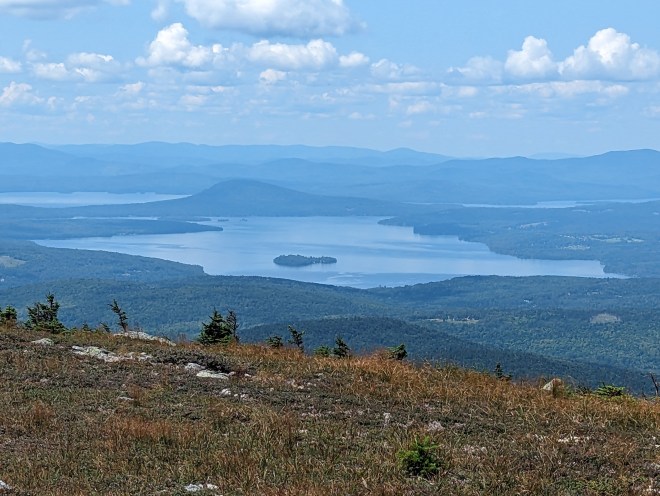
I feel like I’m standing at the base of an abyss. But not a narrow crevice in the earth’s bowels. Rather, one that reaches up to infinity and around in all directions. And is full of clouds. To the west, Rangely Lake is shining blue. Beyond it, the Bigelow Range is also blue, although diffuse and indistinct. But these shades are illusory, because water and air are transparent, and space is black and the bottom of the lake is muck and sand. Nothing is blue, really – except for the blueberries growing in the alpine heather.
On the descent, I eat more bunchberries, which are growing in huge clumps. Admire many familiar grassland species – goldenrod, daisies, dark green bulrush, timothy grass, spotted Joe-Pye weed – as well as plant people that live in mountain forests and meadows – meadowsweet, woodland asters, orange Hawkeye. At the base of the mountain, I spot a solitary lupine, possibly the season’s last, as they bloom typically in June, not late August.


Avery and West Bigelow
The next morning I crack open the door to pouring rain. The forecast calls for rain all day. Although it might possibly clear around midday, for a little while anyway, before the rain resumes. So I dawdle, thinking a late start might be advantageous to catch that window. Stop for coffee and some breakfast. Drive slowly on a round-about route, to the steady rap of drops on glass. This is back country Maine. Indeed, “This is God’s country,” a sign proclaims, “keep the wind towers out.” The Jeep shifts unpredictably on the pavement, which is shiny black and new, but strangely warped. The new pavement ends, and now the road is old and cracked, as well as un-level. There are no houses or buildings out here. There’s no other traffic. There’s no signal for my phone. I’ve done a lot of hiking and never had a problem, but no-one knows I’m out here. If I got lost or hurt, they wouldn’t know where to search. The satellite radio cuts in and out as Soundgarten wails, “How would I know…that this could be my fate?”
A dirt road with intermittent muddy potholes takes me bouncing to the trailhead. I step down from the Jeep and find the rain’s stopped. Head out along the trail, and suddenly my nervousness is gone. The forest feels like home. Why, I feel completely comfortable here. Maybe because I’ve spent so much time in damp northern forests, climbing peak after peak after peak. A moment ago, I was worrying – now I’m feeling confident. When it comes to state of mind, there is evidently no “reality.”
The climb consists of a pleasant walk in wet woods, on a soft damp trail tangled with roots, strewn with rocks, and dimpled with muddy puddles. As I near the top, I hear the winds gibbering in the trees. When I emerge into the alpine zone, the winds are tearing at my goretex jacket, whipping my hood back and forth, and I’m taking baby steps, trying not to get blown off the side of the ridge, laughing in the mayhem.
Crockers and Reddington
I’d programmed in another rest day, but once again the sun is shining.
This morning the forest is dim. Quiet. A breeze tickles the leaves at the summit of Crocker, and then I’m shuffling on damp dirt covered with spruce-fir needles, dropping through boreal groves, and it’s silent again. The air is so hushed, it’s like hearing the sea in a shell held against the ear, but now it’s mountain instead of conch, and instead of the rush of waves, I hear the whine of a fly. I keep moving along, notice prints in the mud from some dog, but never see it. Then I find a leash hanging on a tree – which begs some impossible questions. Was this from the same dog or a different one? And how could a leash get left behind unnoticed?
At the summit of Reddington I cross paths with a young lady with a pack, poles, and light-weight hiking boots, who’s also bagging peaks. We trade observations on our favorite trails, and then she’s striding past me, while I pick my way along the bumpy path in soft wet naked feet, at a much slower pace. As I reach the dirt road I drove in on, I find the common wrinkle-leaved golden rod and flat-topped asters growing in an amazing chest-high yellow-white profusion.
Rangely Lake
The next day, finally, is rest day, and I spend it at Rangely Lake, which I’d studied earlier from the summits of Horn and Saddleback. Now I’m paddling underneath a skyscape of promethean dimensions, which I study both above and below. Overhead, gray clouds mass, and then a squall blows through and roughens up the surface. The sky slowly clears. The water turns smooth and glossy again, like black lacquer with a hint of jade from the dark coniferous forests ringing the shores. Now I’m watching great white shapes surging on the black surface. Remarkably, from this vantage, the mountains hardly matter. Yes, that’s the ski slope I climbed up Saddleback, but otherwise the ridges lap low against the horizon and seem unimportant. The wind gusts along the surface, and the water resolves into choppy lines sparkling with bright pinpricks. The wind calms, and the surface shifts back to glass, with wavy cloud images both boisterous and ponderous, big gray blobs or white bubbles – only everything is upside down. The lake is black instead of blue, the sky is both right side-up and upside down. I bob along in a great expansiveness.
Carl Jung, the psychologist who studied archetypes, wrote of the Black Sun, or Niger Sol as it was referred to in the ancient alchemic texts, as a symbol associated with the confrontation between the conscious mind and the subconscious. Picture an alien landscape shimmering underneath black rays, in which the self must journey into the abyss, there to confront and ultimately reconcile itself to the turbulent primal energies of the subconscious mind. The lust. The rage. The madness. The emotions smothered over since childhood. The traumas that had to be repressed. The terror not only of death but of disease and decay.
But I think he got it wrong. Because the subconscious mind is not like some kind of basement filled with skeletons. It’s more like a tunnel that reaches back in time, to our ancestral memories. It connects us to animal and plant people and all other forms of life. It’s like the ocean. Or the sky. Somewhere in my subconscious mind, I suppose, a Black Sun shines over shadowy coniferous forests and muddy dark trails.

Mt. Abraham
Rain again. Bumping down a rocky road full of holes, again. Heading out into the mist on another morning completely silent but for the soft steady sound of foliage dripping. Three miles stepping thoughtfully on rocks, balancing on roots, slopping through mud, dancing along damp spruce-fir needle-strewn dirt. The trail turns up steeply for a thousand-foot climb on a rude rock staircase. Then it angles across a field of loose scree, where the fragments shift, tilt, and clink underfoot. The summit is a tumble of lichen-crusted blocks and blowing fog. On the descent, the mist rises like a curtain, revealing the two Crocker peaks I climbed yesterday. Once I regain the valley and the path levels out, my legs turn over faster as my thoughts fill with lists of tasks – emails, documents, people to call – and I want to get back, get some coffee, get to work. But at the same time, I’m feeling content, now that the awkward rock piles are behind me, just moseying along on auto-pilot. The sun comes out and dapples black earth with white spots. The air turns warm and humid. Dark-colored rocks drip with dew. Wind tussles canopy.
A thought occurs to me – as people get older, we slow down (to be sure my pace today is not fast). But there’s another way to think about age, because as you get older, you have less time left to live. In a sense, the ground is rushing up at you faster and faster. Which means, as you get older, your perception of life should be accelerating.
How I want to run!
Sugarloaf and Spaulding
At the top of Sugarloaf, there’s a construction crew working on a lift. In the heavy mist they don’t see me. There’s a 2-mile walk to Spaulding on a long flat forested crest, and back again. The trail is wet, full of rocks and roots and mud. This is an exercise in patience. Yesterday I was fantasizing about acceleration. Today the concept of speed is irrelevant. Yesterday’s reality is today’s fiction. Mindset is unstable, or two things at once, or nothing at all.
Old Speck
And then there was one.
Up early for the two-hour drive, I pull into the parking lot for the climb to Old Speck, where I meet a young runner, who’s planning to power-hike all 14 of Maine’s high peaks (which will have taken me ten days) in one long weekend.
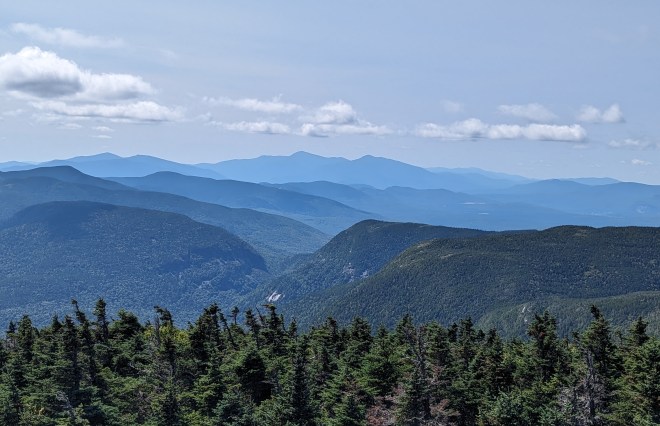
It’s a beautiful sunny late summer day, and the climb is uneventful. At the summit, a short rusty ladder takes me up a fire tower, where I cling to the railing, feeling uncomfortable with the height, and look around wildly. I spot a big mountain with a sharp pointed top and cry, “That’s Mt. Washington!” Only I’m looking north, someone standing on the creaky wooden platform explains, and Mt. Washington lies in the other direction.
I head back down, thinking of the writer and environmentalist Edward Abbey, whose 1971 novel Black Sun tells the story of a love affair between a lonely forest ranger, who hangs out on a fire tower overlooking the Grand Canyon, and a college student who’s looking for adventure. In her company, he comes alive. Finds passion in her body and her spirit and in the forests, rivers, and mountains which they explore. But he can’t bring himself to speak the words (of commitment) that she seeks. Frustrated and uncertain, she vanishes. Fearing she’s lost in the canyon, he plunges into the forest, hoping against hope to find some sign. As he descends, the canyon becomes his abyss. Vultures wheel overhead. Scorpions crawl among the rocks. The sun punishes him with deadly heat, and he struggles with dehydration. Upon his return (he never found a trace of her), he sits with a friend in a diner, staring out the window, silent.
(And all I can think is — in an upside-down world, why not seek the abyss in the sky!)
Homeward Bound
Mission complete, I’m on the road again, this time pointed south. I found a switch in Google Maps which was stuck on avoiding tolls (hence the diversion into Ogunquit and Kennebunk) and am hoping this time for a more direct route, but even so it’s 7 hours easy. Tilting my chair back takes some strain off butt and lower back (I took only one pill this morning).
I look at the sun out of the corner of one eye through my polarized sunglass lens – and a dark spot flashes between the blinding corona and the fiery disc. A hint of Sol Niger. Maybe. I picture a big black orb with the texture of India rubber and spurts of squid ink jetting from the surface. It hangs there in the yawning hollow void, humming malevolently with some weird energy. Whether it casts warmth or chill, it’s hard to say.
I’ve now completed the high peaks in Maine, New Hampshire, the Adirondacks, and the Catskills — which brings me to 110 of the 115 total in the northeast, all without shoes. Only Vermont is left. Perhaps I will be the first person to complete the list barefoot. Or maybe dozens have before me – who knows?
The blacktop rolls on and on beneath the wheels of my black chariot, now sand-spattered and dolloped with muddy drops. Cloudbanks hover along the western sky, with crisp ragged edges and billowing mass, illuminated as if from within, a vision of action at a distance – and I think how weird it is to be moving through life, one moment at a time, for the experience seems suddenly so novel as to be alien. Contact? With what? Or maybe that how life’s supposed to feel. Thoreau’s mentor, Ralph Waldo Emerson, wrote that “the good must be wholly strange and new.” He was not a man to follow in another’s footsteps, and he didn’t think anyone else should, either. No, you should feel like an explorer, making your way through wild forests, stepping over the prostrate trunks of primitive trees.
Maybe I will catch a glimpse of Black Sunlight in Vermont, when I return to bag the last five peaks. Although Sol Niger seems incongruous with a land of red barns, carefully tended perennial gardens, and white farmhouses decorated tastefully with quaint antiques. It would be strange, indeed, to find black sunbeams spattering the forests with spots of tar. Or the forests’ fungi glowing phosphorescently under black light.
Maybe I should follow Edward Abbey’s path, into the mesas and slot canyons of the desert Southwest. Step out onto the soft yellow sand in the dead of night. Search for his hidden gravesite. Search for his ghost. Let it guide me for a time. Then keep going, a few steps farther, on my own.
 The Long Brown Path
Finally paused my Gettysburg studying to read something otherworldly and peaceful! Beautiful imagery throughout–I love how you spend more time on flowers than summits. It’s almost like you’re out there up there for more than one reason or some other reason. –Rik
LikeLiked by 1 person
Goodness, Rik, so many reasons! And so exciting to hear about your Gettysburg studies – brings back memories of the day I reenacted Pickett’s charge!
LikeLike
[…] last thousand miles of barefoot training included nineteen (19) mountains. Last summer I climbed Maine’s 14 high peaks and a single Catskills mountain, but by the time December rolled in, it was time for footwear […]
LikeLike