Minimalism is a modern incarnation of an ancient philosophy — the premise is to simplify. The minimalist would have you declutter your home. Buy fewer things. Save money. Throw out unneeded stuff and create for yourself extra space and time.
Now let’s talk about decluttering your mind. The minimalist would say, be skeptical. About what you hear on the radio or see on TV or read in mainstream and social media. Beware of experts with financial interests. Let go of outdated ideas. Discount conventional wisdom and conformist thinking. Let go of your own rationalizations driven by ego and insecurity. Free yourself from all that mental baggage.
You see, the mind is like a garden that’s gone to seed and needs some weeding.
Or is it?
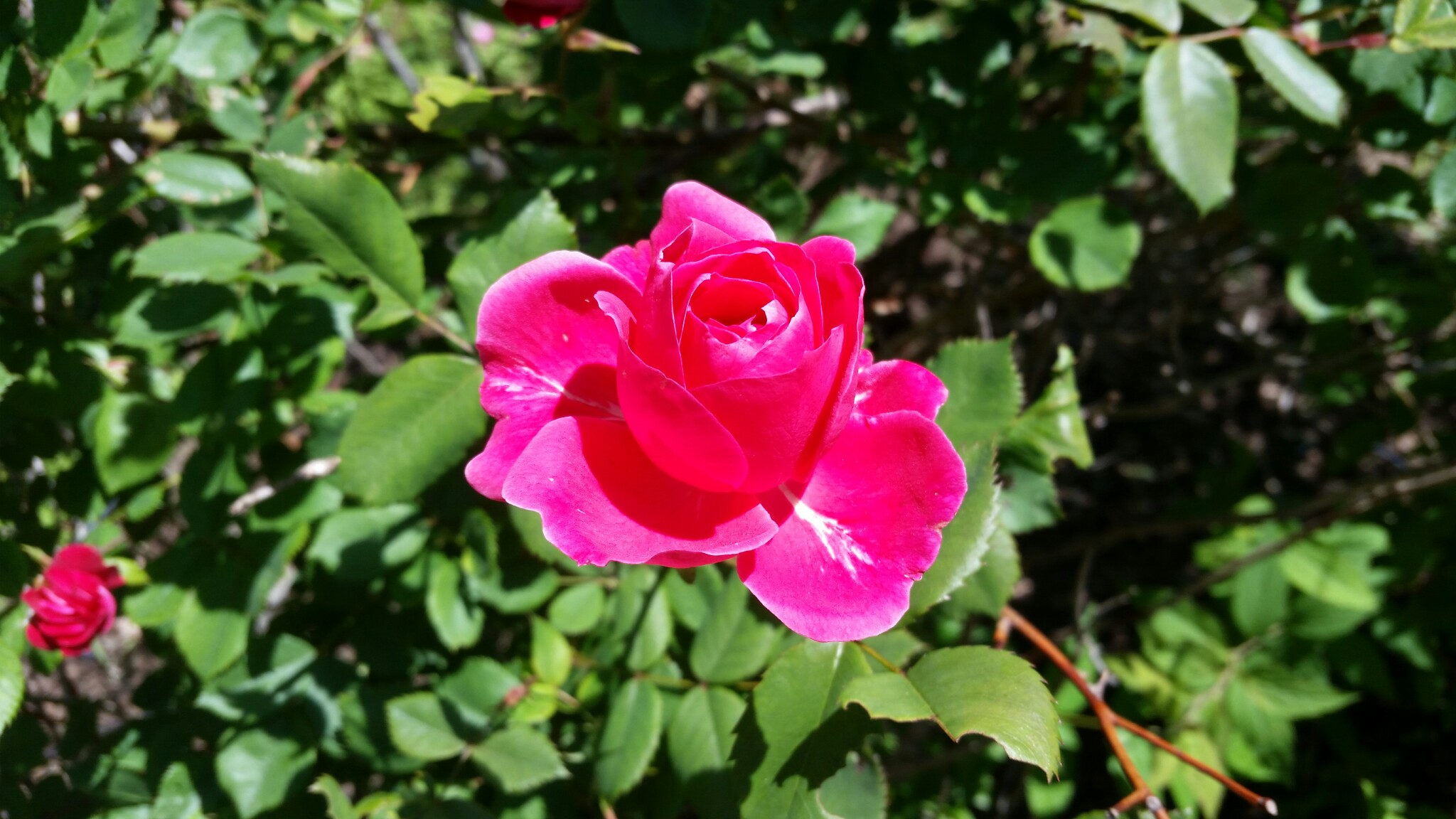
I used to grow roses. One of my favorites was a floribunda called Queen Elizabeth, which opened in ruffled pink clusters with a marvelous musky fragrance. Another favorite was Mr. Lincoln, a hybrid tea cultivar with dark crimson wineglass-shaped flowers and a divine damask scent. I was meticulous with my garden. Dug the holes to just the right depth and mixed in phosphate and bone meal in scientific proportions. Installed an irrigation system to keep the thirsty bushes hydrated. Sprayed them religiously with potent chemicals to defeat the aphids, caterpillars, rust, black spot, and worst of all the Japanese beetles – those shiny-bodied invasive predators that ravage the blossoms.
Over time, however, my interests changed. I spent more time running. Less time tending to the roses. The garden languished. An aggressive forsythia muscled in on one section. A giant raspberry bush materialized in another corner. The hardy old roses lasted longer than the modern cultivars, but eventually everything disappeared. Today, the black plastic tubing still lies under the soil somewhere, although it’s no longer connected to a faucet.
I did love the roses, though. I used to wander out into the garden during the growing season on a daily basis, seeking out the fresh canes, unfurling leaves, swelling buds, and finally the emerging blooms.
Behind the kitchen we have a perennial garden, which was created by the house’s former owner. In the spring a gardener comes by and lays down fresh mulch. This year, I had her plant some bee balm and butterfly bush in a barren spot, thinking the pollinators would appreciate the gesture. The other morning, I was looking out at the garden, when a mother deer stepped between the red and purple flowers – and for a moment I feared she would eat them. She stared at me for a long moment, then stepped along the bed and scarfed up some hibiscus petals which had fallen from a bush.
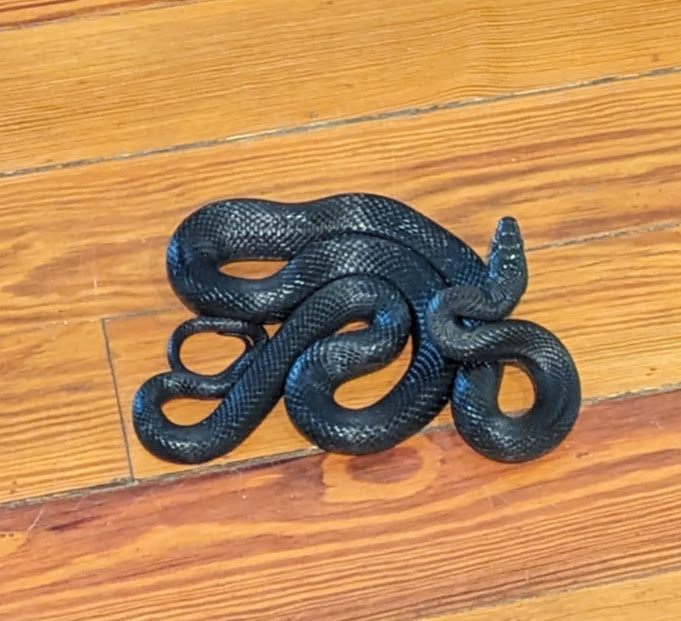
We live in the country, and nature intrudes constantly. I’m frequently rescuing moths from our screened-in porch, and once there was a katydid trapped within the mesh which a friend and I freed with care (they’re said to bite). Once I left the porch door open and not one but three Carolina wrens got inside and I had to chase them out, clearing each room one by one. The other day, I was lounging in the recliner, when movement caught my eye — by the door, a large black snake was coiling around the leg of an antique chair. (By the way, this may explain the mouse I’d seen tearing across the porch, moments earlier, as if running for its life.) I tried to catch the snake with paper bag and coat hangar, to no avail, but finally cornered it under a chair. I lifted my eyes (in search of better implements), and when I looked back it had vanished.
About a year ago, I came up with the idea for a project. I would visit the local Grasslands, which is situated about a ten-minute drive away, at least once in each month of the year, to catalog the sights and sounds. Especially the flowers. In kicking off this project, it occurred to me that if the Grasslands was attracting me, then, by the principle that all motion is relative, there must be some other part of my life I found repelling.
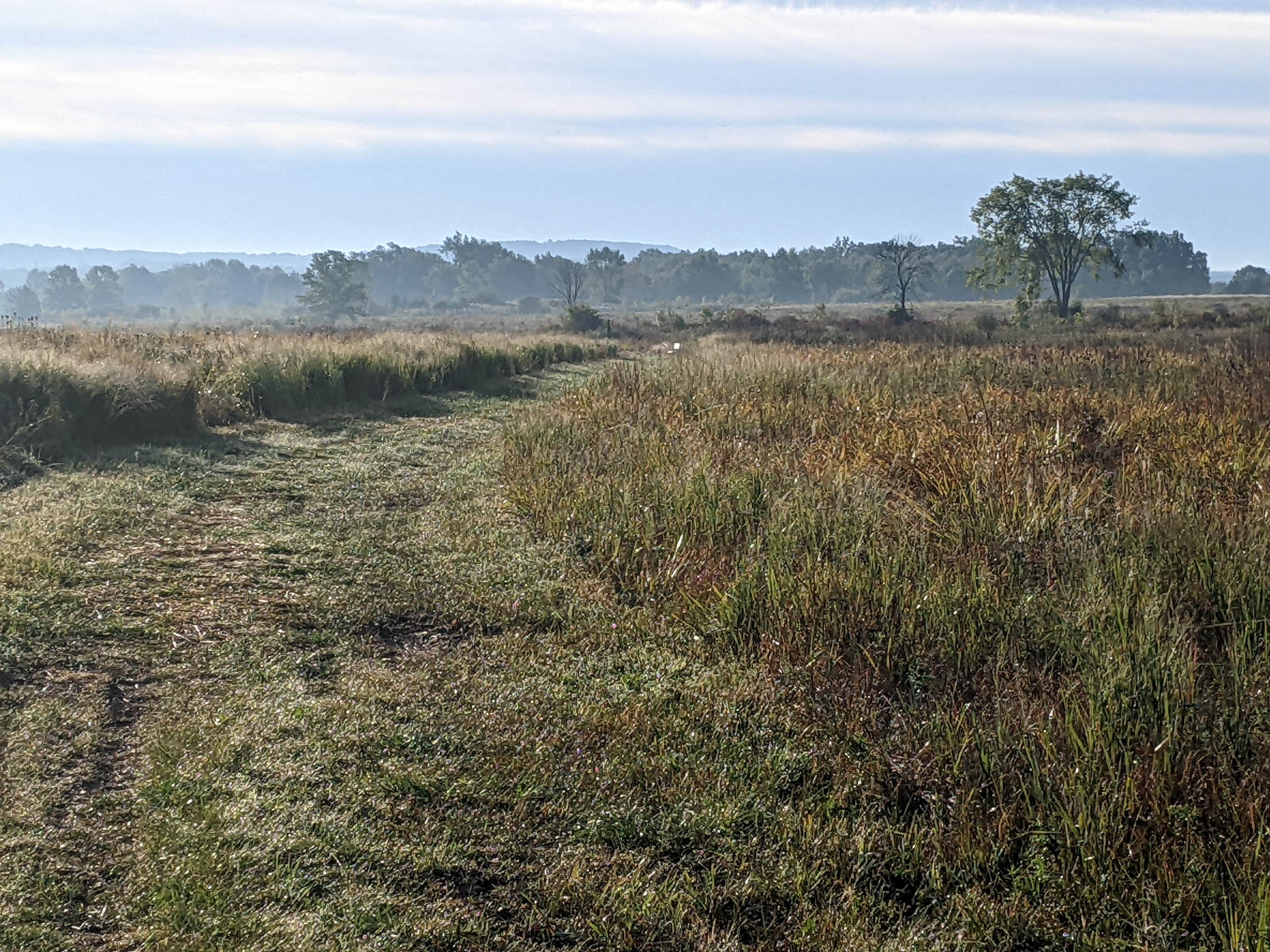
One September morning I showed up at the Grasslands and headed off at a slow jog along the trail among purple blooming New England aster and a solitary monarch butterfly. The morning sun shone so brightly on the dew-clad prairie grasses, now shoulder-high, it seemed I was running through a field of diamonds. There was somewhat less to see in winter. Gradual deterioration of the summer’s growth under onslaught of wind and rain and snow. Full moon casting pewter shadows on a spikey locust tree. Weird sunrises with carnival lights splashed along the underbelly of eggplant-colored clouds. Northern harriers floating low across the fields, eyes down. The local deer herd staring at me from a distance, ears pricked.
Spring came slowly. It was April when I spotted the first flower – caterpillar-sized catkins of the gray willow, spattered with yellow pollen. And then the ragwort exploded, splashing the fields in bands of brilliant yellow, especially where the grass had burned the year before. They burn the Grasslands regularly – about one-third of the 600 acres each year – to keep the prairie grasses from being overrun by common reeds, multi-flora rose, autumn olive, and a multitude of other invasives, many of which they also kill with spot applications of pesticide. Frankly, the fires are necessary to keep the grassland from reverting to scrub – willows, teasel, dogbane, viburnum, dogwood – and ultimately forest.
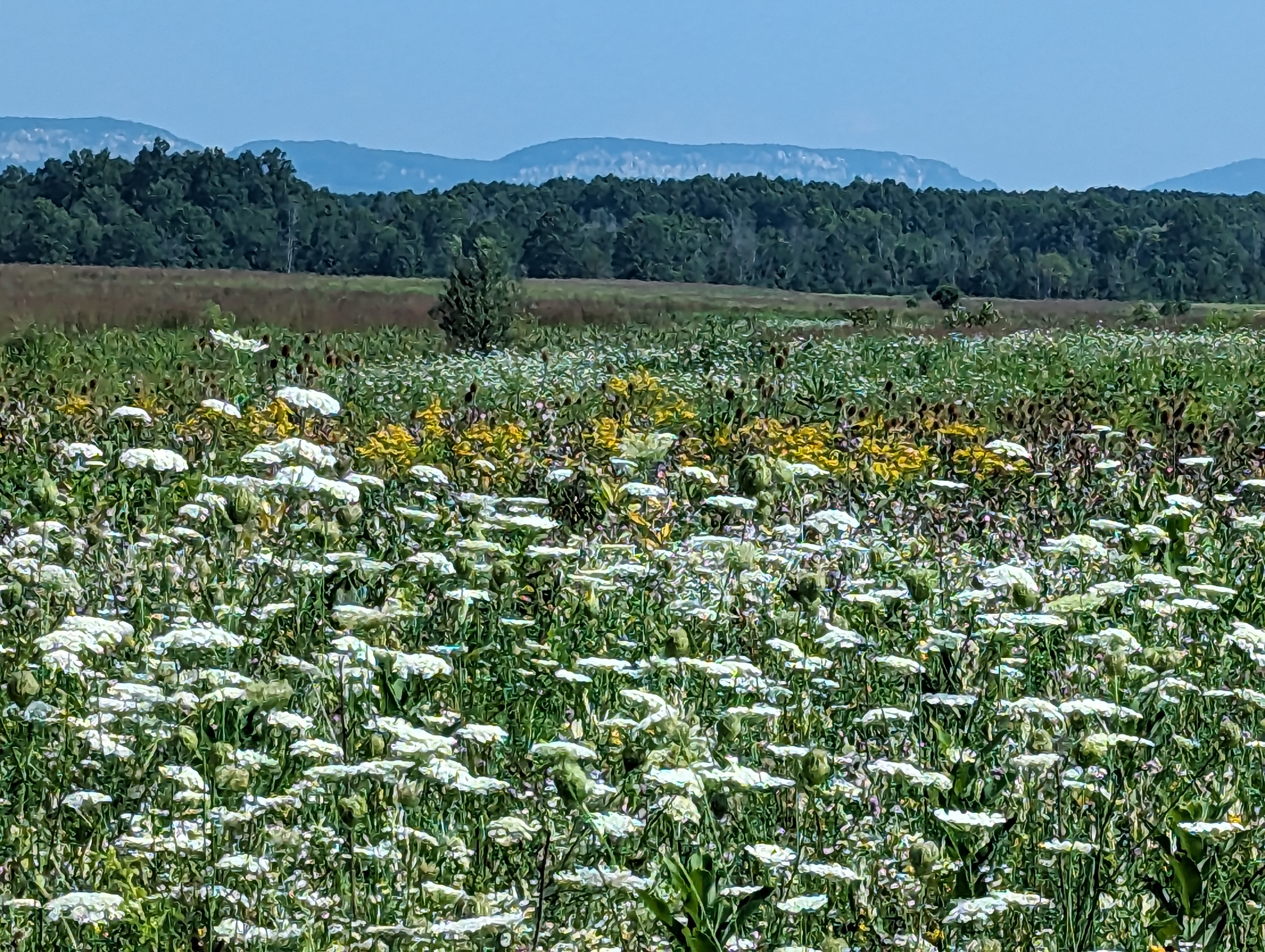
I could go on and on about the flowers, like the Carolina rose I found growing beneath the tangles. Or the successive waves of white bloom that engulf the meadows — first bedstraw, then penstemon, next sweet clover, and finally Queen Anne’s lace. Or the endless yellow dots, such as buttercup, or birds foot trefoil whose flowerheads consist of whorls of 5 cup-shaped flowers, each with the 5 irregular petals characteristic of the pea family (banner, wings, and keel), and looking like teaspoon-sized dollops of scrambled eggs. The other day I discovered another member of the legume family, the American Senna, growing in large bushes with startling yellow flower clusters, where elsewhere the fields were spattered with purple: knapweed, New York ironweed, swamp milkweed, a second bloom of spreading thistle, the last of the tufted vetch.


Yet, was this not merely clutter?
I filled my mind with a years’ worth of Grassland observations — the look of so many different flowers and their names and precious little else about them, although I tried to learn something about their stories. I studied the layout of the fields and the surrounding mountains and the serious-sad gray-blue colors of the clouds. Once I saw a coyote slinking in the brush. Another time it was a box tortoise, a rabbit, a skunk, a wild turkey that flew two hundred yards to the tree line, leaving behind a single feather. A hawk perched in a tree tearing at a mouse. Once I got so close to a harrier I could see it drool.
Clearly, none of these sights had any productive value.
I mentioned that there was a force in life which must have been repelling me (since all motion is relative). The year during which I visited the Grasslands was in the middle of the COVID crisis. I did a lot of research into the risks associated with the virus, as well as the efficacy and side-effects of the various treatment options, including the emergency-authorized mRNA-based vaccines. You understand, I had to make pragmatic decisions. While around me, people panicked. Including people who are educated and successful. The kind of people who always know what to say. How to fit in. People who adopt the official narrative as easily as putting on a suit or dress and who are fastidious when it comes to shunning awkward questions. Let’s call them the “cultivated” crowd.
In any case, I can now talk at great length about the history of communicable diseases and issues with vaccine efficacy and safety, quoting numbers and citing sources. But, as time goes by, this too, seems like clutter.
Our species has grown by imposing order. Boosting productivity. Devising technology. Building cities and farms. Cultivating our gardens and our minds. Clutter is a side-effect of this process.
Don’t try to treat your mind like a garden. Don’t clean it like a house. Don’t mow it like a lawn. Instead, let it run wild. Let it fill with a million observations about all sorts of things.
Everyone mows their lawn. But I don’t see the point. Earlier this summer I decided to let the lawn grow out. It’s now a foot or two high, a mix of wispy green stems and toasty seedheads, matted in places from the rain and wind and maybe where a mother deer and fawns bedded down.
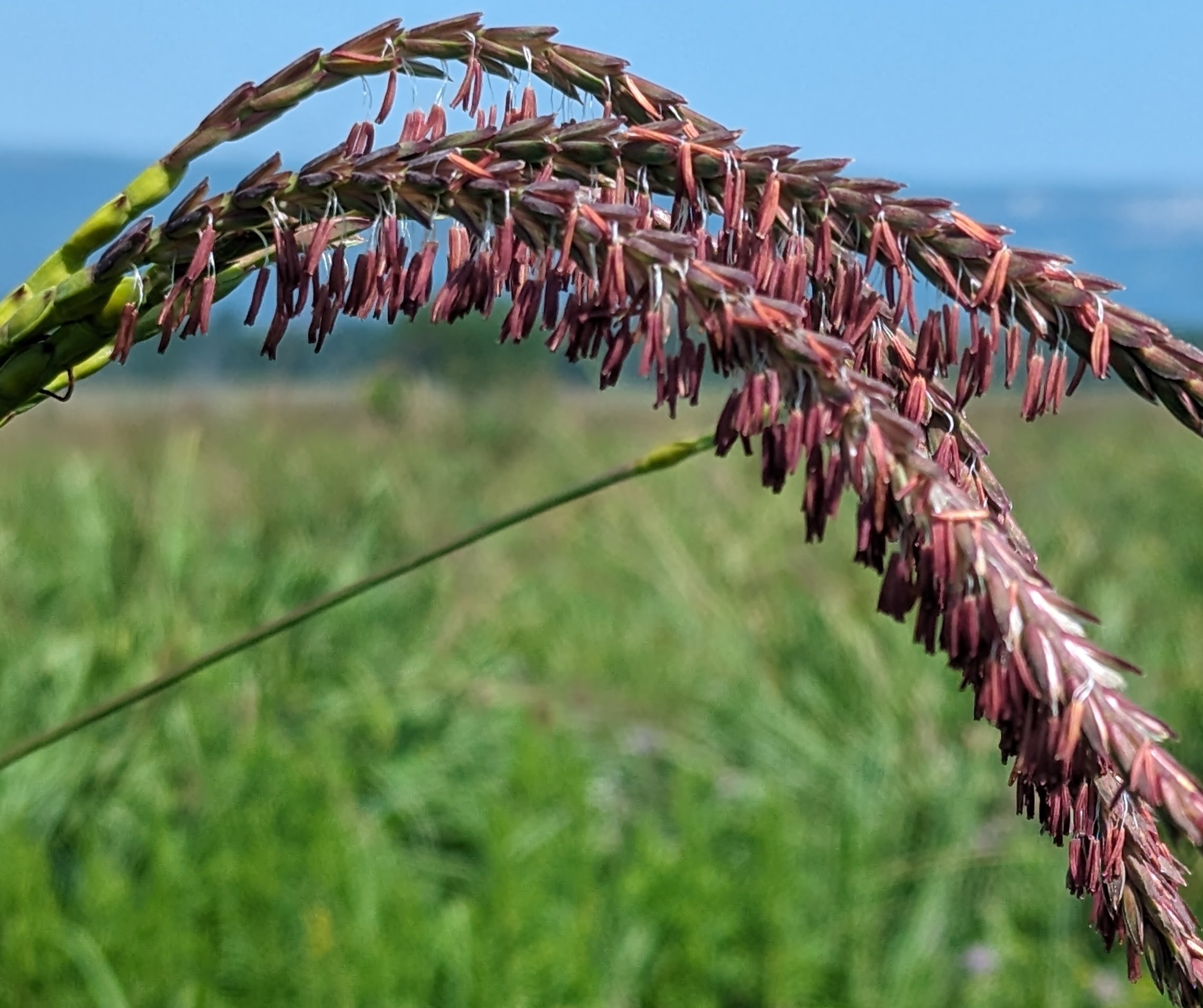
Walt Whitman wrote that he leaned and loafed at his ease and observed a spear of summer grass. For years I pictured a blade of grass on a neatly-manicured lawn. One day on a visit to the Grasslands in late summer, I found the Big Bluestem growing shoulder high. The three-pronged purple seedheads painting the fields in bands of bronze. While dainty yellow seeds depended from the prongs, like earrings sized perfectly for a mouse.
I never imagined that grass could be like this.
Go minimalist. Free your mind.
Running the Long Path is available on Amazon!

 The Long Brown Path